

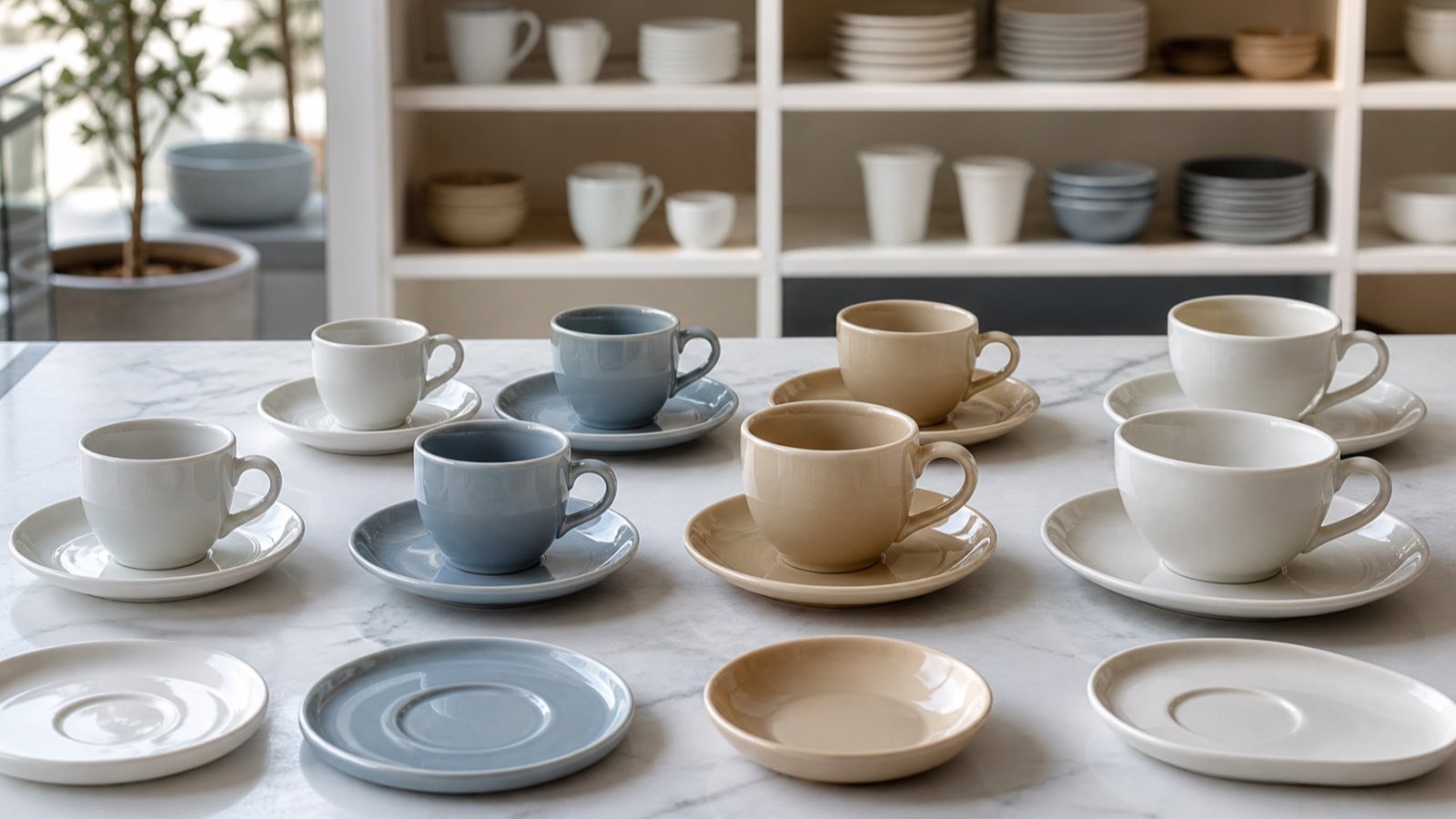
A saucer is small, but an incorrect fit can disrupt an entire beverage program. Buyers sourcing wholesale ceramic saucers must evaluate cup compatibility, well diameter, overall size, rim function, material, decoration, stacking, and packing as one system. This guide explains the main saucer types and gives importers, wholesalers, and hospitality suppliers a practical method for specification and approval.
Understand the Commercial Role of Ceramic Saucers
Define how the saucer will be sold and used before comparing designs. It may be paired permanently with one cup, offered as a replacement, sold in a boxed set, used across several cup capacities, or supplied to cafes and hotels. Each role changes the importance of exact fit, continuity, pack count, decoration, and handling.
In hospitality, a saucer often carries a teaspoon, sugar packet, or small accompaniment while stabilizing the cup during service. Retail buyers may prioritize visual coordination and gift presentation. Replacement programs need model traceability and dependable pairing information. Record the channel, beverage, cup model, service style, target price, quantity, and arrival window.
Do not source the saucer from diameter alone. The central well, slope, foot, rim, weight distribution, and cup foot all affect stability. A cup that appears to fit can slide, sit high, or leave too little usable area for a spoon. Approve the exact cup and saucer together under realistic handling.
Compare Wholesale Ceramic Saucer Types
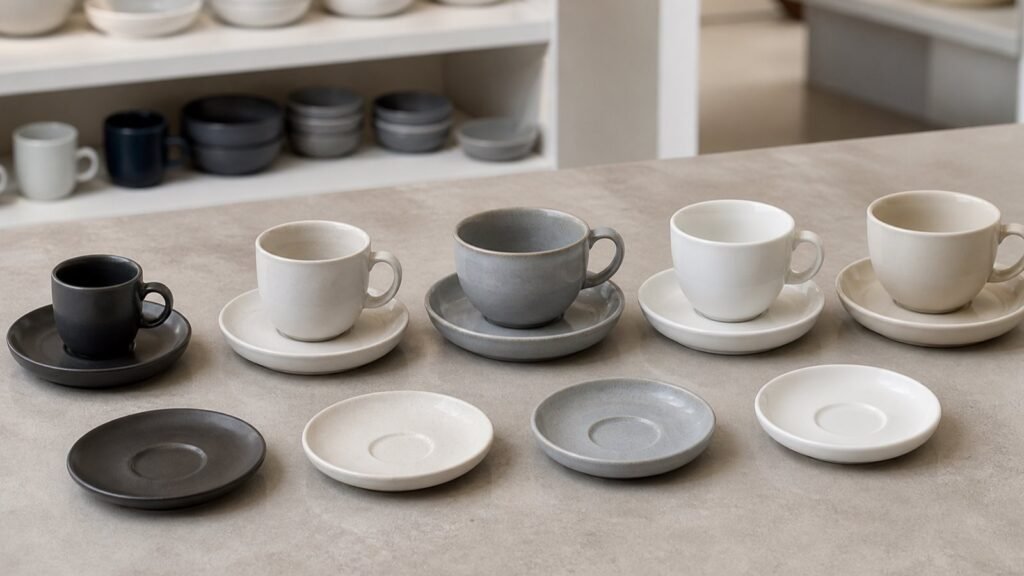
Flat saucers have a relatively low profile and provide a clean modern presentation. Their cup well may be shallow, so correct diameter and surface grip deserve close attention. Deep-well saucers hold the cup more positively and can suit fast service, provided the cup foot sits fully inside the intended area.
Rimmed saucers create a clear edge and can help contain small spills. Coupe saucers use a smoother curved profile and may coordinate with contemporary dinnerware. Rectangular or asymmetric designs add visual distinction but require careful checking of balance, carton space, and orientation in service.
Some saucers include a larger side area for a spoon, biscuit, or sugar. Others center the cup and keep the total diameter compact. An offset well can provide serving space but may feel unbalanced if the cup is heavy or if staff carry the set from the wrong side. Test tray movement and table placement.
Match the Type to the Beverage Program
Espresso service commonly uses a compact cup and saucer, while cappuccino, tea, and breakfast cups require larger proportions. The names are not reliable specifications across suppliers. Record the exact cup capacity, cup height, maximum diameter, foot diameter, space around the handle, and filled weight. Then assess the matched saucer.
For multi-use programs, test whether one saucer truly fits more than one cup model. A shared component can reduce SKU count, but only when both cups remain stable and visually proportioned. Do not force a shared saucer merely to simplify purchasing.
| Saucer type | Main benefit |
| Flat | Clean profile and easy presentation |
| Deep well | Positive cup location |
| Rimmed | Defined edge and spill area |
| Coupe | Coordinated contemporary shape |
| Offset well | Extra serving area |
| Geometric | Distinctive visual identity |
Specify Ceramic Saucer Sizes and Cup Fit
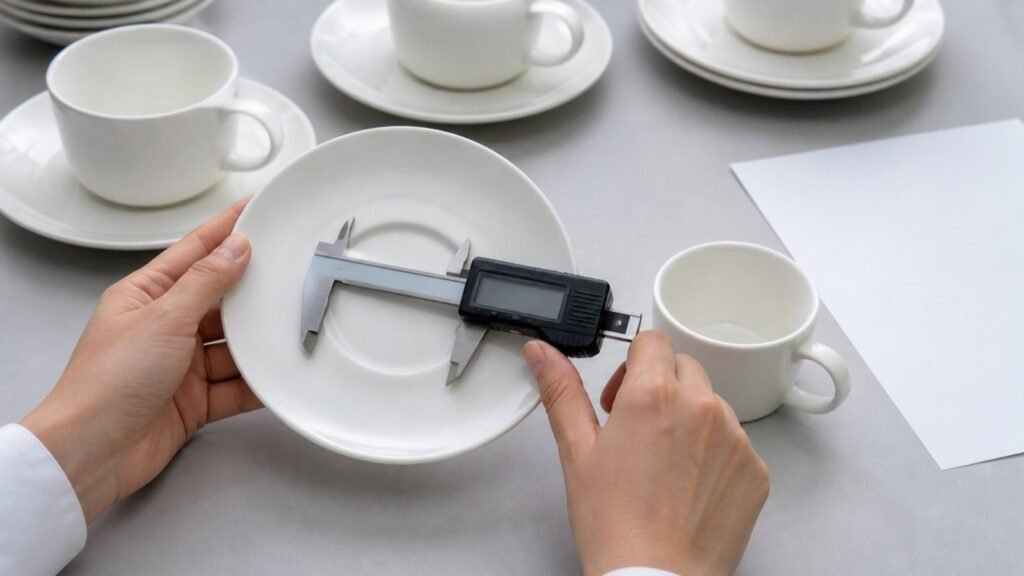
Measure overall diameter or length and width, height, well diameter, well depth, usable side area, foot diameter, weight, and stack height. Use an agreed measurement method and check several pieces. For nonround designs, record the orientation and all relevant dimensions.
Measure the cup foot at its actual contact point. The cup should sit securely without rocking, wedging tightly, or riding on the edge of the well. Check space around the handle and whether fingers can lift the cup naturally. Fill the cup to a realistic serving level and move the pair on a tray, table, and service route.
Typical labels such as espresso, coffee, cappuccino, breakfast, or tea saucer describe intended pairing, not a universal dimension. Do not publish a size promise until the actual model is measured. If the saucer will support an existing cup from another source, send physical samples or a controlled technical record; small profile differences can defeat a nominal match.
Visual proportion matters alongside mechanical fit. Compare cup height and width with the saucer diameter, rim width, and decoration scale. A very small cup on a wide saucer may be appropriate for food accompaniment but look wrong in a compact espresso program. Photograph the approved pair from the side and above.
| Measurement |
| Overall size |
| Cup location |
| Contact |
| Service area |
| Handling |
| Storage |
Review Material Glaze Decoration and Durability
Porcelain, stoneware, new bone china, and other ceramic bodies create different visual weight, thickness, color, and price positions. Compare materials in the ceramic tableware materials guide, then assess the exact cup and saucer pair. Material names alone do not determine fitness for a particular service environment.
Check white tone and glaze under consistent lighting. A cup and saucer described as white may show an obvious warm or cool mismatch. For colored or reactive glazes, document the acceptable variation across several pieces. Consider how the cup foot contacts the decorated surface during stacking and use.
Decoration should align across the pair. Review line position, motif direction, color, scale, and how the design appears when the handle faces the normal service direction. Metallic or specialized decorations may require different care instructions; confirm intended use and evidence rather than assuming identical performance across finishes.
Inspect stability, rim and foot finishing, glaze coverage, visible inclusions, shape consistency, and stacking contact. Test the intended dishwasher, tray, rack, shelf, and service routine where relevant. A short test cannot prove years of performance, but it can expose immediate incompatibility.
Food-contact, labeling, and import obligations vary by destination and decoration. Confirm current requirements with qualified local advisers and request evidence tied to the relevant models and market. Keep cup and saucer records connected when they are sold as a set.
Plan Quantities Packing and Wholesale Cost
Order quantities should follow the way saucers are sold and replaced. A permanent cup-and-saucer set normally requires matched counts plus a documented policy for operational replacements. A hospitality distributor may choose separate replacement depth based on breakage and customer ordering patterns. Use actual records where available rather than applying an unsupported universal percentage.
Confirm whether prices are per piece, per pair, per set, or per carton. Record currency, trade term, named place, packing included, quantity, payment terms, and quotation validity. A low saucer unit price can be misleading if the paired cup, gift pack, or freight basis differs.
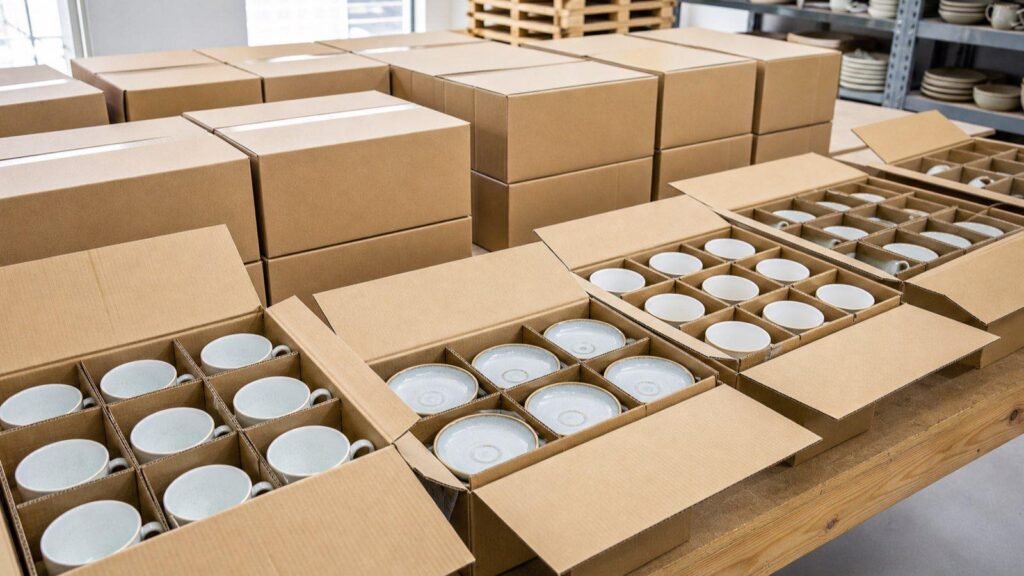
Packing should protect rims and decorated surfaces while controlling carton weight. Review sleeves, separators, inner packs, cushioning, master-carton strength, pieces per carton, dimensions, and gross weight. Saucer stacks concentrate weight; verify the arrangement with the actual profile and intended transport route.
Calculate landed cost for the complete sellable unit. Include cup and saucer, retail or hospitality packing, international transport, insurance, destination processing, duty, nonrecoverable taxes, brokerage, inspection, inland delivery, and handling using current inputs. Confirm classification and rates locally.
Mixed designs may be practical when current availability, carton multiples, labeling, and loading support them. Keep model codes explicit and avoid relying on descriptions such as small white saucer. The ready stock cups and saucers range should be checked by exact pairing and dated quantity before confirmation.
Use a Cup and Saucer Approval Checklist
Approve a labeled reference pair for every model combination. Record cup code, saucer code, material, glaze, decoration, dimensions, capacity, filled weight, well fit, handle orientation, spoon area, stack behavior, and packing. Photograph the pair from several angles and retain samples where practical.
Inspect multiple pieces to understand normal variation. Define functional criteria separately from cosmetic acceptance. A rocking cup, unsafe edge, or incorrect well fit is different from an accepted variation in reactive glaze. Plain language and photographs help buyers, suppliers, and inspectors apply the same standard.
Include the pair in the purchase order and inspection plan. State whether substitutions are permitted; if they are, require approval of the new physical combination. Confirm quantities in pieces and pairs so the order cannot produce unmatched components. Reconcile carton counts and model labels before shipment.
At receiving, inspect carton condition, count, model identity, cup-to-saucer ratio, fit, appearance, and damage. Isolate unidentified or mismatched components until verified. Track sales, returns, breakage, and replacement requests by both pair and component code.
Reordering requires a new availability and commercial check. Confirm that both components remain available in compatible quantities and that no dimensional or decoration revision has occurred. An old photograph is not enough when a model code, mold, glaze, or packing record has changed.
| Final approval item |
| Identity |
| Fit |
| Appearance |
| Quantity |
| Packing |
| Inspection |
Conclusion
Wholesale ceramic saucers should be selected as functional partners to specific cups, not as isolated small plates. Compare type, well geometry, full dimensions, visual proportion, service area, stack behavior, packing, and total landed cost. Approve exact pairs and keep both component codes traceable through receiving and replenishment. Browse ready stock cups and saucers or ask for a current wholesale quotation with your cup model, dimensions, quantities, market, and timing.
FAQ
Measure the cup foot at its contact point and compare it with the saucer well diameter, depth, and slope. Test the physical pair with the cup realistically filled. It should sit without rocking, wedging, or sliding excessively, and the handle should remain easy to lift. Also check visual proportion, spoon space, tray movement, and stack contact across several samples.
Sometimes, but each proposed cup must be tested on the exact saucer. Similar foot diameters do not guarantee the same stability because foot profile, cup height, handle, filled weight, and saucer slope also matter. A shared saucer can simplify inventory when every pairing works; otherwise, separate matched components provide clearer service and fewer customer complaints.
Equal quantities are appropriate for many fixed retail sets, but replacement and hospitality programs may need a different component plan. Use actual breakage, sales, and customer ordering records where available. Confirm quantities in pieces, pairs, inner packs, and cartons, and keep model codes linked. Reconcile final packed counts so unmatched cups or saucers are identified before shipment.