

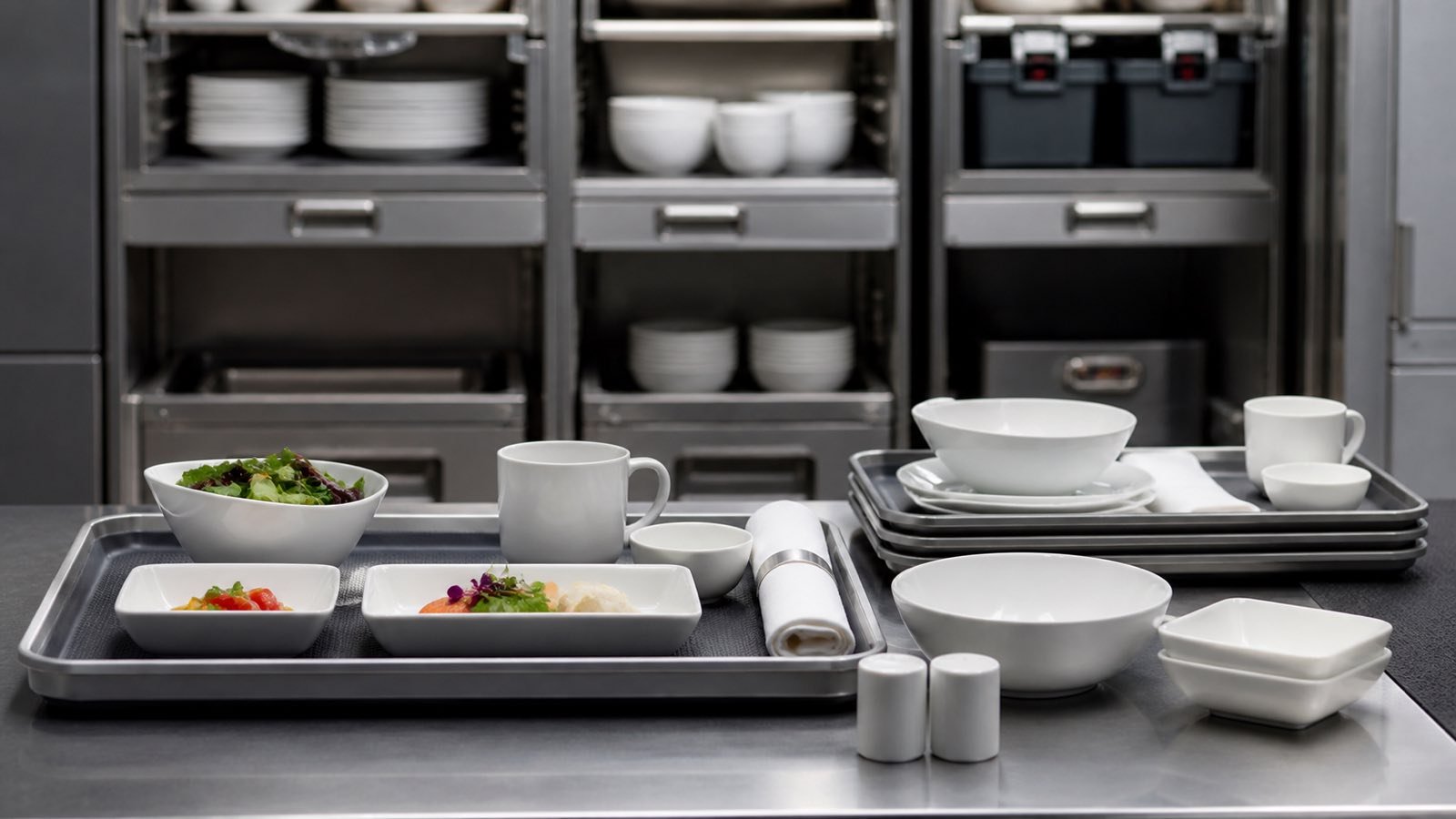
Airline and cruise service compresses many tableware decisions into limited space. Ceramic tableware for airline and cruise catering must suit menus, trays, racks, storage, handling, washing, and replenishment—not appearance alone. This guide helps catering companies, distributors, and procurement teams translate an onboard service concept into measurable product, packing, and supply requirements.
Map the Catering Service Before Selecting Tableware
Begin with the actual service journey. Record where pieces are loaded, stored, plated, carried, collected, sorted, washed, stacked, and returned. Airline equipment dimensions, trolley systems, galley space, and weight objectives may be central. Cruise operations may involve several restaurant formats, long service routes, high wash cycles, cabin dining, buffets, and distributed storage.
List every menu component and the vessel or aircraft route on which it is served. A breakfast bowl, entrée plate, sauce dish, mug, and dessert plate each need a defined capacity or usable area. Identify hot and cold foods, portion size, liquid depth, garnish space, lid or cover needs, and whether pieces share trays or racks.
Distinguish mandatory interfaces from preferences. Tray footprint, rack compatibility, stable stacking, and safe handling may be mandatory. A decorative detail may be adjustable. This hierarchy makes evaluation faster when a current ready stock ceramic tableware range offers several suitable designs.
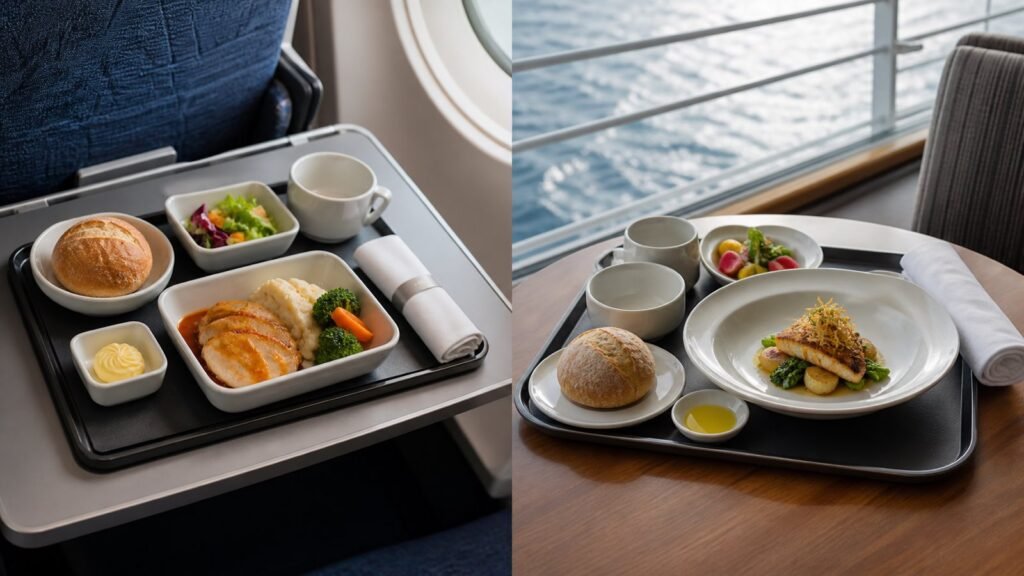
Use physical mock-ups whenever possible. Place the complete meal on the intended tray, add cutlery and drinkware, and test access from the passenger or guest position. A dimension that works on a drawing can still create finger space, handle, cover, or balance problems.
Specify Size Capacity Weight and Stackability
Nominal descriptions such as side plate or cereal bowl are not precise enough. Record maximum length and width, rim diameter, base diameter, height, usable well, capacity measured by an agreed method, piece weight, and stack height. For irregular forms, note the orientation that enters racks or trays.
Weight should be considered at system level. Multiply the verified average piece weight by the number carried, then include packing or handling equipment where relevant. A lighter piece may support operational goals, but excessive thinness can change handling, heat perception, stability, and resistance to impact. Set a realistic weight range and check samples from multiple cartons.
Stacking affects far more than cupboard space. Examine how rims and feet contact, whether glazed surfaces rub, how easily staff separate pieces, and whether a stack leans. Measure a defined number of pieces rather than extrapolating from one. Test the stack in actual racks, shelves, drawers, trolleys, or service stations.
| Specification | Airline emphasis | Cruise emphasis |
| Footprint | Tray and trolley fit | Rack shelf and table fit |
| Weight | Total loaded service weight | Staff handling and stack weight |
| Capacity | Portion control in limited space | Menu and venue differentiation |
| Stack height | Galley and trolley density | Storage across multiple outlets |
| Profile | Cover and tray spacing | Carrying stability and presentation |
Consult the ceramic plate size guide for a measurement framework, then add the interfaces unique to the catering system. Keep approved physical samples labeled with item codes and measurement records.
Evaluate Durability Safety and Cleaning Compatibility
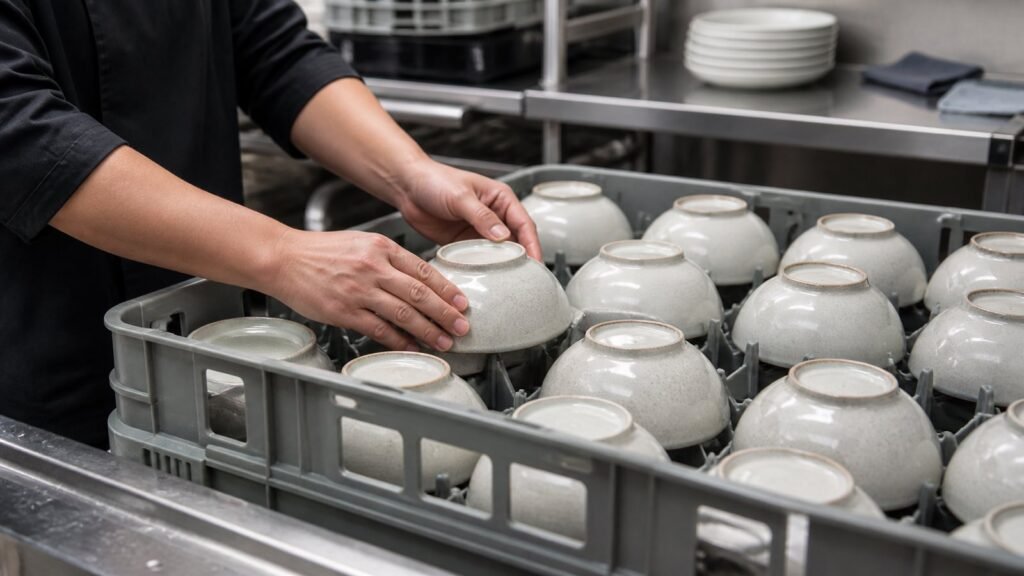
Durability is not a single claim. Define the stresses the item will experience: rim contact, stacking, tray vibration, trolley movement, automatic washing, thermal changes, cutlery marking, and repeated handling. A test should reproduce relevant use rather than rely on an undefined “commercial quality” label.
Inspect several pieces for shape consistency, stable feet, smooth rims, glaze coverage, pinholes, inclusions, cracks, and decoration alignment. Check that cups and small vessels do not rock on trays. For handled items, evaluate grip space and balance when filled. For bowls, test realistic liquid movement during carrying.
Confirm Destination and Operator Requirements
Food-contact, migration, labeling, workplace, maritime, aviation, and waste requirements can vary by market and operator. Procurement teams should define the applicable requirements and request evidence linked to the exact material, glaze, decoration, and intended market. Do not treat a general certificate or an unrelated product report as proof for every item.
Cleaning validation belongs to the operator. Test the intended detergent, water conditions, temperature, rack, cycle, and drying process. Watch for water pooling, retained food, abrasion, decoration change, and difficult-to-handle hot surfaces. Specialized decoration may require specific care instructions.
Create objective acceptance criteria. Separate critical safety or function issues from major appearance issues and minor cosmetic variation. Define sampling and escalation before shipment. Consistent terminology helps the supplier, inspection team, caterer, and operator interpret results in the same way.
Coordinate Design with Menu and Brand Experience
The visual system should support food presentation without compromising operations. White or lightly colored surfaces can offer broad menu flexibility, while colored glazes can distinguish venues or service classes. Check food contrast under the lighting actually used onboard. Gloss, matte, and reactive appearances also behave differently under repeated handling and photography.
Keep the decoration practical. Review motif placement, orientation, color tolerance, edge proximity, and how stacked contact points interact with decorated areas. If an operator requires a brand mark, obtain authorized artwork and define color, size, location, and approval. Ready stock without custom marks can be appropriate for faster or flexible programs.
Mixed designs can help cruise distributors serve several concepts, provided item codes, carton labels, rack fit, and replenishment stay controlled. For airline programs, a smaller coordinated SKU group may simplify loading and counting. In either case, the assortment should be driven by menu roles and operational interfaces.
Run a service trial with representative users. Observe plating speed, tray assembly, carrying, guest access, clearing, sorting, and washing. Ask staff to identify awkward grips, confusingly similar sizes, unstable pieces, and racks that are too dense. Record changes against item codes rather than relying on memory.
Plan Packing Delivery and Replenishment
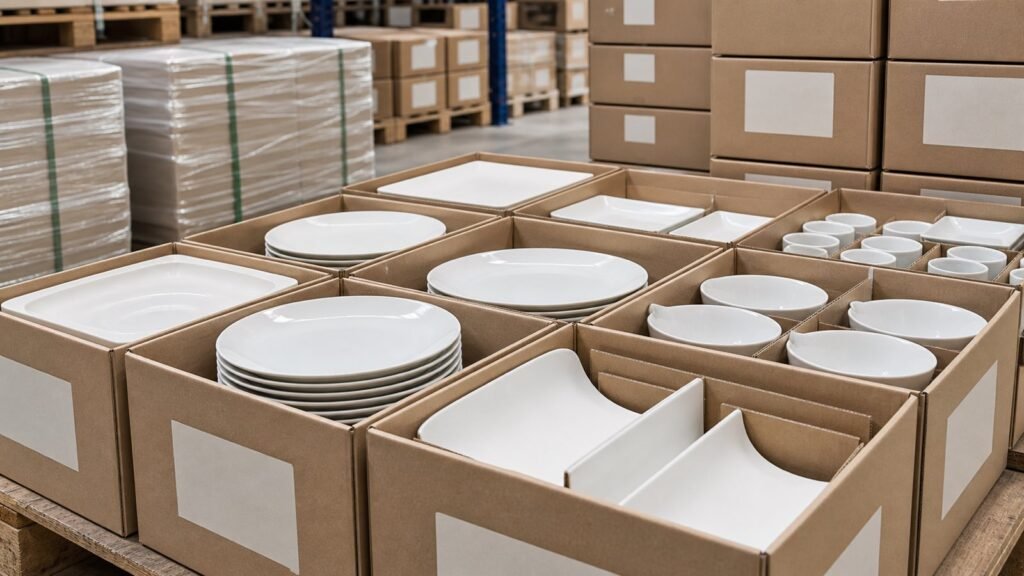
Transport packaging must protect ceramic surfaces and remain workable at the receiving location. Confirm pieces per inner pack and carton, separators, cushioning, carton strength, gross weight, dimensions, labels, pallet method if used, and any destination restrictions. Dense ceramic packs can become difficult to lift even when the carton itself is compact.
Conduct a packing review with the actual item profile. Rim shapes, handles, feet, and irregular edges create different contact risks. Ensure the receiving team can identify item code, description, quantity, batch reference where used, and handling marks without opening every carton.
Plan replenishment before launch. Record the number deployed, reserve stock, usage location, breakage or loss by item code, lead time, reorder point, and acceptable substitute policy. Airline and cruise schedules can make late replacement especially disruptive. Ready stock may shorten the selection and allocation path, but availability must be reconfirmed for each order.
Avoid undocumented substitutions. A replacement piece with a similar diameter may fail the rack, stack, cover, or tray. If an alternative is necessary, repeat interface and service tests and update the approved item record.
| Replenishment record | Purpose |
| Item and location code | Links stock to service area |
| Deployed and reserve quantity | Shows operational coverage |
| Usage and breakage history | Supports reorder planning |
| Current lead time | Defines decision date |
| Approved alternatives | Prevents uncontrolled substitution |
| Carton multiple | Converts need into order quantity |
Use a Catering Procurement Approval Plan
Issue a specification sheet for every item and assemble a complete service set. Verify dimensions, capacity, weight, stack height, tray or rack fit, appearance, cleaning, packing, and labeling. Include photographs from top, side, and stacked views.
Run a controlled pilot before a broad rollout when the program and schedule permit. The pilot should use the intended menu, equipment, staff workflow, and cleaning system. Record observations and assign owners for corrective actions. Approval should state which sample and specification revision controls the order.
Before shipping, reconcile purchase order quantities, carton counts, packing, inspection results, documents, and delivery instructions. At receiving, inspect carton condition, identity, count, damage, and critical dimensions. Quarantine unexplained items until they are matched to the approved record.
Commercial comparison should use total landed and operating value. Include goods, packing, freight, insurance, destination charges, duties and taxes where applicable, storage, handling, washing, replacement, and inventory complexity. Use current professional inputs for customs and transport costs.
Conclusion
Ceramic tableware for airline and cruise catering succeeds when product choices are connected to the complete onboard workflow. Measure interfaces, validate weight and stacking, test durability and washing, coordinate menu presentation, and establish a traceable replenishment plan. Current stock designs can support flexible sourcing when the exact item and quantity are confirmed. Discuss a current catering requirement with your menu, dimensions, quantities, destination, and schedule.
FAQ
Record maximum footprint, height, base diameter, usable area or capacity, piece weight, and stack height. Then test tray, trolley, rack, cover, and finger clearances with the complete meal configuration. Airline systems differ, so a standard product name is not enough. The approved physical sample and interface record should control purchasing and any later substitution.
Test representative pieces in the intended restaurant, buffet, cabin, carrying, sorting, washing, and storage workflow. Check stability, stack release, rack fit, filled handling, food presentation, detergent and cycle response, and staff feedback. Define measurable acceptance criteria and keep labeled samples. A limited pilot can expose operational issues before a larger deployment.
Ready stock can support faster selection and flexible replacement when compatible items are currently available. However, quantity, carton multiples, dimensions, glaze, and item codes must be reconfirmed for every order. Keep approved alternatives documented and retest any substitute against trays, racks, stacks, cleaning, and the service concept before use.