

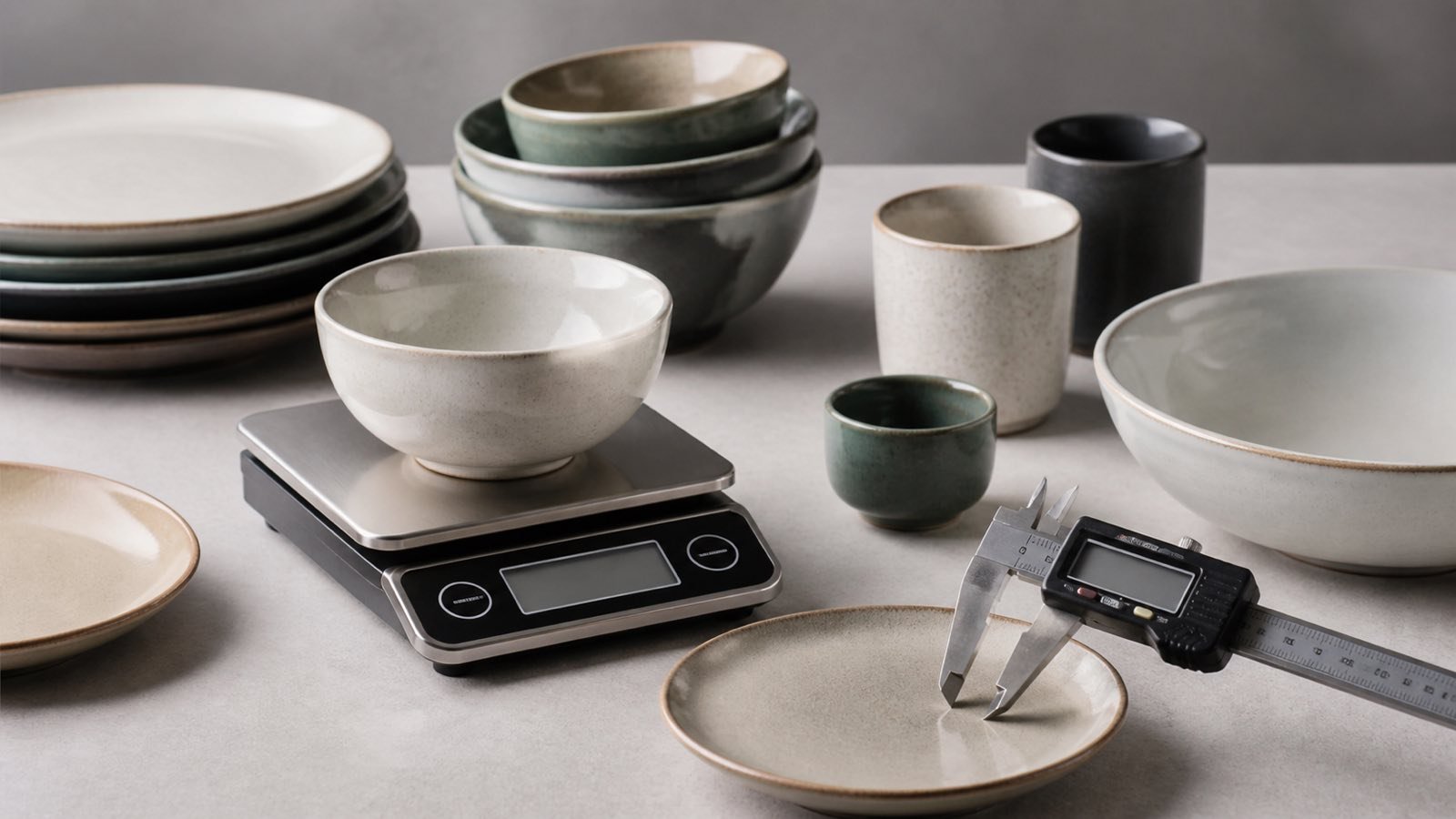
Two plates with the same diameter can feel and perform very differently. Ceramic tableware weight and thickness influence handling, presentation, stack height, packing, freight, and customer expectations, but neither measurement proves quality by itself. This guide gives wholesale buyers a practical way to compare samples, define tolerances, and select a profile suited to the sales channel.
Understand Weight and Thickness as a System
Weight is the mass of the complete piece. Thickness describes a local cross-section and can vary across the center, well, rim, wall, handle, or foot. Shape, diameter, material density, forming method, relief, glaze, and decoration all contribute. A single rim measurement cannot explain the total construction.
Lightweight pieces may support easier service, lower stack loads, or a refined retail feel. Heavier pieces may communicate substance and remain stable in some settings. Either can be appropriate when the design, material, use, and quality controls are aligned. Avoid selling “heavier” as automatically stronger or “thinner” as automatically more premium.
Start with the user. Restaurants may focus on stacking, repeated handling, rack fit, and replacement. Retailers may prioritize hand feel, parcel shipping, set weight, and shelf presentation. Importers also need carton weight, container planning, inland handling, and customer price position.
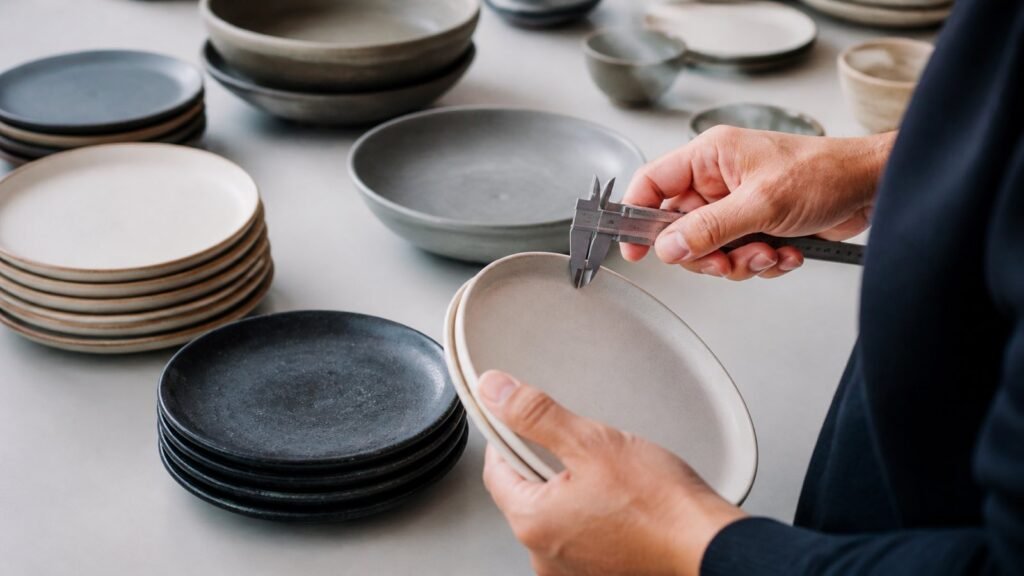
Compare products only within a defined role. A coupe dinner plate, deep pasta plate, embossed charger, and compact side plate should not share one ideal weight target. Establish a benchmark from approved products serving the same function.
Measure Ceramic Tableware Weight Correctly
Use a calibrated scale with suitable resolution and capacity. Zero the scale, keep the piece clean and dry, and record the unit. Weigh several samples individually rather than one stack alone. Calculate the minimum, maximum, and average, then compare the spread with the proposed tolerance.
For sets, record both component weight and total sellable-set weight. Carton planning needs the real packed weight, including sleeves, dividers, boxes, cushioning, labels, and pallet allocation where applicable. Do not multiply one ideal sample when commercial pieces show variation.
Moisture, attached labels, removable fittings, or packaging can distort results. Define exactly what is included. Use the same method at sample approval, inspection, and receiving so differences represent the product rather than the procedure.
Convert Weight into Operational Measures
Translate piece weight into decisions that teams understand. Multiply by pieces per place setting, settings per service, pieces per stack, and pieces per carton. This reveals loaded tray weight, staff handling burden, shelf load, carton gross weight, and freight volume interactions.
| Measure | Calculation | Procurement use |
| Place-setting weight | Sum of selected pieces | Service and consumer handling |
| Stack weight | Average piece weight × stack count | Shelf and staff handling |
| Product carton weight | Average weight × quantity | Packing design estimate |
| Gross carton weight | Product plus all packing | Freight and warehouse planning |
| Order net weight | Average weight × order pieces | Commercial and logistics check |
Round calculations only after retaining precise source values. Confirm final weights from the approved packing because carton design and actual quantity can change the estimate.
Measure Thickness at Meaningful Points
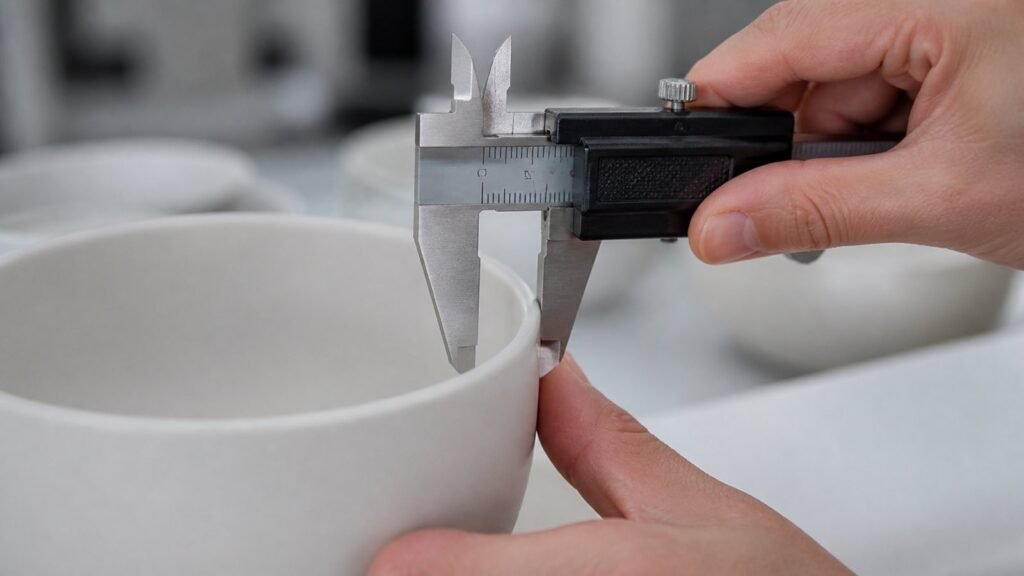
Thickness should be measured at named locations. For a plate, these may include rim, transition, well, and foot area where accessible. For a bowl or cup, measure rim and wall points at defined heights. Calipers can help on accessible edges, while complex profiles may require supplier drawings or a controlled section sample.
Use care: caliper pressure and angle can change a reading, particularly at curved rims. State the tool, location, orientation, and method. Take repeated readings around the piece to detect variation. Never damage saleable samples merely to obtain an internal measurement without agreement.
Thickness often changes intentionally. A reinforced rim, lighter wall, substantial base, or tapered transition can support design and handling goals. The question is whether the distribution is consistent and appropriate, not whether every location is identical.
Check thickness together with edge finish and visual proportion. A thick wall with a carefully tapered rim can feel less bulky than its maximum measurement suggests. A thin rim with an abrupt heavy foot can change balance. Side-profile photographs and filled handling trials add context to numbers.
Connect Profile to Material Durability and Use
Ceramic body and geometry interact. Porcelain, stoneware, new bone china, and other bodies differ in typical color, density, translucency, forming possibilities, and market position. Review the ceramic tableware materials guide, then evaluate the exact model rather than applying a generic rule to a material name.
Durability depends on body formulation, firing, glaze fit, shape, transitions, residual stress, rim and foot design, and the impacts encountered in use. Weight or thickness alone cannot predict resistance to chipping or breakage. Request suitable product evidence and run comparative handling or laboratory tests when the commercial risk justifies them.
Look closely at transitions. Sharp changes in cross-section, narrow contact points in stacking, projecting handles, and exposed rims may matter more than average wall thickness. Test the piece in racks, trays, shelves, dishwashers, retail boxes, and parcel packs relevant to its channel.
Thermal use also requires specific validation. Do not infer oven, microwave, freezer, or sudden-temperature-change suitability from appearance or thickness. Claims should be based on product-specific evidence, care instructions, and applicable requirements.
| Intended channel | Weight and thickness questions |
| Hospitality | Can staff lift stacks and use existing racks |
| Retail sets | Does hand feel match price and packaging |
| E-commerce | Can parcel packing manage piece and set weight |
| Catering | Does the full tray meet space and handling goals |
| Distribution | Are carton and pallet weights practical |
Assess Freight Packing and Storage Effects
Ceramic tableware is commonly constrained by both mass and volume. A heavier item raises net and gross weight, while a broad rim or inefficient stack can consume carton and container space. Compare actual carton dimensions, quantity, gross weight, and stack arrangement instead of focusing on product weight alone.
Set a practical maximum carton gross weight based on warehouse practices, customer requirements, route, and local rules. Then design pieces per carton around protection and handling. Reducing quantity per carton may improve lifting but increase cartons, packing material, labels, and handling events.
Stack height can be as important as thickness. Measure a defined stack of several pieces, because small profile differences accumulate. Observe whether feet contact glazed faces and whether separators are needed. A compact stack may improve storage, but overly tight nesting can make pieces difficult to separate or increase contact risk.
Calculate freight using current quotations and verified packed data. International shipping charges may be based on weight, volume, container use, or a combination depending on mode and provider. Keep goods cost and logistics assumptions separate so they can be updated without renegotiating the product specification.

Set Useful Tolerances for Wholesale Orders
A specification should describe the approved product and allowable commercial variation. Set nominal weight, measurement locations, sample basis, and tolerance using evidence from representative pieces and the needs of the application. An arbitrary narrow range can create disputes without improving function; an undefined range provides little control.
Separate individual-piece limits from average requirements where appropriate. A batch average can hide one unusually heavy or light piece, while strict individual limits can be unrealistic for a deliberately varied handmade appearance. A quality professional can help design an inspection method suited to the product and order risk.
Link weight and thickness to functional criteria. Include stability, dimensions, stack height, rack fit, handle comfort, capacity, appearance, packing, and any validated use claims. If a change is proposed, require a new sample and assessment rather than accepting weight alone as proof of equivalence.
For ready stock, request current measurement data and inspect representative samples from the available quantity. The same item description offered at a later date should be reconfirmed. Keep dated photographs, readings, and item codes for traceability.
Use a Sample Comparison Scorecard
Create a table with one column per candidate. Record material, dimensions, piece weight range, thickness locations, capacity, stack height, balance, rack or shelf fit, packing quantity, carton dimensions, gross weight, target channel, and price basis. Add observations from staff or customer handling trials.
Score only criteria connected to the buying objective. If freight and shelf density are central, weight and stack height may carry more importance. If a premium retail hand feel is central, balance, rim profile, finish, and set presentation may matter more. Document weighting so the final choice is explainable.
Approve the complete configuration, not an isolated bare piece. Retail packaging, labels, mixed assortments, carton quantities, and final pallet method can change commercial performance. Reconcile the scorecard with the purchase order and inspection plan before confirmation.
Conclusion
Ceramic tableware weight and thickness are useful specification tools when measured consistently and interpreted with material, geometry, use, packing, and logistics. Compare representative samples, translate piece measurements into stack and carton effects, and set evidence-based tolerances. Browse ready stock ceramic tableware or request current product specifications with your channel, sizes, quantities, destination, and handling priorities.
FAQ
No. Durability also depends on the ceramic body, firing, glaze fit, shape, rim and foot design, transitions, residual stress, and actual impacts in use. A heavier piece can still have vulnerable features, while a lighter well-designed piece may perform appropriately. Compare representative products with use-specific tests and documented acceptance criteria rather than weight alone.
Measure named points that describe the profile, such as the rim, transition, well, and accessible base or foot areas. Record the tool, exact location, angle, and pressure method, then repeat readings around several pieces. Because thickness may vary intentionally, combine these readings with total weight, side profile, stability, stack height, and handling.
State the nominal weight, unit, included components, measurement method, number or sampling basis, and permitted individual or average variation supported by representative samples. Link the range to dimensions, capacity, stability, and function. The tolerance should control meaningful inconsistency without being narrower than the ceramic process and approved product can reliably support.