


A successful Middle East tableware program begins with a specific channel and commercial plan, not a broad regional assumption. Buyers evaluating wholesale ceramic tableware need to connect local product evidence with specifications, samples, packing, landed cost, and controlled quantities. This guide explains a practical workflow for regional assortment and import planning while keeping decisions measurable and adaptable.
Before contacting suppliers, establish a working budget, target arrival window, decision team, and the evidence needed for approval. Keep product taste separate from commercial requirements, and record uncertainties rather than filling them with assumptions. The result should be a brief that another colleague can review and a supplier can answer item by item. That clarity reduces repeated messages and exposes gaps while samples, quantities, packing, or timing can still be adjusted.
Use one controlled worksheet from research through receiving. Give each item a model code, intended channel, specification, sample status, quoted terms, carton data, landed-cost estimate, and final decision. Attach dated evidence instead of relying on memory or chat history. When a field changes, preserve the earlier value and record the reason. This audit trail helps buyers compare offers consistently, brief inspectors accurately, and explain assortment choices to colleagues. It also makes the next order faster because unresolved questions and successful criteria remain visible. Review the worksheet with every responsible department before approval.
Define the Buyer and Channel in Middle East
Middle East is not one uniform market. Countries, cities, channels, income groups, hospitality formats, and retail calendars create different demand patterns, so buyers should avoid treating regional labels as a product specification. Begin with a written buyer profile covering country, city tier, sales channel, target customer, price position, order frequency, and planned selling period. Map supermarkets, homeware chains, independent stores, ecommerce, hospitality distributors, restaurants, hotels, and institutional buyers separately. Each channel changes the required pack, design, continuity, and margin. Record observed retail prices, promotions, piece counts, materials, dimensions, colors, and stock status on the same date. Separate verified observations from assumptions and interview notes. A broad preference such as modern, traditional, neutral, or decorative must be converted into specific shapes, colors, rim treatments, and set compositions. This channel brief should guide sample selection and prevent a personal design preference from becoming an unsupported demand forecast. Put the decision owner, evidence source, review date, and acceptance threshold beside each requirement. This small discipline separates a preference from a purchasing condition and makes later quotation comparisons fair. It also gives sales, quality, logistics, and finance teams one shared record. Where the market evidence is incomplete, label the point as an assumption and define how it will be tested before a larger commitment.
| Channel brief | Purchasing implication |
| Mass retail | Clear price ladder and compact shelf pack |
| Ecommerce | Accurate dimensions and parcel protection |
| Hospitality | Stackability handling and replacement logic |
| Independent retail | Curated mixed designs and flexible depth |
Build a Commercial Ceramic Assortment
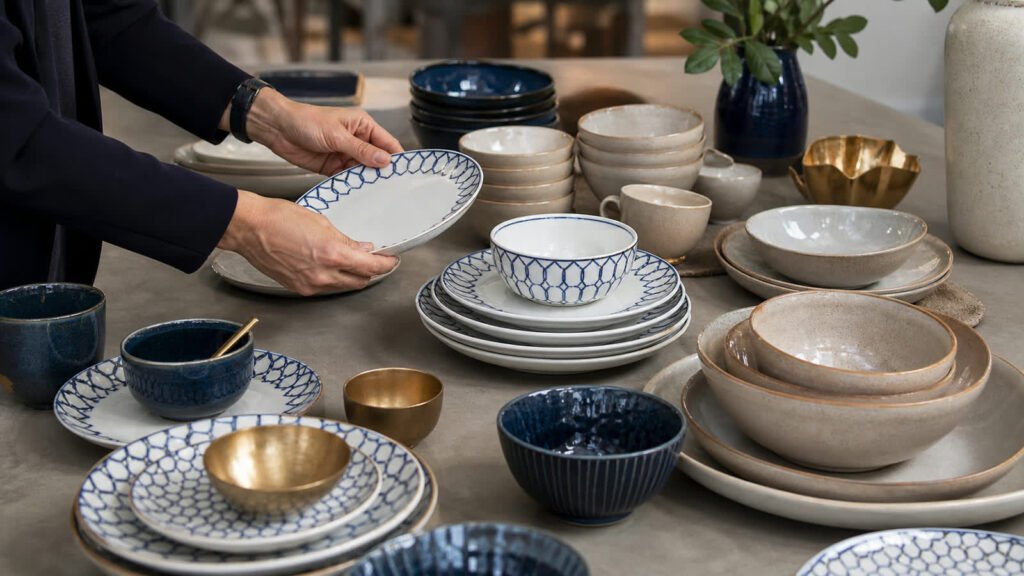
Start with item roles rather than isolated designs. Define core dinner plates, side plates, bowls, mugs or cups, and serving pieces, then decide which forms must coordinate. For Middle East, test actual meal styles and portion sizes with local channel partners instead of assuming one global set composition. Measure diameter, height, capacity, usable area, weight, foot, rim, and stack height. Review white and neutral anchors first, then add colors or decorations that support the target price position. Keep trend-led items shallower until sales evidence supports greater depth. Country-level demand should be validated by store audits, online listings, distributor interviews, and a controlled launch. Compare ceramic tableware materials when preparing the specification. Check the range as a system as well as item by item. A dinner plate, bowl, mug, and serving piece may look coordinated in a catalogue yet differ in scale, stack behavior, or price position. Assemble a sample setting, measure the working footprint, and photograph it under the intended light. Note which pieces are essential, optional, or interchangeable so budget changes do not destroy the assortment logic.
| Assortment decision list |
| – channel and customer for every SKU |
| – core or exploratory item role |
| – dimensions capacity and weight |
| – color finish and acceptable variation |
| – set composition and pack multiple |
| – target landed cost and selling price |
Approve Samples and Quality Criteria
Approve the exact wholesale ceramic tableware items through labeled samples and written criteria. Inspect several pieces for stability, rim and foot finishing, glaze coverage, decoration placement, handle attachment, dimensions, weight, and normal appearance variation. Use controlled lighting for color decisions. Test the intended food, utensils, dishwasher or hand-washing method, rack, shelf, and stacking sequence where relevant. A quick demonstration cannot prove long-term performance, but it can identify immediate incompatibility. Photograph accepted examples and retain reference samples. Define which observations are functional and which are aesthetic; this avoids rejecting intended glaze variation as though it were a structural fault. Compliance obligations depend on destination and intended use. Ask for product-specific evidence and confirm current requirements with qualified local advisers. Do not rely on a catalogue logo or an unrelated report. Write tolerances only where they are meaningful and measurable. Excessively narrow cosmetic limits can create disagreement without improving customer value, while vague functional criteria leave genuine risk uncontrolled. Ask the supplier to comment on the draft specification before order confirmation. Resolve conflicts in terminology, measurement method, sampling, and visual references while samples are still available and changes remain inexpensive.
| Sample approval sequence |
| 1. identify and label every model |
| 2. measure multiple pieces |
| 3. test intended handling and care |
| 4. document acceptable visual range |
| 5. retain references for inspection |

Compare Packing Freight and Landed Cost
Ceramic pricing must be compared on a normalized basis. Record currency, trade term, named place, unit basis, packing included, payment terms, quotation validity, current quantity, and shipment preparation time. Request pieces per inner pack and carton, carton dimensions, net and gross weight, and protective arrangement. Calculate cubic volume and weight per sellable piece. Wide rims, tall feet, and unusual shapes may consume more freight space even when unit price looks attractive. Build landed cost with current freight, insurance, destination charges, duty, nonrecoverable taxes, brokerage, inland delivery, inspection, finance, and a documented allowance for damage. Confirm classification and rates locally. Stress-test exchange rate, freight, and sell-through rather than depending on one optimistic scenario. Recalculate from final packing data whenever the assortment changes. Adding one bowl or changing a plate profile can alter carton count, volume, weight distribution, and the number of complete sets delivered. Keep the commercial comparison version-controlled and record who supplied each input. A transparent calculation is easier to update when freight, currency, quantities, or destination charges change.
| Cost comparison fields |
| Product and packing cost |
| International transport and insurance |
| Destination customs processing and inland delivery |
| Finance inspection and handling |
| Expected promotional returns and damage |
Plan Quantities Timing and Reorders
Translate the assortment into SKU quantities using channel reach, pack multiples, cash budget, review period, and acceptable inventory exposure. Avoid equal quantities for all designs. Give core pieces enough depth to support the sales test and keep uncertain forms controlled. Build a calendar around local retail and hospitality cycles in Middle East, allowing time for sampling, approval, packing, booking, customs, receiving, and distribution. Do not describe goods as immediately deliverable until the complete route is confirmed. At receiving, inspect carton condition, count, labels, measurements, appearance, and packing against the order record. Track sell-through, returns, damage, customer feedback, and reorder requests by SKU. These results provide a stronger basis for the next purchase than regional generalizations. Set a formal review after the goods enter the channel. Compare actual results with the assumptions used for selection, costing, and quantity planning. Record slow and fast sellers, common customer questions, missing companion pieces, packaging complaints, and operational issues. Use those findings to revise the specification and assortment map. Reordering should be a fresh availability and cost decision, not an automatic copy of the first purchase.
| Order control record |
| – approved sample and specification |
| – confirmed quantity and pack multiple |
| – shipment and receiving milestones |
| – landed cost by SKU |
| – sales damage and feedback review |
| – reorder revise or discontinue decision |

Conclusion
Wholesale Ceramic Tableware decisions should connect local channel evidence with measurable product specifications, approved samples, packing data, and landed-cost scenarios. Build a balanced range, control exploratory quantities, and keep every claim tied to evidence. Review results by SKU after receiving and selling rather than projecting from a regional average. To discuss current options, contact Chengguo with your destination, channel, quantities, and assortment brief.
FAQ
Define the specific country, channel, customer, meal use, price band, and selling period before choosing designs. Compare local listings and stores, then test exact samples for dimensions, handling, washing, stacking, and presentation. Regional trends can help form a hypothesis, but a controlled assortment and SKU-level sales record should decide reorders.
Mixed purchasing may be possible depending on current quantities, carton packs, commercial terms, and shipment planning. Keep the assortment coherent by using a controlled color, material, shape, or price architecture. Confirm every model, quantity, pack multiple, carton mark, and replacement expectation in writing before payment. Confirm assortment labels and receiving controls as well.
Provide destination, sales channel, required items, dimensions or capacity, material preference, finish, color direction, quantities, packing needs, target schedule, and applicable compliance questions. Ask the supplier to return model codes, current quantities, unit prices, trade terms, carton data, sample options, quotation validity, and preparation time so offers can be compared consistently.