

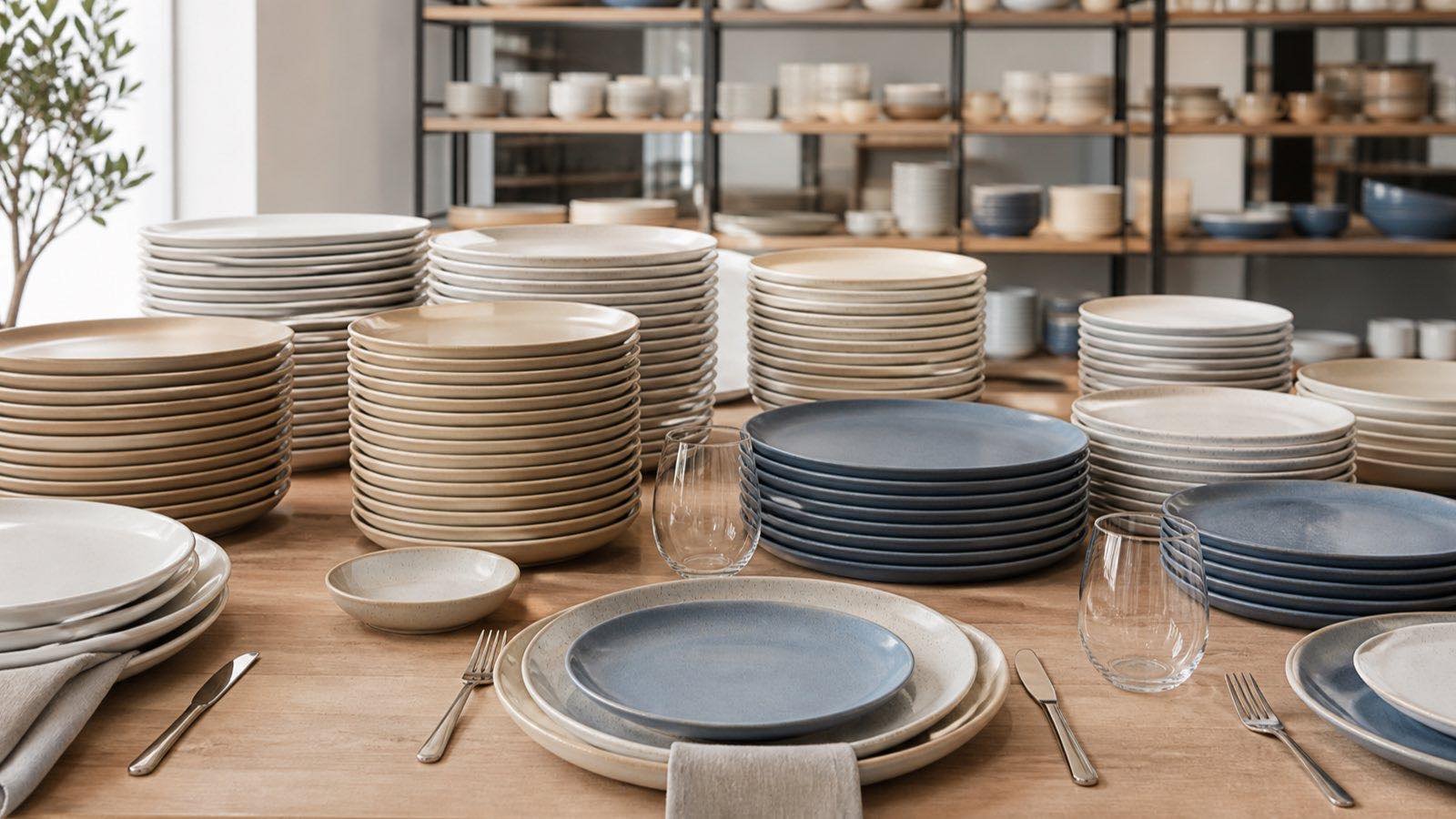
Large plate orders reward precise planning and expose vague specifications. Buyers evaluating ready stock ceramic plates need to align available models, exact dimensions, quality criteria, packing, and shipment timing before confirming quantities. This guide provides a practical framework for comparing plate ranges, approving samples, calculating order depth, and controlling delivery risk without relying on assumptions about availability or performance.
Define the Commercial Brief for Ready Stock Ceramic Plates
Start with the selling channel and the job each plate must perform. A supermarket program may prioritize clear price tiers and compact retail packs, while a hospitality distributor may focus on stacking, replacement availability, and efficient handling. Record the destination, customer type, planned selling period, target arrival date, budget, required assortment, and decision owners in one controlled brief.
Convert broad descriptions into measurable fields. “Large dinner plate” should become a target diameter range, usable eating area, rim style, height, weight range, glaze direction, and acceptable decoration. State whether plates will be sold individually, as coordinated place settings, or in boxed sets. The same plate can produce very different costs and shelf requirements under each format.
Use current model codes and dated availability records. Ready stock means the goods are available at the time they are checked; it does not guarantee that every design will remain available indefinitely. Ask the supplier to confirm quantity by model, color, and size, together with quotation validity and preparation time. Reserve commercial decisions until samples, quantities, terms, and packing have been reviewed together.
| Brief field |
| Sales channel |
| Plate role |
| Specification |
| Commercial target |
| Evidence |
Build a Balanced Wholesale Ceramic Plate Assortment
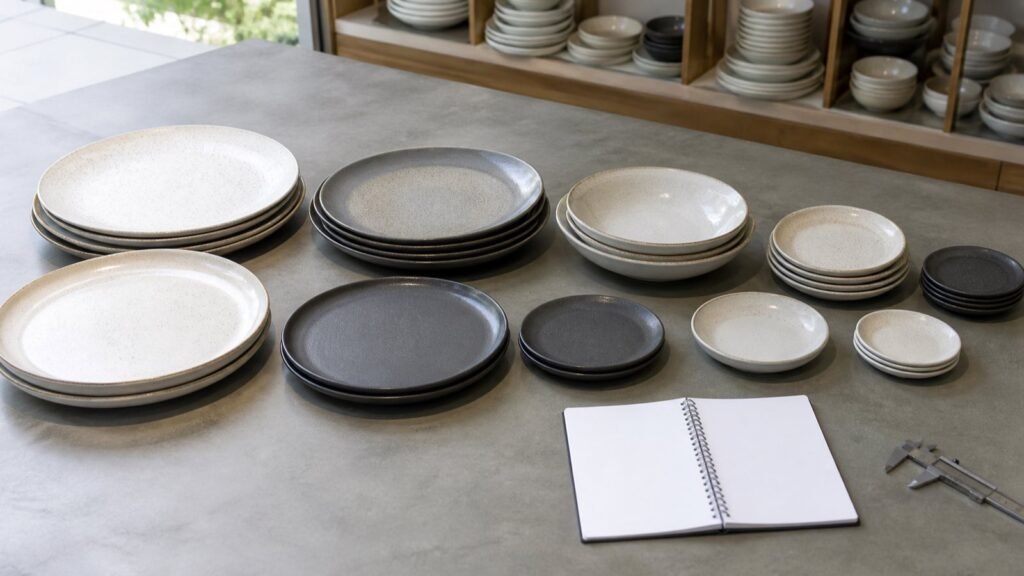
A large order should be designed as a range rather than a collection of unrelated attractive pieces. Begin with core functions: dinner plates, side plates, dessert plates, deep plates or pasta bowls, and serving platters where the channel requires them. Assign every SKU a role such as core volume, coordinated extension, seasonal accent, or controlled test.
Dimensions should be checked on physical samples. Nominal size alone does not describe usable area, rim width, foot diameter, stack height, or cabinet fit. Two 27-centimeter plates can present different portions and occupy different carton volume. Use the ceramic plate size guide to structure measurement fields, then record actual values for the selected models.
Create a simple assortment architecture. A dependable approach is to place the deepest quantities behind versatile colors and shapes, medium quantities behind coordinated decorative pieces, and smaller controlled quantities behind less familiar designs. The ratio must come from sales evidence, store count, pack multiples, and replenishment plans rather than a universal formula.
Check Coordination Across Models
Set the samples together under consistent light. Compare white tone, glaze gloss, rim profile, foot height, decoration scale, and visual weight. Pieces do not need to be identical, but the buyer should be able to explain why they belong in one commercial story. Photograph the approved setting and identify any item that can be substituted without breaking the range.
Test stacking by model and by the actual handling method. Record the height of a fixed stack, the stability of the base, contact points between plates, and the ease of lifting one piece. For hospitality programs, also test the intended rack, trolley, shelf, or pass. For retail, measure the final pack and shelf footprint.
| Assortment layer | Typical role |
| Core neutral plates | Repeatable everyday demand |
| Coordinated colors | Range building and display |
| Decorative accents | Choice and seasonal interest |
| Serving pieces | Higher value range extension |
Approve Plate Quality with Written Criteria
Approve labeled samples before a large bulk ceramic plate order. Inspect several pieces from each proposed model rather than treating one sample as proof of the full quantity. Check stability on a flat surface, rim smoothness, foot finishing, glaze coverage, decoration position, visible inclusions, shape consistency, and the normal variation associated with the finish.
Separate functional criteria from appearance criteria. A plate that rocks, has an unsafe sharp edge, or does not fit the intended rack presents a functional issue. Small variations in a reactive glaze may be part of the accepted design. Define both categories with photographs and plain language so the supplier, buyer, and inspector use the same reference.
Measure diameter, height, weight, foot, usable area, and stack height using an agreed method. Avoid tolerances that have no commercial purpose. The objective is consistent use and presentation, not arbitrary precision. If a set combines several plate sizes, confirm their visual proportions as well as individual measurements.
Food-contact and labeling obligations vary by destination and intended use. Identify the applicable requirements with qualified local advisers, then request evidence tied to the relevant material, decoration, model, and market. Do not assume a general statement or an unrelated report covers the exact order. Keep documents, sample approvals, and revision dates connected to the purchase record.
Use a pre-shipment inspection plan that identifies models, quantities, sampling method, checks, acceptance criteria, and reporting format. Include carton count, markings, retail pack configuration, and barcode verification where relevant. Resolve ambiguous criteria before the inspection date.

Calculate Quantities Pack Multiples and Landed Cost
Large orders must reconcile sales demand with carton reality. Begin with a demand plan by SKU, channel, location, and review period. Then convert desired piece quantities into inner-pack and master-carton multiples. Rounding can create meaningful differences across many models, so show requested quantity, adjusted quantity, and variance on the order sheet.
Compare prices on the same basis. Record currency, trade term, named place, unit basis, packing included, payment conditions, quotation validity, and quantity. Request carton dimensions, net and gross weight, pieces per carton, and packing arrangement for every model. Wide rims, deep profiles, and irregular shapes can increase cubic volume even if their unit price appears favorable.
Build landed cost by SKU using current inputs for product, packing, international transport, insurance, customs processing, duty, nonrecoverable taxes, brokerage, inspection, finance, inland delivery, and handling. Confirm classification and rates locally. Stress-test freight, exchange rate, damage, and sales pace instead of relying on one optimistic result.
Mixed designs may support assortment flexibility, but only when quantities, carton packs, labeling, and loading remain manageable. Consolidate repeated colors or shared shapes where that simplifies receiving and replenishment. Keep each model traceable on the purchase order, carton list, inspection report, and warehouse record.
| Cost control |
| Unit comparison |
| Freight model |
| Quantity control |
| Risk test |
| Receiving plan |
Plan Packing Shipment and Receiving
Plate packing must balance protection, carton weight, handling, and storage. Review separators, sleeves, inner cartons, cushioning, edge protection, master-carton strength, and movement inside the pack. A pack that survives normal export handling also needs to remain practical for warehouse staff and the final sales channel.
Conduct a packing review with the actual plate profile. Rimmed, coupe, square, embossed, and footed plates do not behave identically. Confirm how pieces contact each other and whether decorative surfaces need additional separation. For ecommerce resale, export packing alone may not be sufficient for individual parcel delivery; test the intended downstream pack separately.
Build the schedule backward from the required arrival date. Include sample approval, commercial confirmation, payment, final quantity allocation, packing preparation, inspection, booking, export handling, international transit, customs, inland delivery, and warehouse receiving. Ready stock ceramic plates can shorten the product sourcing stage, but logistics still depend on confirmed space, documents, and destination procedures.
At receiving, inspect carton condition before unloading records are closed. Reconcile carton count and model labels with the packing list, then sample pieces for dimensions, appearance, stability, packing, and damage. Photograph findings by model and carton reference. Keep sellable quantity separate from ordered quantity when calculating the initial availability for customers.
After launch, track sales, returns, breakage, customer comments, and requested companion pieces by SKU. Set a review date before the initial order is exhausted. Reordering is a fresh decision: reconfirm current availability, price, packing, and timing rather than copying the earlier purchase order automatically.

Conclusion
Ready stock ceramic plates can support large orders when the buyer connects current availability with a measurable assortment, approved samples, carton-level costing, and disciplined receiving. Build depth behind proven core items, keep unfamiliar designs controlled, and document every specification and commercial assumption. Browse ready stock ceramic tableware for range planning, or request a wholesale quotation with your destination, models, quantities, and required arrival window.
FAQ
Start with expected demand by SKU, channel, location, and review period. Add the operational buffer your business can justify, then convert pieces into confirmed inner-pack and carton multiples. Record the rounding variance and avoid giving every design equal depth. Core plates normally need stronger coverage than experimental colors or shapes, but the final ratio should follow sales evidence and cash limits.
Check model identity, diameter, height, weight, usable area, foot, rim, stability, glaze coverage, decoration placement, stack behavior, and packing fit. Review several pieces under consistent light and document the acceptable appearance range. Test the plate with the intended rack, shelf, dishwasher, food presentation, or retail pack where relevant, and retain a labeled approval sample.
Combination may be possible when current quantities, commercial terms, carton multiples, labels, and loading support it. Confirm each model and quantity in writing, keep carton marks traceable, and calculate freight from final packing data. A coherent color or shape architecture helps the assortment sell together, while separate SKU records protect inspection, receiving, and later replenishment decisions.