

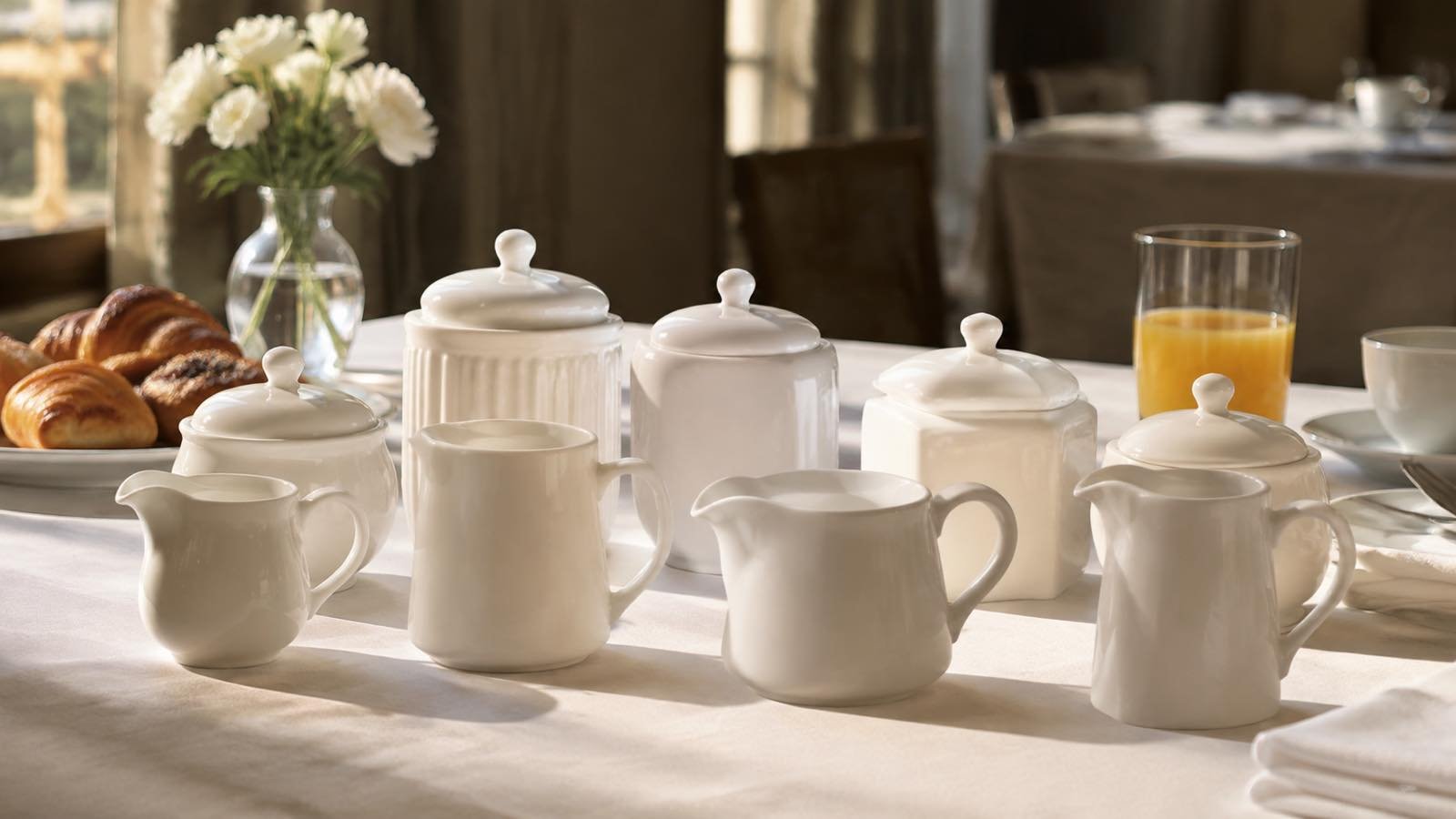
Small service pieces can create large purchasing problems when capacity, lid fit, pouring control, or packing is overlooked. Wholesale ceramic sugar bowls and creamers need to coordinate visually with cups and tableware while performing reliably in cafés, hotels, restaurants, and retail sets. This guide explains how buyers can define the assortment, evaluate samples, calculate useful quantities, compare quotations, and protect fragile shapes in transit.
Define the Service Format and Product Pairing
Start with how the products will be used. A hotel breakfast station may need larger, easy-to-refill pieces, while an individual afternoon tea service may call for compact, refined forms. A café may use a creamer for milk at the table, portion control, or beverage preparation. Retailers may sell a matched sugar bowl and creamer as a giftable pair or combine them with cups, a teapot, and a tray. Each application changes the target capacity, weight, handle, spout, lid, and presentation.
Create an item brief before reviewing designs. Record the target user, table setting, beverage type, serving frequency, expected fill level, material, body color, finish, decoration, approximate dimensions, capacity, and preferred packing. State whether the products must coordinate with an existing cup, saucer, teapot, or dinnerware line. Physical samples of the companion pieces are more reliable than color names when matching white bodies and glazes.
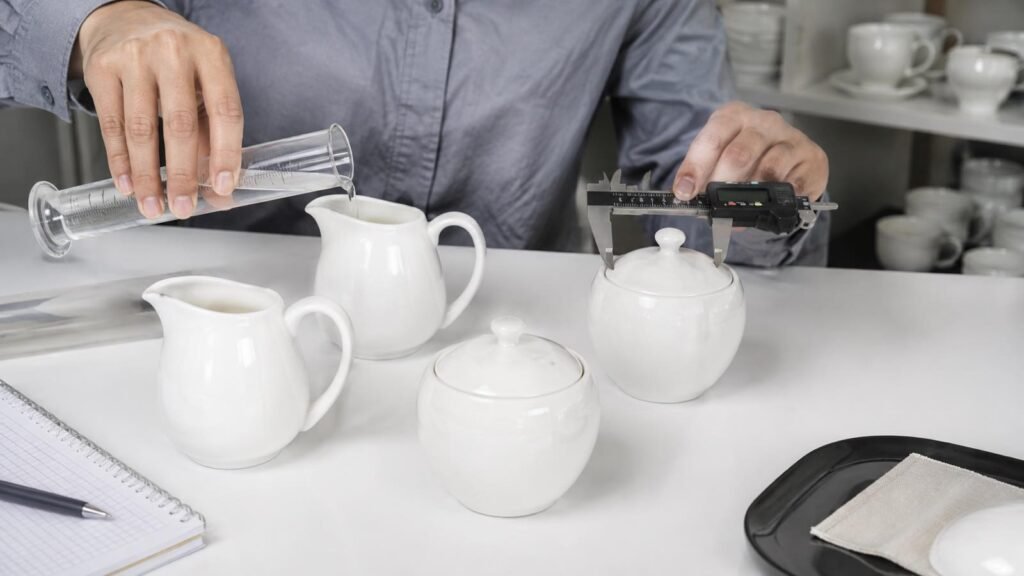
Decide whether the pieces form a permanent core range or a seasonal accent. Core products benefit from simple profiles, stable bases, comfortable handling, and colors that can work with several collections. More expressive shapes or reactive glazes can add visual interest, but buyers should approve the expected variation and decide whether each piece will be sold individually or only as a set.
Choose Capacity from Real Use
Capacity should be tested, not inferred from overall dimensions. Ask how the supplier measures stated capacity and define the practical fill line needed for clean service. A vessel filled to the rim is not usable during carrying or pouring. Test the quantity of sugar, milk, cream, syrup, or condiment intended for the service. Granulated sugar, cubes, packets, and alternative sweeteners use the space differently.
For a creamer, compare total capacity, comfortable carrying level, and controlled pouring level. A broad body may look generous but feel unstable when full. For a sugar bowl, check whether a spoon can enter when the lid is in place and whether the opening is suitable for cubes or packets. Record volume, product weight when empty, and approximate service weight when filled.
Inspect Pouring Lid Fit and Tabletop Stability
A creamer’s spout is a functional component, not decoration. Fill the sample to the planned level and pour slowly, then at normal service speed. Observe stream control, drips, liquid tracking down the body, and whether the handle remains comfortable. Test with the actual liquid type because viscosity and surface behavior can change results. Set the creamer down on a light surface to reveal delayed drips.
Inspect the handle opening, attachment points, and balance. The user should be able to lift and tilt the piece without an awkward wrist angle. A handleless creamer may suit compact service, but the body must remain comfortable to grip. Confirm that the foot is smooth and the base sits flat without rocking.
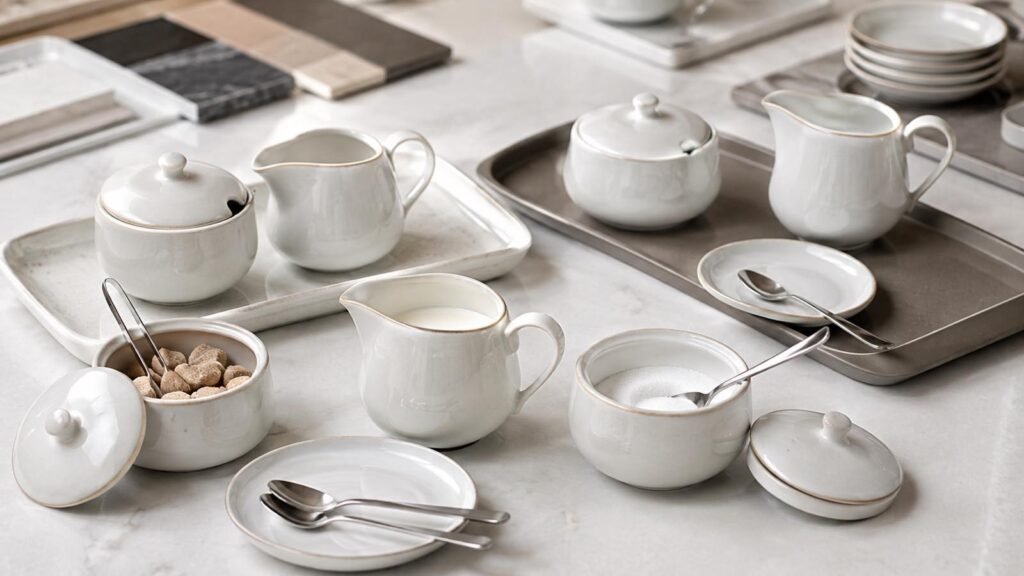
For sugar bowls, review lid fit across several samples. The lid should locate naturally and remain stable during normal movement, but it should not bind. Check the knob for a secure grip and inspect the lid gallery and rim for rough contact. If there is a spoon slot, test the proposed spoon and verify that the lid still rests correctly. Buyers should also decide whether lids and bowls need matched identification during packing and replacement.
Assess Glaze Decoration and Coordination
Compare body tone and glaze under neutral daylight as well as the lighting used in the destination. “White” can range from cool blue-white to warm ivory, and differences become obvious when pieces share a tray. Review gloss level, color coverage, rim appearance, pinholes, specks, scratches, decoration placement, and natural variation. If a reactive glaze is selected, approve a representative range rather than one unusually uniform sample.
Decoration near the lip, spout, handle, or lid contact area may receive more wear. Ask for applicable care information and assess the actual sample under the buyer’s intended washing and service conditions. Metallic decoration requires specific review where microwave use is expected. Never assume suitability from appearance alone.
| Product feature | Practical test | Approval record |
| Creamer capacity | Fill to a usable line and carry | Milliliters and fill reference |
| Spout | Pour at slow and normal speed | Drip and stream observation |
| Sugar bowl lid | Rotate lift carry and replace | Fit range and spoon compatibility |
| Base | Set on a flat surface | Stability and foot finish |
| Coordination | Compare with companion ware | Approved sample and color reference |
Build a Commercially Useful Assortment
Avoid buying every available shape. Start with the service combinations your customers actually use. A focused wholesale range may include one compact creamer, one medium creamer, a lidded sugar bowl, and perhaps an open packet holder or larger service option. Retail buyers can create good-better differentiation through material, decoration, packing, or set composition without adding many near-identical sizes.
Map each item to its companion products and selling unit. Record whether a sugar bowl includes the lid, whether a creamer includes a saucer, and whether prices refer to an individual piece, pair, inner pack, or carton. Use clear item codes for bodies and lids where separate tracking is needed. This prevents errors in orders, catalogs, and warehouse counts.
Review wholesale ceramic tableware as coordinated families, but verify availability for every component. A product shown in the same visual collection may have a different carton quantity or available volume. When mixed designs are considered, specify the assortment ratio and whether the buyer or supplier selects the mix. Document acceptable alternatives before order confirmation.
Plan Quantities for Sets and Replacements
Calculate quantities from the number of complete selling or service units. For example, a retail gift pair needs equal usable quantities of sugar bowls and creamers, while a hotel may deploy more creamers than sugar bowls depending on its service format. Convert the plan into inner packs and cartons, then check whether lid breakage or misplacement creates a need for separately available replacements.
Do not split purchasing funds equally across shapes without demand evidence. Use order history, customer commitments, service covers, replacement data, display needs, and storage limits. Keep a modest alternative plan for core items when availability is time-sensitive. The alternative should preserve capacity, function, material, color family, style level, price position, and packing compatibility.
Specify Packing for Handles Spouts and Lids
Sugar bowls and creamers have projections and separate components that require careful packing review. Confirm the inner pack, protective sleeves, partitions, lid protection, master-carton quantity, carton dimensions, gross weight, and drop or handling test method agreed for the shipment. Check whether a creamer spout points toward empty space or another product, and whether handles can receive side pressure.
Lids should be protected against movement and direct contact with the bowl. If lids are packed separately, the carton and item identification must make receiving and assembly simple. If retail boxes are required, inspect how the pair is restrained, how the box survives stacking, and whether product photography and set contents are accurate. Packing should be reviewed with the actual approved product, not a generic diagram.
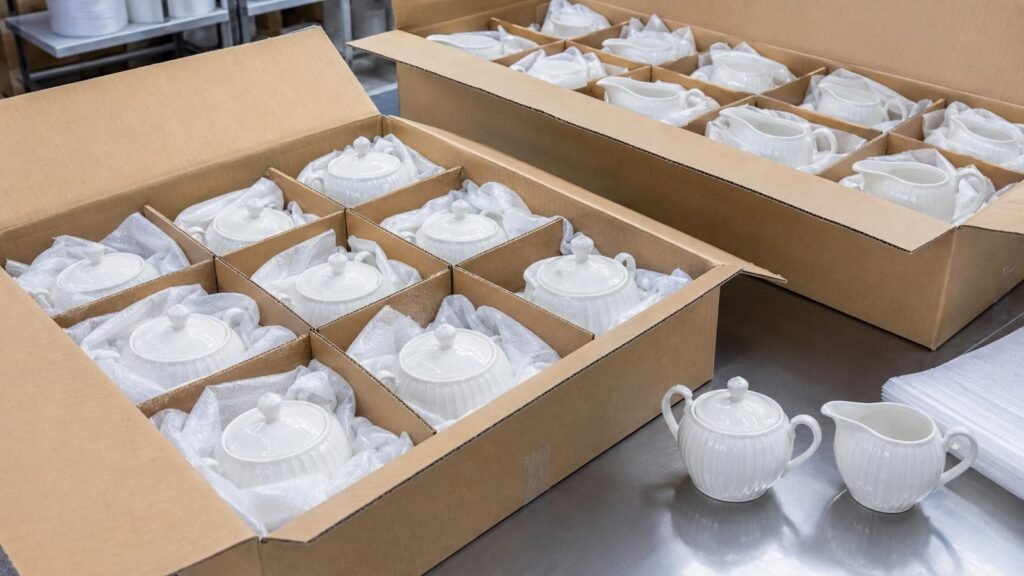
Carton efficiency affects landed cost, warehouse labor, and breakage exposure. A smaller carton may cost more per piece to handle but be safer and easier for hospitality storerooms or retail distribution centers. Compare scenarios using expected usable units rather than only freight volume.
Compare Quotations on a Landed Cost Basis
Normalize offers by currency, trade term, named place, price unit, included components, packing, payment terms, quotation validity, available quantity, and preparation schedule. Add sampling, inspection, inland transport where applicable, freight, insurance, duties, taxes, destination handling, storage, labeling, and an evidence-based allowance for loss. For sets, divide cost by complete saleable sets after allowing for unmatched components.
Ready stock can support shorter preparation times, but buyers should reconfirm current quantities near approval. Ask whether goods can be reserved, when packing can begin, and what documents are supplied. Work backward from the required receiving date and include inspection, shipping, customs, destination handling, and internal distribution.
Control Approval Product Data and Reorders
Use a final specification sheet containing item code, photographs, material, dimensions, usable capacity, weight, body color, glaze, decoration, spout and handle details, lid configuration, base finish, packing, available quantity, and approved sample date. Record measurement tolerances or visual variation in language both parties can apply. The purchase order should reference the controlled revision.
Prepare accurate product data for the sales channel. Retail listings should state set contents, dimensions, capacity, material, color, care guidance, and whether natural variation is expected. Hospitality line sheets should emphasize service capacity, stack or tray fit where relevant, packing, and replacement item codes. Avoid promising replenishment without current confirmation.
After receipt, track sales, sample requests, returns, breakage, lid losses, customer questions, and reasons for rejection. These observations reveal whether the problem is product selection, missing information, packing, or merchandising. Use them to adjust the next purchase rather than expanding the range on intuition.
Conclusion
Wholesale ceramic sugar bowls and creamers should be chosen through real service tests, not appearance alone. Define practical capacity, verify pouring and lid fit, coordinate body tone, and specify protection for spouts, handles, and lids. Plan quantities as complete service or selling units and compare full landed cost. Explore our ceramic tableware buying guides or request a current quotation with your capacity and style brief.
FAQ
Ask for the supplier’s stated measurement method, then test the sample at a practical fill line below the rim. Record the usable milliliters, empty weight, and approximate filled weight. Pour the intended liquid at normal service speed to check stream control and drips. The usable capacity, rather than brimful capacity, should guide menu planning, portioning, and customer-facing product information.
Check that the lid locates easily, sits evenly, and remains stable during normal carrying without binding. Inspect the knob, lid gallery, rim contact, glaze coverage, and any spoon slot. Test the intended spoon and sugar format. Review several samples because fit can vary, and clarify whether replacement lids are available or whether lids and bowls must remain matched as sets.
Mixed designs may be available, but the assortment must be defined precisely. Record the included shapes, colors or patterns, quantity ratio, packing method, and whether selection is buyer-controlled, supplier-proposed, or fixed by carton. Approve representative samples and acceptable variation. Confirm current quantities close to order approval because availability can differ by component even within one coordinated collection.