

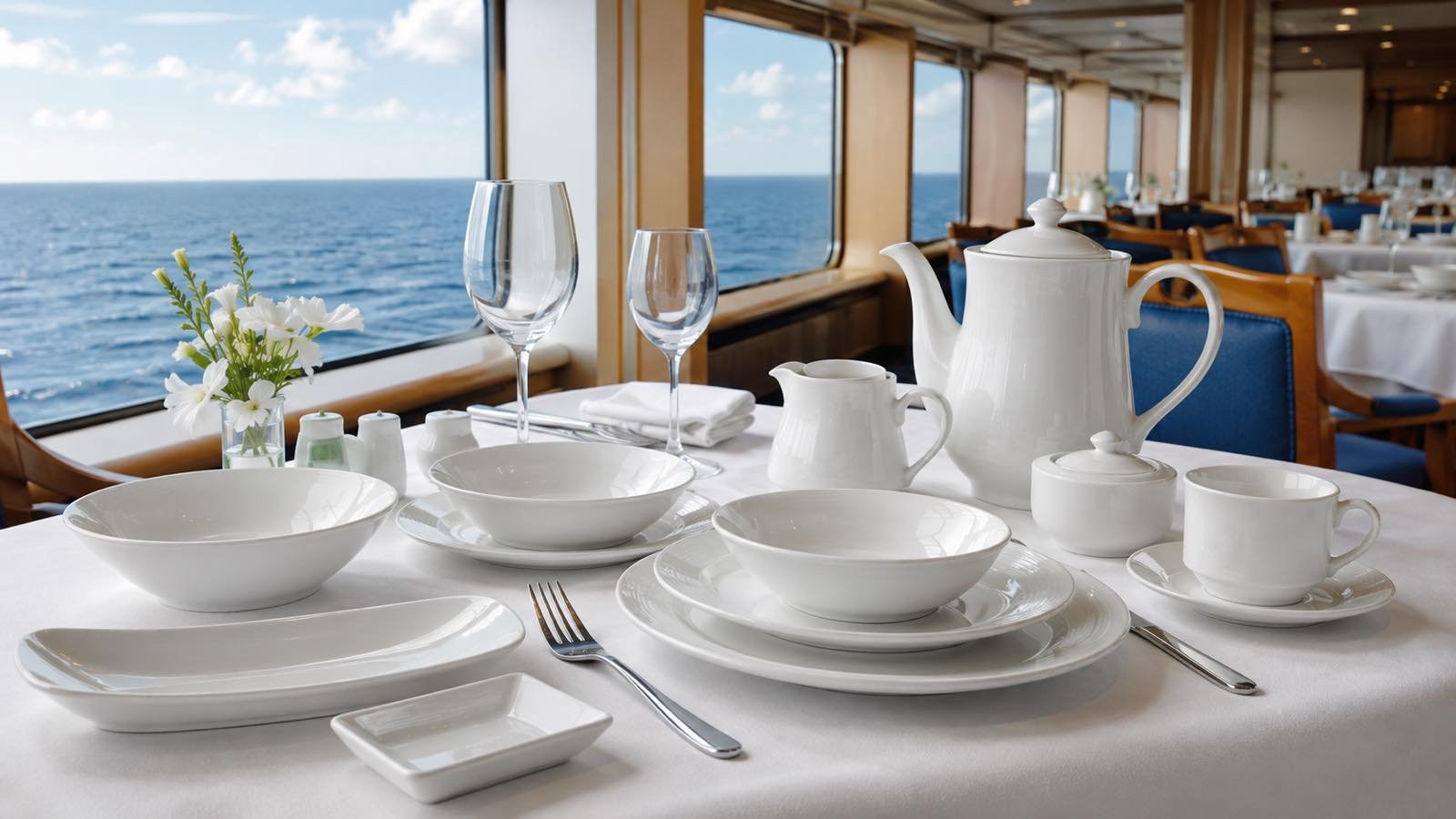
A plate used at sea has to do more than look appropriate on a dining table. Wholesale ceramic tableware for cruise ship suppliers must support high meal volumes, compact storage, repeated handling, varied dining concepts, and tightly scheduled replenishment. This guide gives marine catering buyers a practical framework for selecting shapes, checking quality, planning quantities, comparing landed cost, and keeping a usable replacement program.
Translate the Cruise Dining Brief into Product Requirements
Begin with the service operation rather than a catalog. A large vessel may have a buffet, main dining room, specialty restaurant, crew mess, café, room service, and event space. Each venue creates a different combination of presentation, speed, storage, and replacement needs. Record the venue, meal period, cuisine, cover count, service method, menu items, tray or trolley limits, dishwasher and rack dimensions, and desired visual direction. This brief prevents an attractive but unsuitable item from advancing simply because it photographs well.
Divide the range into operational roles. Core pieces include dinner plates, side plates, cereal or soup bowls, mugs, and cups with saucers. Specialty shapes may support pasta, Asian cuisine, steak, desserts, or shared service. Serving pieces should be included only when their size and handling method fit the actual outlet. Crew dining usually benefits from a focused, robust range, while premium venues may justify finer profiles and more distinctive decoration.
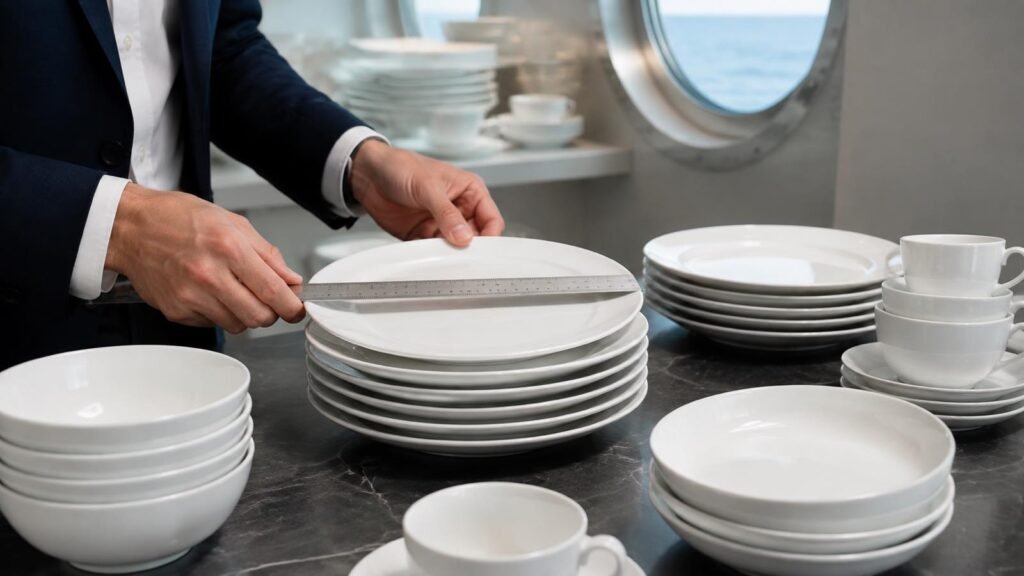
Build a line sheet with item code, material, dimensions, capacity, weight, rim profile, foot design, stack height, packing quantity, available quantity, and intended venue. Evaluate coordinated shapes as a system. A dinner plate, for example, must fit the plate cover, dish rack, service tray, storage shelf, and food presentation standard. The same discipline applies to bowls, cups, and serving items.
Set Measurable Functional Criteria
Use measurable acceptance points wherever possible. Dimensions should include diameter or length, overall height, usable well, and foot-ring diameter. Capacity needs a stated measurement method because nominal and practical fill levels differ. Weight should be reviewed as both a single piece and a loaded stack. Specify the maximum stack height that the storage shelf, trolley, or rack can accommodate, and confirm that stacked pieces separate without excessive force.
Avoid treating thickness as a universal quality score. A thicker body may feel substantial, but geometry, material, firing, glaze coverage, foot finishing, and handling practice all affect performance. The objective is the right balance of durability, stackability, presentation, and staff comfort for each venue.
Evaluate Samples for Service and Handling Performance
Photographs can support shortlisting, but representative samples should control approval. Review several pieces from the proposed supply when natural glaze or decoration variation is relevant. Place samples on a flat surface and check rocking, rim consistency, glaze coverage, pinholes, specks, scratches, foot finishing, and handle alignment. Compare pieces side by side under neutral light so normal variation can be distinguished from a material mismatch.
Simulate the service path. Load plates into the actual or dimensionally equivalent rack, stack them to the planned height, fit covers, place bowls on trays, and check cups in saucers. Ask staff to lift a realistic stack and remove individual pieces. Test whether cutlery marks are visible on the chosen glaze, whether decoration sits in a high-wear zone, and whether raised textures trap food or complicate cleaning.
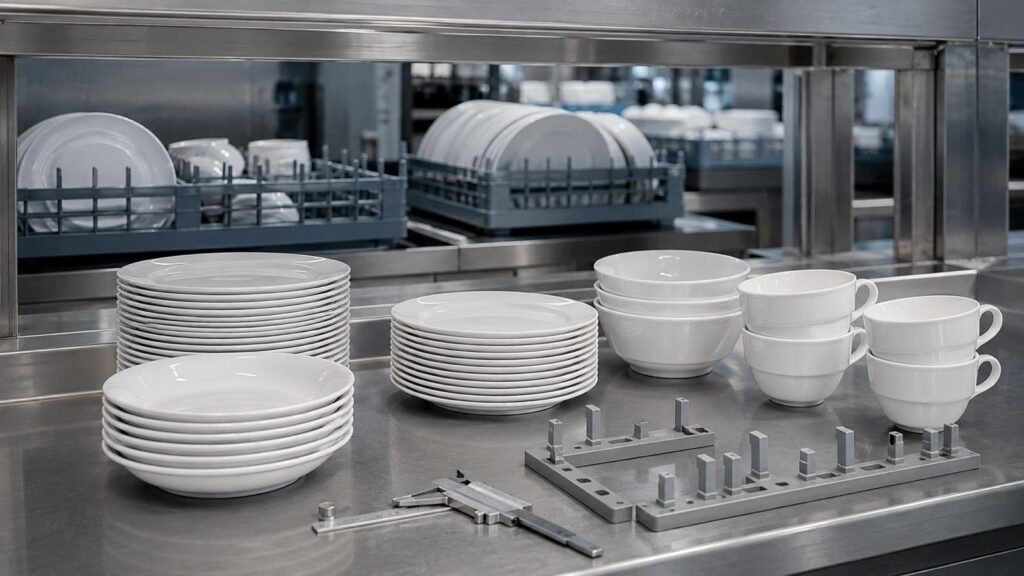
Agree on the inspection method before the order. The written specification should identify the approved sample, measurements, color or decoration reference, packing, and the process for recording findings. If the buyer uses an independent inspection company, give the supplier and inspector the same controlled document. Verbal descriptions such as “hotel quality” are too open to interpretation.
Compare Materials and Finishes by Venue
Porcelain is widely considered where a clean white body, refined profile, and broad design choice are important. Vitrified or hospitality-oriented bodies may be considered for intensive operational use, subject to verified product specifications. Stoneware can support casual concepts with warmer body tones and tactile finishes, although its weight, glaze variation, and stacking behavior require careful review. Material names alone do not confirm performance; test the actual product.
Decoration also changes the operating profile. Plain white glazed ware simplifies coordination and replacement. Colored glazes or printed decoration can distinguish a venue, but the buyer should approve color tolerance and understand where the decoration sits relative to food contact and wear. Metallic details may conflict with microwave use, so intended appliances and care instructions must be checked rather than assumed.
| Review area | Operational question | Evidence to approve |
| Dimensions | Does the item fit racks trays covers and shelves | Measured sample and equipment check |
| Handling | Can staff carry and separate planned stacks | Loaded service simulation |
| Surface | Is the glaze suitable for the menu and cleaning process | Sample review and agreed test |
| Range | Can core pieces be replenished coherently | Item matrix and alternative plan |
| Packing | Can cartons be stored moved and counted safely | Packing specification and carton data |
Plan Quantities Replacements and Ready Stock Supply
Calculate demand by venue and item, not only by total passenger capacity. Start with the number used during one service cycle, then add quantities needed while items are being collected, washed, returned, or held at another station. Include the agreed reserve for breakage, loss, menu changes, and delayed replenishment. The appropriate reserve depends on the operation, voyage pattern, storage, handling data, and supply lead time; it should not be copied blindly from another fleet.
Convert every quantity into inner packs, cartons, pallets, and storage volume. A theoretically correct piece count may become inefficient when it produces awkward carton remainders or exceeds available stores. Record where stock will be held—on the vessel, at a central warehouse, or with a service partner—and who can release it. Use one item code across purchasing, warehouse, vessel, and finance records.
Ready stock dinnerware can support short preparation windows and mixed design selection, but availability is a dated fact. Request confirmation close to order approval and clarify whether quantities can be reserved. For core items, define acceptable alternatives in advance. The rule may protect material, function, diameter, stack height, body color, finish, price position, and compatibility with existing pieces. An alternative should maintain the service system, not merely resemble the original in a photograph.
Build a Replacement Strategy Before Deployment
Create a replacement register showing each vessel, venue, item code, pieces deployed, pieces held ashore, pieces held onboard, usage start date, and review point. Capture breakage and loss by item and venue instead of combining them into one percentage. Patterns can reveal a rack mismatch, unstable stack, vulnerable handle, service bottleneck, or unsuitable shape. The data helps buyers decide whether to replenish, adjust handling, or select another item.
When a design cannot be replenished, prioritize operational compatibility. A controlled transition may introduce a new line by venue or meal period while remaining pieces of the previous line serve another defined use. Mixing visibly different replacements without a plan weakens presentation and makes inventory harder to control.
Compare Packing Logistics and Landed Cost
Unit price is only one element of the procurement decision. Normalize every quotation by currency, trade term, named place, price unit, included packing, payment terms, validity, available quantity, and preparation schedule. Add inspection, inland transport where applicable, freight, insurance, duties, taxes, destination handling, warehousing, vessel delivery, financing, and expected loss. Divide the total by expected usable pieces or service settings.
Review packing through the entire route. Confirm inner quantity, separators, protective sleeves, master-carton quantity, dimensions, gross weight, shipping marks, pallet requirements, and moisture protection where appropriate. Check how rims, handles, lids, and feet contact neighboring pieces. Oversized cartons may reduce carton count but become difficult to lift through warehouse and vessel access points.

Shipment timing should work backward from the vessel’s receiving window. Include order approval, availability confirmation, inspection, document preparation, main transport, customs procedures, destination handling, and delivery to the nominated point. Build decision dates and contingency actions into the schedule. Ready stock can shorten the product preparation portion, but it does not remove transport or import steps.
Use a Controlled Approval and Handover Process
Keep final decisions in one approved order sheet rather than scattered across emails and messages. Include photographs, item codes, specifications, quantities, packing, price basis, confirmed availability date, required delivery date, inspection instructions, and responsible approvers. Mark unresolved questions clearly. After approval, issue the same revision to purchasing, supplier, inspector, freight partner, warehouse, and vessel team.
On receipt, reconcile cartons and item codes before opening a broad sample. Record packaging condition, quantity differences, and inspection findings with photographs linked to the shipment. Retain an approved sample or reference set for future orders. This documentation turns a one-time purchase into a repeatable supply program.
Prepare a Practical Supplier Enquiry
A concise but complete enquiry receives a more comparable response. State the vessel or venue type without disclosing confidential information, service concept, required items, material preferences, dimensions, capacities, colors or decoration, quantity by item, packing needs, target delivery point, and timing. Attach rack, tray, cover, or shelf limits when they affect selection. Ask the supplier to identify available quantity, packing data, preparation estimate, quotation validity, and any product variation that requires approval.
Shortlist products against the same scorecard: operational fit, sample quality, range completeness, current availability, replacement logic, packing efficiency, landed cost, and communication quality. Do not allow one attractive feature to hide a major operational weakness. The result should be a range that supports food presentation while remaining manageable for procurement, stores, service staff, and replenishment teams.
Conclusion
Wholesale ceramic tableware for cruise operations should be selected as working equipment and a coordinated visual range. Translate each venue into measurable requirements, approve representative samples, model complete landed cost, and plan replacements before deployment. Ready stock options can support urgent and mixed requirements when availability and alternatives are documented carefully. Browse our ceramic tableware buying resources or contact our wholesale team with your item matrix for a current quotation.
FAQ
Include the venue and service method, item list, material, dimensions, capacities, colors or decoration, quantity by item, packing needs, equipment limits, delivery point, and required timing. Sharing rack, tray, cover, and shelf dimensions helps prevent compatibility problems. Ask for current availability, carton data, representative samples, quotation validity, and preparation estimates so offers can be compared on the same basis.
Measure several samples, stack them to the planned operational height, and check stability, separation, total weight, rim contact, and fit in racks or shelves. Simulate handling with staff and relevant service equipment. Also inspect the foot finish and glaze contact points because these can affect scratching. Document the accepted sample, stack height, measurements, and any allowable variation before ordering.
Ready stock can help when buyers need a shorter product preparation window or mixed selection, but quantities and designs can change. Reconfirm availability near approval, reserve quantities where agreed, and define acceptable alternatives for core items. Maintain accurate item codes and replacement records so a fast purchase still fits existing racks, service settings, packing systems, and the venue’s visual direction.