

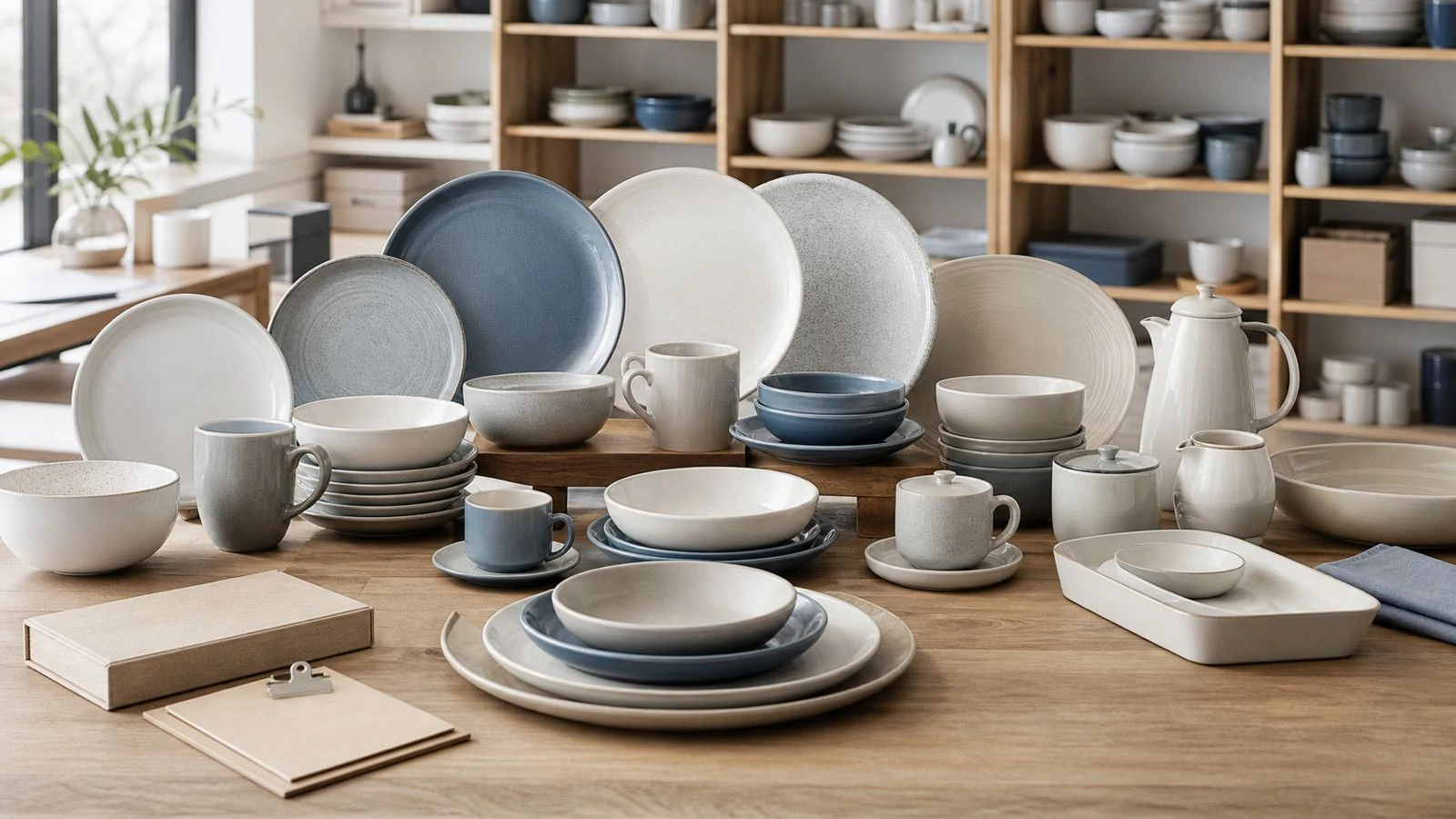
Buying tableware in bulk involves more than comparing a unit price. A successful wholesale ceramic dinnerware order must fit the buyer’s market, handling conditions, sales format, and shipping plan. This guide gives importers, wholesalers, distributors, and trading companies a practical framework for defining specifications, reviewing samples, comparing quotations, and confirming an order with fewer surprises.
Define Your Wholesale Ceramic Dinnerware Requirements
The most efficient enquiries begin with a written buying brief. Without one, suppliers may quote products that look similar but differ in material, dimensions, decoration, packing, or available quantity. Those differences can make two prices impossible to compare fairly.
Start with the selling channel. A restaurant distributor may value stackability, replacement availability, and a neutral design. A homeware wholesaler may prefer coordinated shapes and several colors. A promotional buyer may focus on a narrow budget and a fixed delivery window. The intended customer determines which trade-offs are reasonable.
Your brief should state:
- Product types, such as dinner plates, side plates, bowls, mugs, cups, and saucers
- Preferred material and finish
- Diameter, height, capacity, and acceptable dimensional tolerance
- Target colors or patterns
- Quantity by item, design, and color
- Individual set packing, bulk packing, or another retail-ready format
- Destination port or delivery location
- Required shipping window
- Market-specific testing or labeling requirements
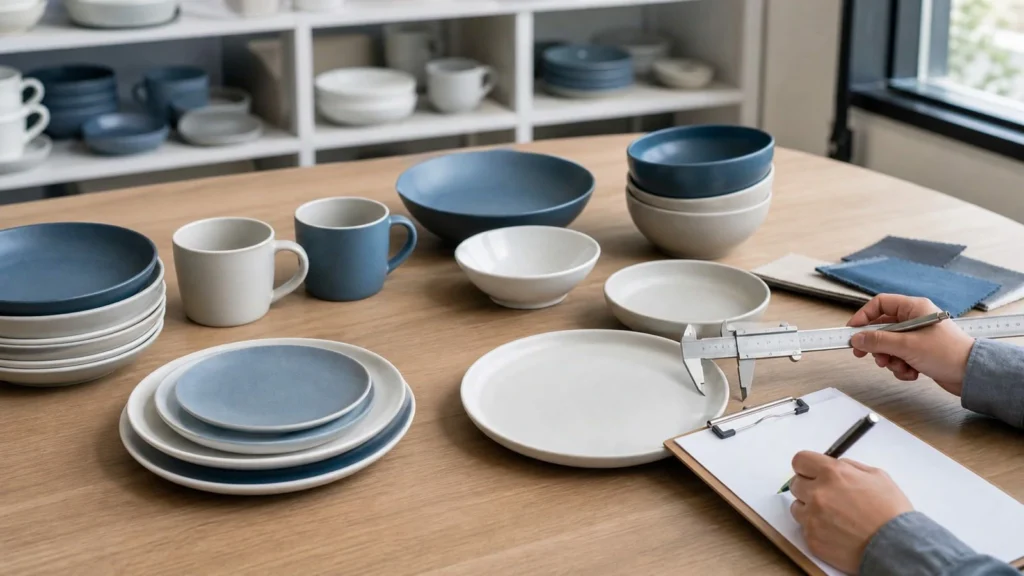
Separate essential requirements from preferences. For example, a plate diameter and destination deadline may be fixed, while the rim profile and shade can remain flexible. This distinction helps a stock ceramic tableware supplier identify workable alternatives when an exact design is unavailable.
Keep units consistent throughout the enquiry. State whether dimensions are in millimeters or inches, whether mug capacity is measured to the brim or to a practical fill level, and whether quantities refer to pieces, sets, cartons, or pallets. Clear units prevent expensive misunderstandings later.
Compare Ceramic Materials, Shapes, and Finishes
When comparing wholesale ceramic dinnerware, material names alone do not tell the whole story. Porcelain, stoneware, new bone china, and other ceramic bodies can each suit different price positions and visual styles. Buyers should evaluate the finished item rather than assuming that one material name guarantees a particular weight, whiteness, strength, or appearance.
| Buying factor | Porcelain | Stoneware | New bone china |
| Typical visual character | Refined, clean, often bright | Substantial, crafted, often warmer | Light-looking, smooth, often creamy |
| Common design direction | Classic to contemporary | Casual, rustic, hospitality-led | Elegant retail and dining collections |
| Weight perception | Varies by body and shape | Often feels heavier | Often designed to feel lighter |
| Finish options | Gloss, matte, decorated | Reactive, matte, gloss | Gloss and delicate decoration |
| Buyer check | Rim, glaze, translucency, flatness | Glaze variation, stacking, weight | Color consistency, rim quality, handling |
Shape affects both presentation and logistics. Coupe plates provide a broad food presentation area, while rimmed plates offer a defined border and can be easier to carry in service. Deep bowls suit soups and noodles; shallow bowls can serve pasta, salads, or shared dishes. Before ordering, check usable food area and internal depth rather than relying only on the outside diameter.
Finish also changes the buying decision. Gloss surfaces are familiar and easy to assess visually. Matte and reactive glazes can provide a distinctive look, but natural variation should be reviewed across several pieces rather than from one photograph. Ask the supplier to explain the acceptable appearance range for color, speckling, glaze flow, and edge tone.
Browse a current stock ceramic dinnerware selection to compare available combinations of material, shape, finish, and decoration. When reviewing options, shortlist complete product families where possible. Coordinated plates and bowls make range planning easier than unrelated single items.
Build a Practical Product Mix and Quantity Plan
A wholesale ceramic dinnerware order should reflect how customers buy. Ordering equal quantities of every item can create an imbalance because dinner plates, bowls, mugs, and serving pieces rarely sell at the same rate. Use previous sales data when available. For a new market, begin with a controlled assortment and record demand by shape, color, and price point.
Choose the Range Architecture
There are three common ways to structure a wholesale ceramic dinnerware range:
- Open stock: Each item is sold separately. This supports replacements and lets customers build their own combination.
- Fixed sets: Pieces are packed in a defined place setting or dinner set. This simplifies retail presentation but requires careful set composition.
- Mixed wholesale assortment: Several compatible designs or item types share one shipment. This can broaden a catalog without concentrating the entire purchase in one design.
For open stock, consider the likely replacement rate of high-use items. For fixed sets, confirm the exact number of each shape and verify that all pieces fit the chosen carton. For a mixed assortment, request a line-by-line packing list so quantities remain visible at item level.
Plan Around Cartons, Not Only Pieces
Suppliers pack ceramics in carton quantities. An order for an arbitrary number of pieces may need to be rounded to full inner boxes or export cartons. Ask for pieces per inner box, inner boxes per carton, carton dimensions, gross weight, and net weight before finalizing quantities.
A simple quantity worksheet should include:
| Item | Design/color | Pieces per carton | Planned cartons | Total pieces |
| Dinner plate | Buyer selection | Supplier to confirm | Buyer plan | Calculated total |
| Side plate | Buyer selection | Supplier to confirm | Buyer plan | Calculated total |
| Bowl | Buyer selection | Supplier to confirm | Buyer plan | Calculated total |
| Mug | Buyer selection | Supplier to confirm | Buyer plan | Calculated total |
This carton-level view supports freight planning and reveals whether the mix is commercially sensible. It also reduces last-minute changes when the packing list is prepared. For plate-led assortments, compare the dimensions and decoration options in the stock ceramic plates category before fixing the final mix.
Evaluate Samples and Quality Before Ordering
Photos are useful for narrowing wholesale ceramic dinnerware choices, but a physical sample provides information that a screen cannot. Evaluate a representative group of pieces under consistent lighting and on a flat surface. Record observations in a repeatable checklist so different products and suppliers are judged by the same criteria.
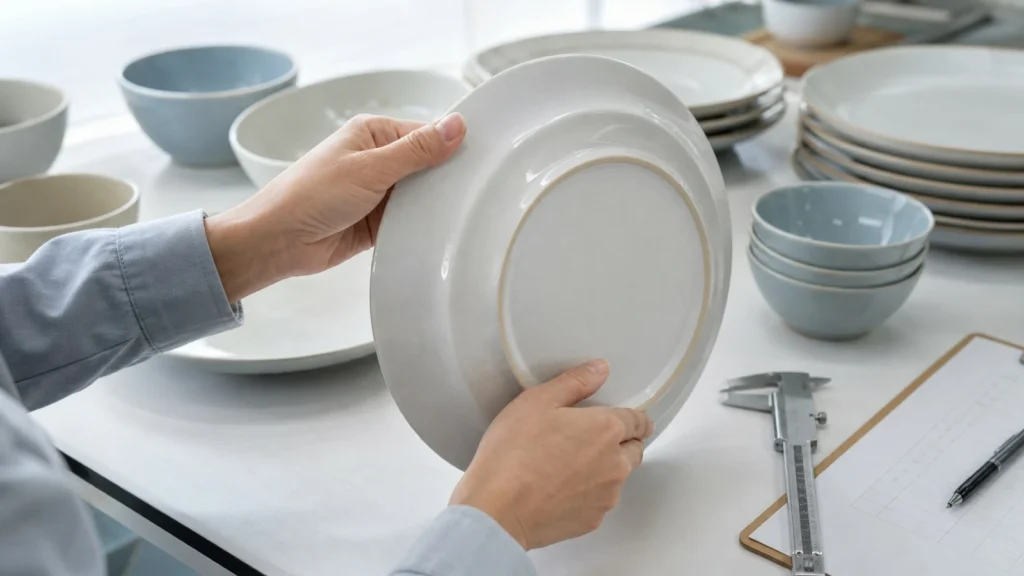
Check the following:
- Dimensions and capacity: Measure the actual item using the agreed method.
- Flatness and stability: Place plates and bowls on a level surface and check for rocking.
- Glaze coverage: Review the face, rim, underside, handle joins, and recessed areas.
- Surface appearance: Compare color and decoration across multiple pieces.
- Rim and foot: Look for smooth handling surfaces and a properly finished foot.
- Stacking: Build a practical stack and observe alignment, height, and contact points.
- Weight: Weigh several pieces to understand consistency and handling feel.
- Decoration position: Check alignment, continuity, and the agreed appearance range.
- Packing: Review dividers, inner boxes, carton strength, and movement inside the carton.
Avoid judging handmade-looking or reactive finishes by the same visual criteria as uniform white porcelain. Variation can be part of the intended design, but buyer and supplier should agree on its acceptable boundaries. A reference sample, approved photos, or a written description can document that agreement.
Testing requirements depend on the destination market, product use, decoration, and buyer policy. Do not assume that a generic test report automatically covers a different body, glaze, decoration, or production group. State the required standard or test scope in the enquiry and ask what supporting documents are available for the specific products under consideration.
Create a sample approval record with the item code, date, photos, measured dimensions, weight, color reference, packing method, and comments. Both sides can then use the same reference during order confirmation and pre-shipment review.
Compare Supplier Quotations on the Same Basis
The lowest number in a wholesale ceramic dinnerware quotation is not necessarily the lowest landed cost. Compare offers only after aligning the commercial terms and product specifications. A useful quotation should identify the item, material, size, finish, quantity, packing, price basis, availability, and payment terms.
Request these details in writing:
- Supplier item code and product description
- Clear product photos
- Unit price and the unit to which it applies
- Quantity available for each item or design
- Minimum packing increment
- Packing configuration and carton measurements
- Price term and named port or place
- Quotation validity
- Sample terms
- Estimated order preparation window
- Payment terms
- Required documents and labeling

Stock availability can change as orders are confirmed. Ask when the quantity will be reserved and what commercial step secures it. If a coordinated range contains several items, confirm availability line by line rather than relying on a total quantity.
When comparing prices, normalize the calculation. Convert set prices to a per-piece value when needed, separate optional retail packaging, and identify freight or local charges that are outside the quoted term. Also consider carton efficiency, because two products with similar unit prices may use shipping space differently.
Communication quality is another practical factor. A reliable ceramic dinnerware supplier should answer specification questions clearly, flag unavailable combinations, and record agreed changes. Keep a single confirmation sheet or pro forma invoice as the commercial reference instead of relying on scattered chat messages.
Confirm Packing, Shipping, and Order Details
Wholesale ceramic dinnerware needs packing that matches the product shape, decoration, route, and handling environment. There is no universal carton specification for every item. Ask for the proposed packing method and review it during sampling when packaging risk is important.
Confirm whether the order uses bulk packing, individual boxes, color boxes, or sets. Retail packaging affects cost, carton size, labeling, and artwork approval. If labels or barcodes are required, provide print-ready information and verify placement with a sample or digital proof.
Before payment or final confirmation, reconcile the quotation, product list, and packing list. The following details should agree:
- Item codes, descriptions, colors, and sizes
- Quantity per item and total quantity
- Unit prices and total value
- Packing quantities and carton estimates
- Shipping term and destination
- Preparation window and required shipping date
- Payment schedule
- Labeling, marks, and documents
- Approved sample or visual reference
- Inspection arrangement, if required
Plan inspection checkpoints in proportion to the order’s risk. A first order, a complex mixed assortment, or retail-specific packaging may justify more detailed verification than a repeat order of an unchanged item. The buyer should define what will be checked, who will check it, and what records are required.
Finally, leave time for documentation and booking coordination. Ready stock dinnerware removes the production stage, but order review, packing, inspection, export preparation, and transport booking still require coordination. A realistic schedule is based on the confirmed order rather than a general promise.
Conclusion
Buying wholesale ceramic dinnerware becomes more predictable when the specification, assortment, quality reference, quotation basis, and packing plan are documented before confirmation. Compare finished products and complete commercial terms instead of choosing by material name or unit price alone. Ready stock can provide a broad selection and a shorter route to shipment, while a disciplined buying process protects quality and margin. Review available products or contact our team with your item list, quantities, destination, and required timing to request a tailored quotation.
FAQ
Send the product types, material or style preference, dimensions or capacity, quantity by item, preferred packing, destination, and required shipping window. Include photos or reference links when they clarify the desired look. Also state any testing, labeling, barcode, or document requirements for your market. A complete brief helps the supplier confirm suitable items and prepare a quotation that can be compared accurately.
Samples are advisable when you are assessing a new item, supplier, glaze, decoration, or packing method. Use them to check dimensions, weight, stability, glaze appearance, stacking, handling, and packaging. Review several pieces when the finish is expected to vary. Record the approved sample details and photos so they can serve as a practical quality reference for the confirmed order.
A mixed shipment may be possible when the selected items are available and their packing quantities work with the order plan. Confirm quantity, carton configuration, and availability for every line. Mixing designs can help wholesalers broaden their range, but the assortment should still reflect expected sales by shape and color. Ask the supplier for a detailed packing list before final confirmation.