

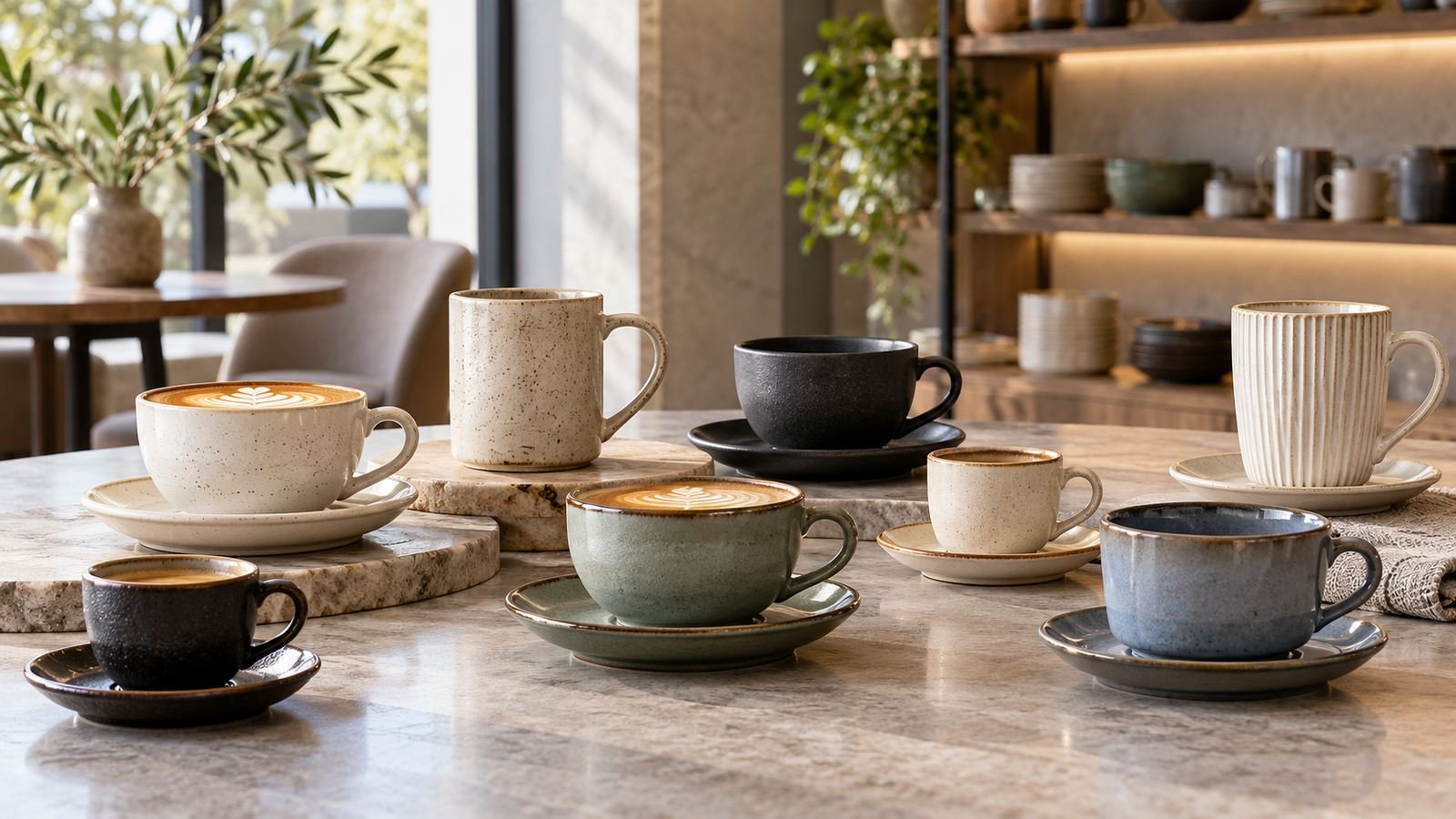
A cup that looks appealing in a catalog can still complicate a cafe supply order. Wholesale ceramic coffee cups need to suit beverage portions, staff handling, storage, and repeat purchasing across your customer base. This guide helps importers and distributors build a focused assortment, evaluate samples, define cup and saucer specifications, and confirm ready stock quantities before committing to a bulk order for cafe customers.
Match Wholesale Ceramic Coffee Cups to the Beverage Menu
Begin with the drinks your customers serve and the vessel each drink needs. Ask cafe buyers for their working beverage portions, serving style, and preferred headspace. The volume stated in a product listing may refer to a brimful measurement, while the cafe uses a lower working fill. Obtain both measurements where relevant and document how each was established.
For wholesale ceramic coffee cups, size names alone are insufficient. Espresso, cappuccino, and latte labels describe menu associations rather than a shared dimensional standard. Record the cup height, rim diameter, widest body dimension, base diameter, and overall width including the handle. Those measurements help customers assess presentation, storage, and fit beneath their equipment.
A hypothetical customer might ask for 180 milliliters of beverage in a cup with room above the liquid. That request does not mean a cup listed as 180 milliliters will be suitable. Test the sample with the requested portion, then photograph the resulting fill level. The number is an illustration of a purchasing method, not a recommended universal cafe portion or Chengguo product capacity.

Compare wholesale ceramic coffee cups in families that share a coherent appearance while serving different uses. A narrow selection of confirmed shapes can be easier to explain and replenish than many visually similar options. Record which customers need matching saucers, which prefer standalone cups, and which want room for a beverage garnish or additional serving item.
Before building depth, ask customers to rank their priorities: beverage presentation, handling, equipment fit, or storage. A cup can satisfy one priority while presenting a tradeoff elsewhere. Use the menu brief to decide which tradeoffs are acceptable instead of treating the largest capacity or most elaborate design as an automatic improvement.
Evaluate Handles Saucers and Daily Handling with Samples
Order samples of the exact references under consideration and label them so observations remain connected to the correct item. A cup photograph provides limited information about the handle opening, the balance of a filled vessel, or its fit on a saucer. For wholesale ceramic coffee cups, physical evaluation is especially useful when the distributor supplies several cafe formats with different workflows.
Hold the cup in the way a customer would use it, then ask cafe staff to assess the same sample. Check handle access, grip comfort, and whether fingers contact the body during normal handling. Assess the cup with an appropriate representative fill under controlled conditions. Do not infer a product temperature limit or safe heating method from an informal sample exercise; follow the supplied care instructions.
Compare cup and saucer together. Record the saucer outer diameter and the central seating area, then assess whether the base rests evenly and whether the cup shifts during ordinary serving movements. Consider the room needed for a spoon or a wrapped accompaniment. A saucer that matches the decoration may still be a different reference from the one intended for the cup.
Review the ceramic coffee cups and tableware alongside your specification sheet. Ask for the offered material description, care statement, and available supporting documentation for each chosen item. For wholesale ceramic coffee cups, a broad material label should not substitute for product-specific information about dishwasher use, microwave use, or any other performance claim you intend to pass to customers.
Use a consistent sample record
A common review sheet makes customer feedback comparable:
| Review area | What to record | Purchasing use |
| Working volume | Measured portion and fill level | Match beverage presentation |
| Handle | Opening and staff observations | Assess routine handling |
| Cup and saucer | Codes and seating fit | Avoid mismatched components |
| Dimensions | Height and full width | Review equipment and shelf fit |
| Care information | Supplier statement and evidence | Support customer product guidance |
Check rim feel, surface appearance, and the base in normal lighting. Record observations factually and use photographs where necessary. Agree with the supplier how the approved sample will be referenced during order preparation. Sample approval should identify the item and accepted attributes, not become an open-ended statement that every similar design is acceptable.
For wholesale ceramic coffee cups, retain one approved sample in your own records when practical. Give customer-facing teams a concise product sheet based on confirmed information. This helps prevent capacity, matching, and care details from changing as the assortment moves from purchasing to sales.
Plan Cup and Saucer Quantities for Cafe Supply Orders
Count components separately before turning a customer brief into an order. A cup and saucer pair contains two physical pieces, but the supplier may quote it as one set. Confirm how the quotation, carton count, and commercial documents express quantities. For wholesale ceramic coffee cups, component clarity prevents an apparent quantity agreement from turning into a receiving discrepancy.
Ask whether cups and saucers can be purchased independently and whether each component has its own minimum quantity or pack count. Some cafe customers may need replacement cups more often than saucers, while others order complete pairs for a new service setup. Do not assume the supplier can support every replacement ratio from ready stock; obtain current quantities for both codes.
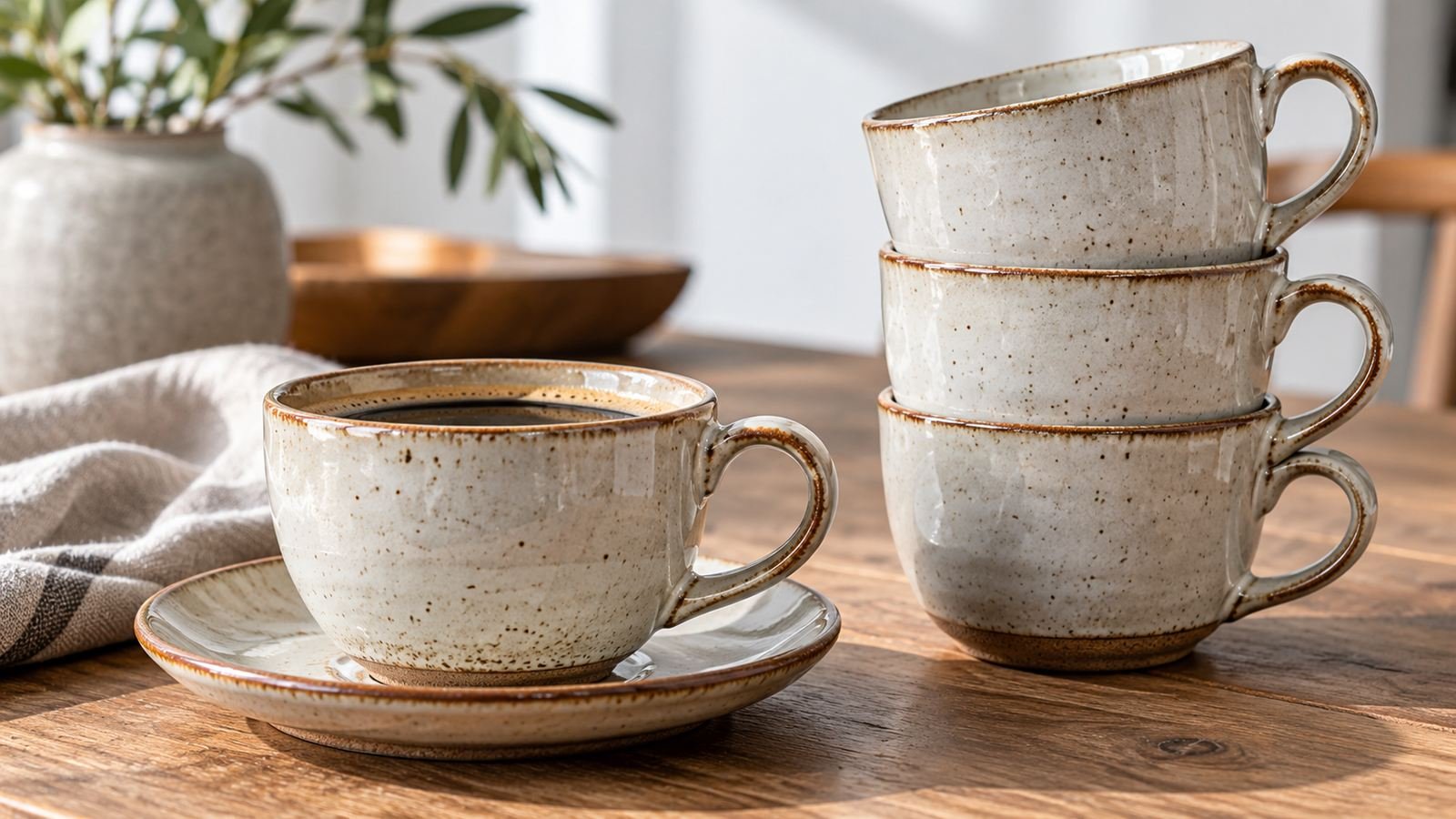
Use an illustrative planning example to expose the arithmetic. If a customer requests 72 pairs and the confirmed packing is 12 cups per carton and 12 saucers per carton, the order requires six cup cartons and six saucer cartons. If you also purchase 24 standalone replacement cups, cup demand rises to eight cartons while saucer demand stays at six. These are hypothetical pack counts that must be replaced with the supplier’s actual specification.
For wholesale ceramic coffee cups, build an assortment by customer role. A distributor serving compact cafes may prioritize a small family with straightforward matching. A supplier to larger venues may need additional shapes or colors. In each case, depth should come from a purchase plan or customer commitment rather than an assumption that all variations will sell evenly.
Keep three demand categories visible: committed customer orders, distributor display or samples, and unallocated purchasing inventory. Do not combine them into a single unexplained quantity. This distinction helps your team negotiate accurately and assess whether an additional carton supports a real need.
Inspect packing requirements alongside component quantities. Ask for the proposed protective arrangement, carton dimensions, and gross weight when available. If cups and saucers travel in separate cartons, ensure carton labels and the packing list allow them to be paired at receiving. For wholesale ceramic coffee cups, clear references are more useful than a generic carton label that leaves staff guessing which customer order the goods belong to.
Confirm Ready Stock Coffee Cups and Replenishment Options
An available assortment can help distributors respond to cafe inquiries, but initial supply and future replenishment are separate decisions. Obtain a dated availability record for the exact item codes and colors. Ask what quantity is available to your proposed order and what action is needed to reserve it. Avoid treating a catalog photograph as proof that the full required assortment is ready.
The ready stock ceramic cup options can support a focused inquiry, particularly when you include accepted alternatives. For wholesale ceramic coffee cups, define the limits of an alternative: capacity range, overall dimensions, matching saucer requirements, and color family. The supplier should seek approval for the specific replacement instead of interpreting those limits as permission to choose any item.
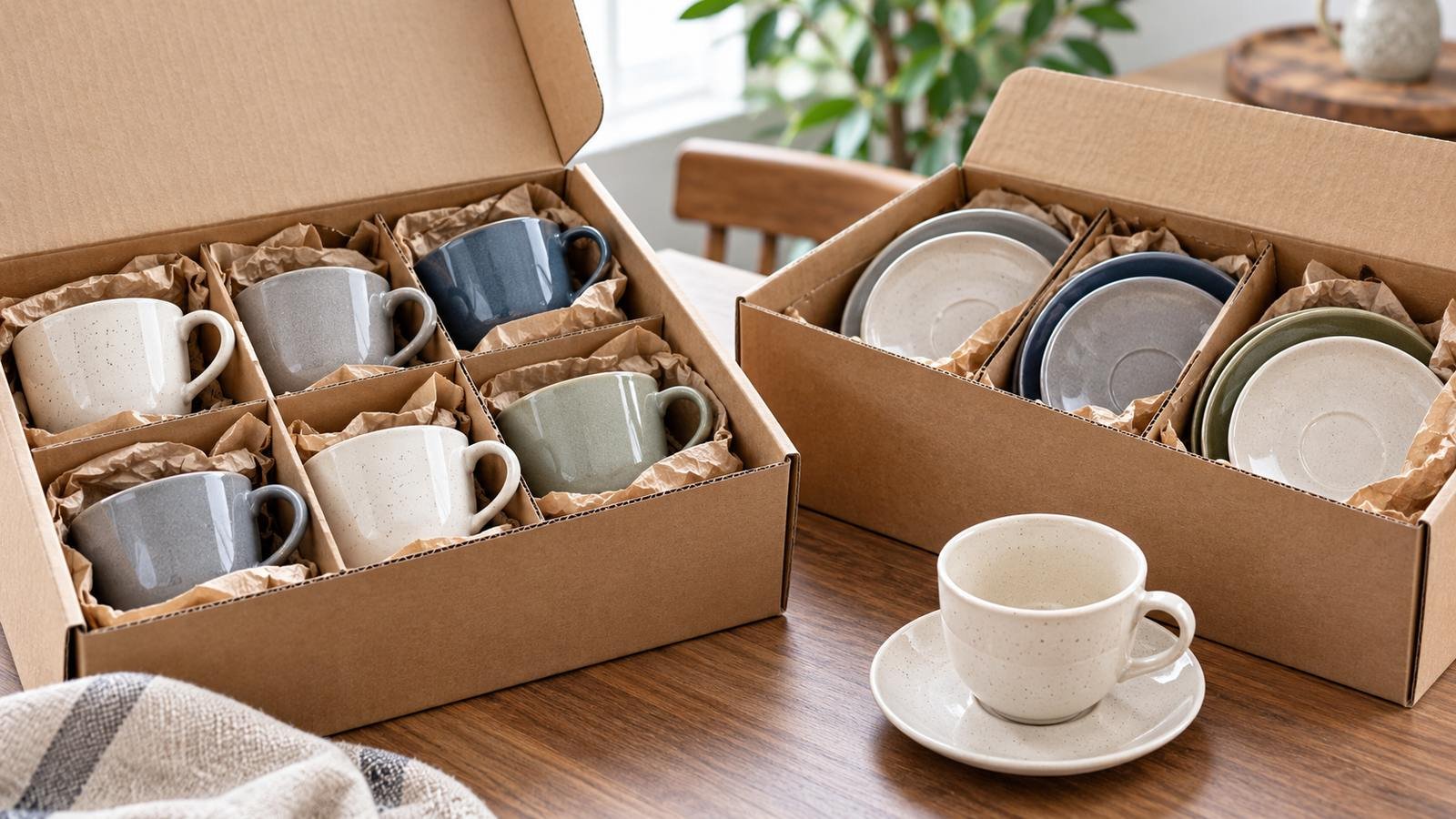
Discuss replenishment in factual terms. Ask whether the supplier can currently offer the same reference again, whether quantities are limited to the present confirmation, and how new availability will be communicated. Do not promise cafe customers uninterrupted continuity unless you have an arrangement that supports the claim. A ready stock model requires regular availability checks as purchasing demand develops.
For wholesale ceramic coffee cups, maintain a reference library with item photographs, dimensions, material description, saucer code, packing, and supplier confirmation date. When a new shipment is offered, compare those details before approving it as a continuation of the earlier item. Similar appearance alone does not confirm matching dimensions or interchangeability.
Before final approval, verify that the order sheet distinguishes pairs from individual pieces and identifies every cup and saucer code. Record the confirmed preparation milestone and the logistics contact. A careful closing check allows your customer service team to give accurate information about the assortment without relying on assumptions made during an earlier sample review.
Conclusion
Wholesale ceramic coffee cups should be selected around confirmed beverage portions, handling needs, and component matching. Use samples to evaluate the exact cup and saucer combination, then convert customer requirements into clear item and carton quantities. Keep current availability separate from future replenishment expectations. Contact Chengguo with your cup specifications, matching requirements, and quantity plan to request current options and a wholesale quotation.
FAQ
Ask cafe customers for their working beverage portion and desired headspace, then compare that request with the supplier’s stated measurement basis. Test the exact sample at the intended fill level and record the result. Capacity names can vary across listings, so retain dimensions as well as volume. A measured customer brief gives wholesale ceramic coffee cups a clearer purchasing specification than an espresso or latte label alone.
Ask the supplier whether separate purchasing is available for the exact references. Confirm cup and saucer codes, available quantities, carton counts, and minimum purchasing quantities individually. Separate components can support a customer’s replacement needs, but they may have different stock positions. For wholesale ceramic coffee cups, the final quote should state whether quantities refer to individual pieces or complete pairs so purchasing and receiving teams use the same interpretation.
Check working capacity, dimensions, handle comfort, base and saucer fit, material description, and product-specific care information. Confirm current stock, packing, component quantities, and reservation terms after sample review. Keep records tied to item codes and approved photographs. For wholesale ceramic coffee cups, these checks help you describe the product consistently to customers and avoid approving a shipment on the strength of a general catalog image.