

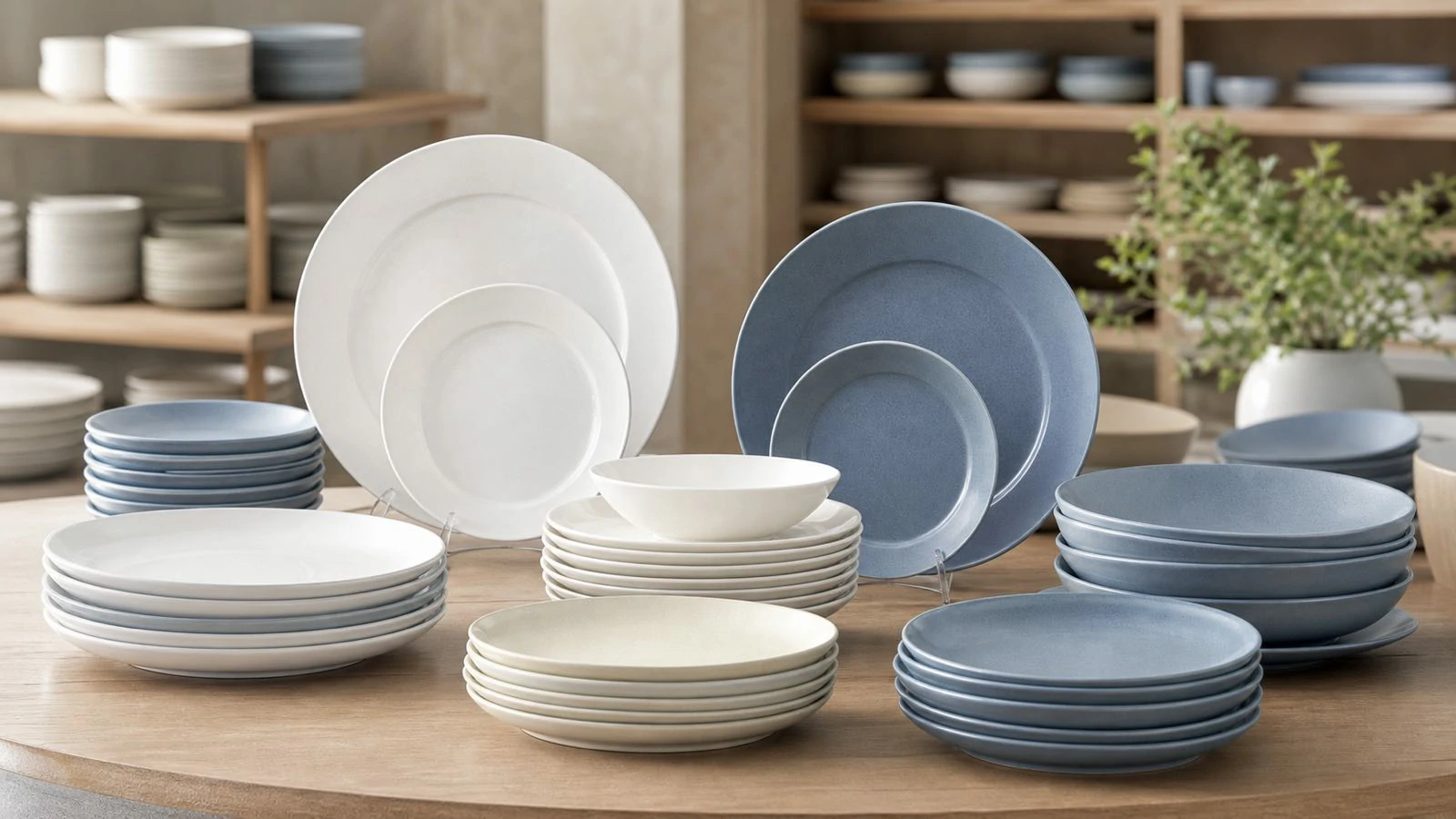
A plate that looks suitable in one photograph may still differ in usable area, weight, glaze, stacking, or packing. Buyers of stock ceramic plates in bulk need a repeatable way to compare products before reserving quantities. These eight checks help importers, wholesalers, distributors, and trading companies evaluate the product and the complete commercial offer without relying on appearance or unit price alone.
Confirm the Plate Specification
Begin with the intended user and selling channel. Restaurant supply, retail sets, open-stock replacement programs, and promotional distribution each place different demands on plate shape, weight, decoration, and packaging. A written specification keeps the supplier and buyer focused on the same product.
1. Check Diameter, Profile, and Usable Area
Nominal diameter is only one dimension. A wide rim reduces the central food area, while a coupe plate can offer more usable surface at the same outside diameter. Request a side-view photograph or profile drawing when the depth and rim angle matter.
Record:
- Outside diameter
- Overall height
- Rim width
- Usable center diameter
- Approximate piece weight
- Foot-ring diameter
Use one measurement method throughout the order. Ceramic dimensions naturally need an agreed tolerance, so ask the supplier to state the expected range rather than treating a single sample measurement as absolute.
Plate profile affects presentation and handling. Rimmed plates provide a defined border; coupe plates provide a continuous curved surface; deeper plates can help contain sauces. Match the shape to the buyer’s customer rather than choosing only by current visual trends.
2. Verify Material, Glaze, and Decoration
Confirm the ceramic body and finish for the exact item code. Do not infer material from color, thinness, or product photography. Ask whether the plate is plain, printed, hand-applied, reactive glazed, or otherwise decorated, and record the approved appearance.
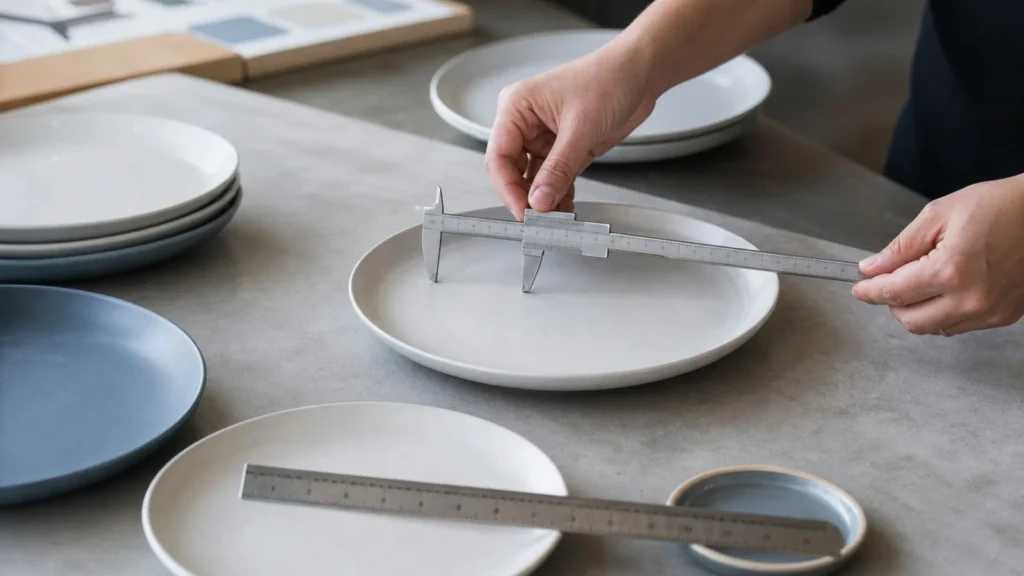
Review glaze coverage on the face, rim, underside, and recessed areas. For plain white plates, compare shade and surface under neutral light. For matte, speckled, or reactive finishes, inspect several pieces to understand the intended range of color and glaze flow.
Decoration should be evaluated for position, continuity, and consistency. If a pattern crosses a rim or uses multiple colors, agree on how normal variation will be judged. An approved sample or dated photo set provides a clearer reference than a general description.
Evaluate Handling and Quality
Stock ceramic plates in bulk pass through warehouses, transport networks, and customer handling. Practical performance depends on shape, finish, packing, and how the plates are used. Physical samples are the most useful way to assess these features.
3. Test Flatness, Stability, and Rim Finish
Place each sample on a clean, level surface and press gently at several points. Observe whether the plate sits steadily. Turn it slowly and inspect the foot ring, then feel the rim and foot for a comfortable, properly finished surface.
Use consistent light to examine:
- Visible surface appearance
- Rim smoothness
- Foot finishing
- Glaze application
- Decoration alignment
- Stability on a flat surface
Avoid judging every decorative style by identical visual criteria. Natural variation may be part of a reactive or handcrafted-looking design, while plain commercial whiteware generally aims for a more uniform appearance. The important step is to document the acceptable reference.
4. Check Weight, Balance, and Stackability
Piece weight influences customer perception, manual handling, carton weight, and shipping efficiency. Weigh several samples rather than relying on one value. Hold the plate at the rim and from underneath to understand its balance in normal service.
Build a practical stack. Check whether the plates sit evenly, whether contact points could mark decorated surfaces, and how tall a normal stack becomes. Hospitality buyers should consider shelf, trolley, and dish-area space. Retail buyers should check whether the stack fits the proposed inner box.
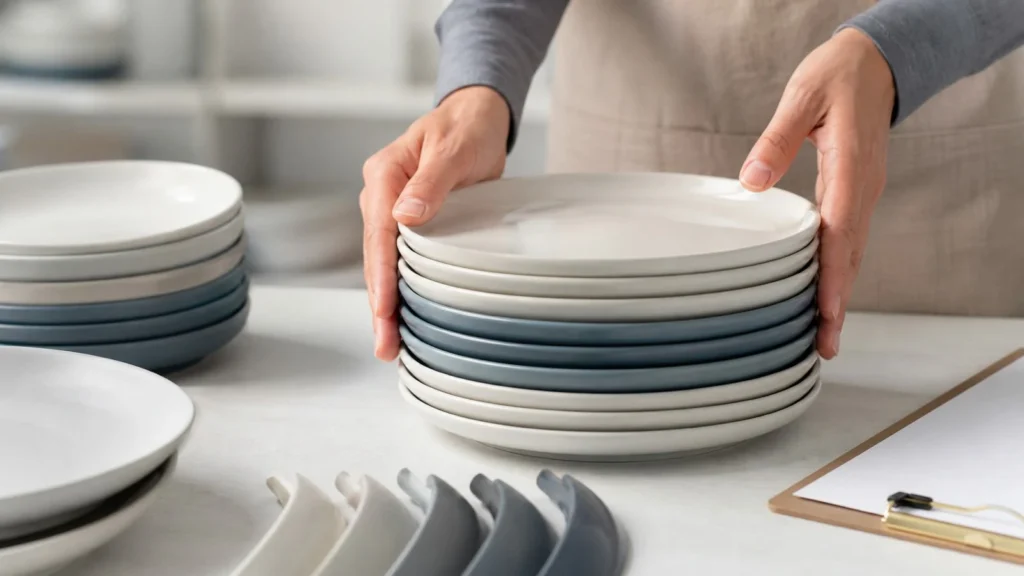
Measure the height of a defined stack, such as six or twelve pieces, and keep the method in the sample record. This gives packing and warehouse teams a useful reference. If plates are expected to nest closely, check that they can be separated comfortably.
Verify the Commercial and Packing Plan
A technically suitable plate still needs workable availability, quantities, cartons, and documents. These checks turn a shortlist into a confirmable order.
5. Confirm Available Quantity and Packing Increment
Ask for current availability by item code, size, design, and color. Similar products displayed together may have different quantities. When building a coordinated assortment, confirm each line separately.
Stock is not necessarily reserved during an informal enquiry. Ask which step reserves the selected quantity and how long the quotation remains valid. Keep an alternative for any critical product so the order can proceed if availability changes.
Plate orders usually need to follow complete inner-box or carton quantities. Request pieces per inner pack, packs per carton, carton dimensions, gross weight, and net weight. Calculate the planned order in both pieces and cartons:
| Order field | Buyer check |
| Item code | Matches sample and quotation |
| Available pieces | Confirmed for the selected design |
| Pieces per carton | Used to round order quantities |
| Planned cartons | Based on sales and freight plan |
| Total pieces | Cartons multiplied by packing quantity |
Compare current stock ceramic dinner plates by size and design, then place matching bowls or mugs from the wider ready stock ceramic dinnerware selection into a separate line-by-line plan.
6. Review Protective and Retail Packing
Packing should be designed for the specific plate profile, decoration, route, and handling conditions. Ask to see the proposed inner protection, dividers, cartons, and any retail packaging during the sample or order-review stage.
Confirm whether the order uses bulk export cartons, inner boxes, color boxes, or complete sets. Retail packaging changes carton dimensions, cost, artwork approvals, labels, and barcodes. The final quotation should make optional packaging costs visible.
Request a packing specification that includes:
- Pieces per inner box and carton
- Divider or protective material
- Carton dimensions
- Estimated gross and net weight
- Shipping marks
- Retail label or barcode placement
Do not assume that a carton used for one plate shape will suit another. Coupe, rimmed, square, and irregular profiles can require different spacing and protection.
Control the Order Before Shipment
The last two checks cover compliance, documents, inspection, and logistics. They help ensure that the physical order and the paperwork describe the same goods.
7. Define Testing, Inspection, and Acceptance Criteria
Testing requirements depend on the destination, intended food-contact use, ceramic body, glaze, decoration, and buyer policy. State the required standard or test scope in the enquiry. Ask whether available supporting documents apply to the specific item under review.
Inspection instructions should be measurable. Identify the item codes, quantity checks, dimensional method, visual reference, packing points, and report format. For a first order or a mixed assortment, a more detailed pre-shipment review may be appropriate.
Agree on how observations will be classified and discussed. A phrase such as “good quality” is difficult to apply consistently; an approved sample, measurement range, photo reference, and packing specification are far more useful.
8. Reconcile Price, Documents, and Shipping Details
Compare quotations only when they use the same product, quantity, packing, trade term, and named port or place. Convert set pricing to a per-piece basis when necessary and separate optional charges.
Before dispatch, reconcile:
- Item codes, materials, sizes, colors, and finishes
- Quantity per item and total quantity
- Unit prices and total value
- Carton count and packing configuration
- Labels, barcodes, and shipping marks
- Trade term and named destination
- Required commercial and transport documents
- Inspection record and approved reference

Ready stock removes the manufacturing stage, but selection, sampling, packing, inspection, export preparation, and transport booking still need coordination. Build the schedule around the confirmed order and shipping arrangement rather than a general estimate.
Conclusion
Buying stock ceramic plates in bulk is more predictable when buyers check the complete product and order system. Confirm dimensions and usable area, record the finish, test handling and stacking, verify availability, review packing, define inspection, and reconcile documents before dispatch. These checks protect range consistency and make supplier quotations easier to compare. Browse available plate styles or request a plate quotation with your sizes, quantities, destination, and required timing.
FAQ
Confirm outside diameter, overall height, rim width, usable center area, foot-ring diameter, and approximate piece weight. If the plate is deep or strongly curved, request a side view and check internal depth. Use a consistent measurement method and agree on a practical tolerance. These details make products with similar nominal sizes easier to compare.
One sample can confirm basic shape and dimensions, but several pieces give a better view of weight, flatness, glaze, decoration, and expected variation. This is especially useful for reactive or handcrafted-looking finishes. Record measurements and photographs of the approved reference, and connect that record to the supplier item code used in the order documents.
Mixed designs may be possible when each item is available and the quantities follow practical packing increments. Confirm availability, pieces per carton, carton dimensions, and price for every line. Build the assortment around expected sales rather than ordering equal quantities automatically. A detailed packing list helps the buyer track each design through shipment and receiving.