


Quality discussions become clearer when buyers and suppliers use observable criteria instead of broad descriptions. Ceramic tableware quality checks should cover dimensions, handling, appearance, decoration, stacking, packing, and the records used for approval. This guide gives importers, wholesalers, distributors, and trading companies a seven-part sample evaluation process that can be adapted to plates, bowls, mugs, cups, saucers, and serving pieces.
Prepare a Repeatable Sample Review
Before checking individual products, create a controlled review method. Use a clean, level work surface, neutral lighting, basic measuring tools, a scale, and a camera. Assign each sample its supplier item code so photographs and measurements cannot be confused later.
Review more than one piece when possible. A single sample shows the basic design, but several pieces reveal the expected range of weight, glaze, decoration, and dimensions. The number required depends on the product and the buyer’s risk, but the method should remain consistent.
Create a record with:
- Supplier and item code
- Product description and material
- Date received
- Sample quantity
- Intended market and use
- Measurement method
- Photographs from consistent angles
- Notes, questions, and approval status
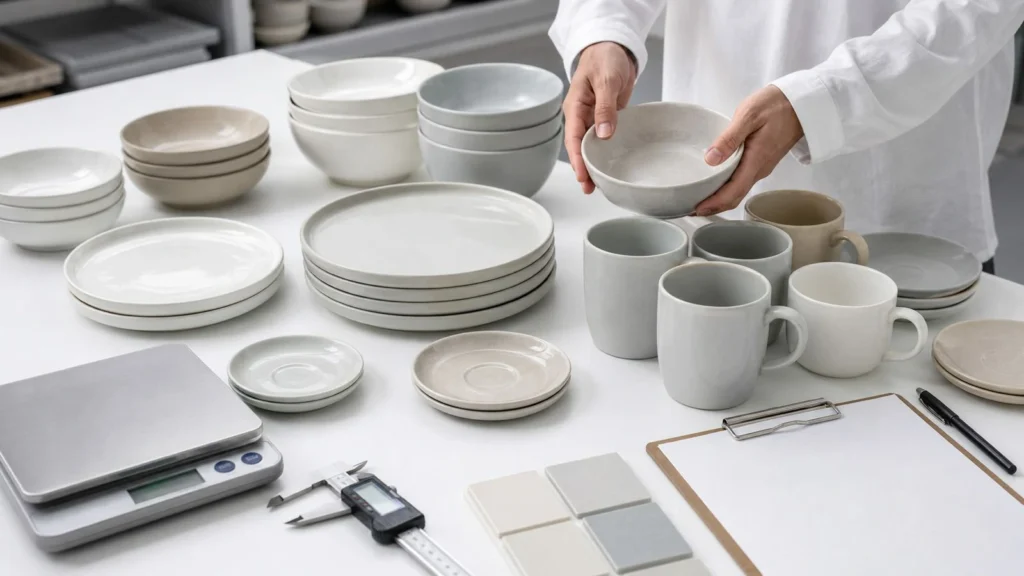
Define what the sample is meant to confirm. A styling sample may not represent final packing; a packing sample may not represent every glaze variation. If the supplier changes the product, decoration, or packing after approval, update the record and identify the current reference.
The following ceramic tableware quality checks are most useful when both sides agree on how observations will be made and recorded.
Check Dimensions, Stability, and Handling
Physical measurements and handling affect product fit, set coordination, packing, and customer experience. These first checks establish whether the item matches the buying specification.
1. Measure Dimensions, Capacity, and Weight
Measure diameter, height, foot ring, and other critical dimensions with a consistent tool and method. For mugs and cups, define whether capacity is measured to the brim or to a practical fill line. For bowls, measure both outside dimensions and usable internal depth when food volume matters.
Weigh several pieces and record the range. Weight affects hand feel, carton limits, shipping calculations, and how items combine in a set. A supplier’s stated value may be approximate, so the buyer and supplier should agree on an appropriate tolerance for the actual product.
Use a simple measurement table:
| Feature | Method | Buyer purpose |
| Diameter | Across agreed outside points | Fit and set coordination |
| Height/depth | On a level surface | Capacity and packing |
| Capacity | Agreed fill method | Serving expectation |
| Piece weight | Calibrated scale | Handling and carton planning |
| Foot ring | Across outside edge | Stability and stacking |
Do not compare products using different methods. A mug measured to the brim cannot be compared directly with one measured to a normal fill level.
2. Check Stability, Balance, Rims, and Handles
Place plates and bowls on a level surface and press lightly at several points to check stability. Inspect the foot ring for a properly finished contact surface. Hold each piece as a customer or service worker would.
For cups and mugs, hold the handle with different hand positions. Review the handle opening, joint areas, balance when empty, and balance with a safe test fill. For serving pieces, check whether weight distribution feels manageable.
Run a finger carefully around rims, foot rings, and handle joins. The surfaces should match the agreed product reference and be comfortable in normal handling. Record observations with close photographs rather than relying on memory.
Review Glaze, Color, and Decoration
Appearance should be assessed under consistent conditions. Warm or colored lighting can change the perceived shade of white, cream, blue, and reactive glazes. Compare samples together against the agreed visual reference.
3. Inspect Glaze Coverage and Surface Appearance
Review the face, rim, underside, recessed areas, and handle joins. Tilt glossy pieces under the light to observe the surface from several angles. For matte finishes, inspect texture and color continuity without expecting the reflections of gloss ware.
Different design styles require different acceptance references. Plain white dinnerware is generally evaluated for a uniform commercial appearance. Reactive or handcrafted-looking glazes intentionally vary in tone, speckling, edge effect, and flow. The buyer should review enough pieces to understand that range.
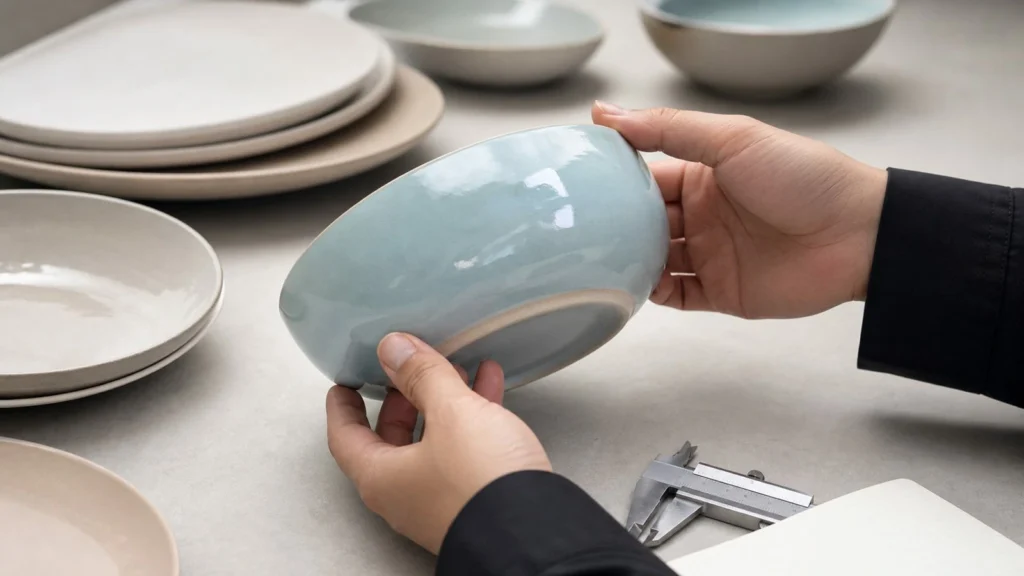
Record:
- Base color under neutral light
- Gloss or matte level
- Edge and rim appearance
- Speckling or reactive variation
- Coverage in curves and recessed areas
- Agreed reference photographs
Avoid vague color names as the only reference. “Blue,” “ivory,” or “gray” can cover a wide range. A physical sample, controlled photo, or agreed color reference is more useful.
4. Verify Decoration Position and Consistency
For printed, banded, or patterned tableware, check placement relative to the rim, center, handle, or other fixed point. Compare several pieces for alignment and continuity. Where a design crosses a curve, inspect whether the appearance remains acceptable from normal viewing angles.
Record which visual differences are intended and which require review. Hand-applied decoration may naturally vary, while a geometric border may need tighter alignment. The supplier and buyer should connect the acceptance reference to the specific item code and decoration.
Testing requirements can depend on the ceramic body, glaze, decoration, use, and destination market. State the relevant test scope in writing and ask what product-specific supporting documents are available. Do not assume a report for one decoration automatically applies to another.
Test Stacking and Product Coordination
Tableware is usually stored, packed, displayed, and used in groups. Individual inspection should therefore be followed by a system check.
5. Assess Stacking, Nesting, and Set Compatibility
Build a practical stack of plates or bowls and view it from the side. Check alignment, stack height, contact points, and how easily pieces separate. A stable individual plate may still create an uneven stack if profiles vary.
For bowls, confirm whether foot rings or bases contact glazed internal surfaces. For decorated plates, consider whether stacking contact can affect the visible decoration during handling. For mugs, check how handles influence carton arrangement and shelf space.
Place coordinated items together. Verify that dinner plates, side plates, bowls, cups, and saucers share the intended color, proportion, and design language. If items come from different stock groups, confirm that any shade difference is commercially acceptable.
Browse stock ceramic dinnerware as complete assortments and compare bowl profiles in the stock ceramic bowls category. Record the exact combination rather than assuming similarly named colors will match.
Verify Packing and Order Controls
Product quality can be compromised if the packing specification and approval records are unclear. The final checks connect samples to cartons, inspection, and commercial documents.
6. Review Inner Packing and Carton Configuration
Ask the supplier to demonstrate the proposed packing for the actual product shape. Confirm inner protection, dividers, pieces per pack, packs per carton, carton dimensions, gross weight, and net weight.
Retail boxes require additional checks:
- Correct set composition
- Product fit inside the box
- Artwork version
- Barcode and label placement
- Inner protection
- Master-carton quantity
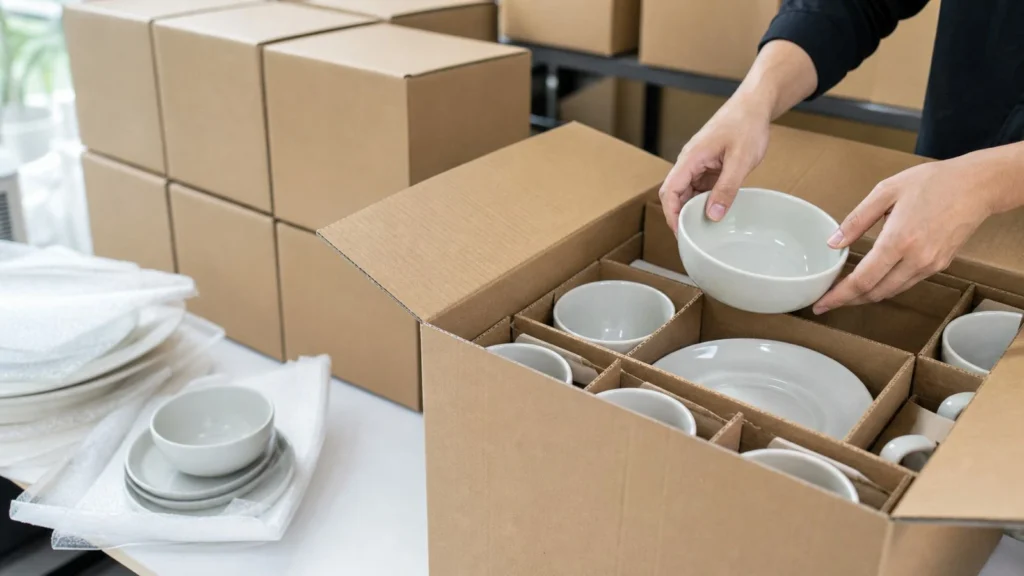
An attractive retail box is not sufficient if products move excessively inside it. Conversely, heavy packing can increase volume and cost. The packing approach should balance protection, presentation, and shipping efficiency for the chosen route.
7. Create an Approval and Inspection Reference
Consolidate accepted specifications into one current record. Include item codes, descriptions, dimensions, weights, photos, glaze or decoration reference, packing details, labels, and required documents.
Before shipment, inspection instructions should state what will be checked, the sampling method or scope, who will perform the check, and what report is expected. Acceptance criteria should be measurable wherever possible.
Reconcile the inspection record with the final invoice and packing list:
- Item codes and descriptions
- Material, color, and finish
- Quantity by item
- Packing configuration
- Carton count and marks
- Approved sample reference
- Required supporting documents
If a change is accepted, update every affected document. Conflicting versions create more risk than a clearly documented revision.
Conclusion
Ceramic tableware quality checks work best as a documented sequence, not a quick visual judgment. Measure the product, test handling, review glaze and decoration, assess stacking, inspect packing, and create one approval reference for the order. The method should reflect the product style and destination requirements rather than imposing identical visual expectations on every ceramic finish. Explore available products or contact our team to discuss samples, specifications, and a wholesale quotation.
FAQ
A level work surface, calipers or a suitable ruler, a reliable scale, a capacity measuring vessel, neutral lighting, and a camera cover most basic checks. Buyers may also use an agreed color reference. The important point is consistency: record the tool and method so later samples or shipment checks can be compared on the same basis.
Review several pieces together to understand the intended range of tone, speckling, edge effect, and glaze flow. Do not judge a reactive finish by the uniformity expected from plain whiteware. Agree on physical samples or controlled photographs that show acceptable variation, then use that reference during order approval and any pre-shipment inspection.
Yes. Confirm pieces per inner pack and carton, protective materials, dividers, carton dimensions, and estimated weight. If retail boxes are used, verify set composition, fit, artwork, barcode placement, and master-carton quantity. Product approval without packing approval leaves an important part of transport and receiving risk undocumented.