


Testing a new product is most useful when the buyer knows what the test is meant to prove. Ready stock ceramic tableware trial orders can help wholesalers, retailers, and distributors assess demand without beginning with a broad permanent range. This guide shows how to define a test, choose a focused assortment, convert quantities into cartons, collect meaningful results, and decide whether to reorder, adjust, or stop.
Define the Product Test Before Selecting Items
A trial order should answer a commercial question. “Will customers buy this?” is too broad to guide product selection. A stronger question identifies the audience, channel, product difference, and decision that will follow. For example: will independent homeware stores reorder an earth-tone coupe dinner plate at the planned wholesale price, or will cafe accounts prefer a smaller neutral plate with a stronger rim?
Write one primary hypothesis for each product group. The hypothesis may concern shape, color, price position, use, packaging, or channel. Avoid changing several variables at once unless the goal is to compare complete concepts. If two bowls differ in size, glaze, decoration, and price, sales results will not reveal which difference mattered.
Define the test period and the minimum evidence needed. A retailer may need a fixed number of weeks across comparable stores, while a distributor may need feedback from a defined group of accounts. Seasonal promotions require a different review window from an everyday replenishment line. Record the timeline before inventory arrives so slow setup does not consume the entire test period.
Select metrics that can lead to an action:
- Units sold and sell-through by item and location.
- Gross margin after inbound and local handling costs.
- Number and reason for returns or damages.
- Customer questions about size, color, use, or care.
- Reorder requests from wholesale accounts.
- Remaining stock and weeks of coverage at the review date.

Build a Focused Ready Stock Trial Assortment
The purpose of a trial is clarity, not maximum variety. Too many items divide demand into small groups and create shallow results. Choose products that represent distinct, relevant options. Each line should have a reason to be included, such as testing a size, serving use, color family, or target customer.
Start with the role in the assortment. A ready stock ceramic plates trial might include an everyday dinner plate, a smaller cafe plate, and one presentation-led shape. That structure is more informative than selecting three visually similar plates because they happen to be available.
Control the Variables You Can
Keep price architecture understandable. If one item is significantly more expensive, decide whether the test concerns style or willingness to pay. Use consistent photography and comparable placement where possible. When store exposure differs, record it; a product placed at eye level cannot be compared fairly with one left in a lower corner.
| Trial element | Define before ordering | Review after launch |
| Target customer | Channel and buyer profile | Which group actually purchased |
| Product hypothesis | Shape, use, color, or price question | Evidence supporting or rejecting it |
| Selling price | Planned price and margin | Realized price and discounting |
| Placement | Stores, pages, or accounts | Exposure differences |
| Test period | Start date and review date | Delays or seasonal effects |
| Decision rule | Reorder, revise, or stop threshold | Final action and explanation |
Samples can eliminate unsuitable options before the commercial order. Check proportions, weight, hand feel, glaze appearance, and compatibility with the intended setting. Photograph the sample under normal sales lighting and test it with the relevant food or drink when appropriate. Link the approved sample to the exact item code.
Do not treat a sample as proof of current bulk availability or packing. After approval, request fresh confirmation of saleable pieces, full-carton quantities, price basis, and timing. If availability changed during evaluation, decide whether the remaining quantity still supports a valid test.
Set Quantities That Produce Usable Results
A small order is not automatically a good test. The quantity must be large enough to reach the intended stores or accounts and remain available during the test period. At the same time, it should fit the buyer’s acceptable inventory exposure. Work backward from distribution rather than starting with an arbitrary piece count.
Suppose a retailer wants to test one plate in eight stores with 12 display and sale units per store plus a central replenishment quantity. The opening requirement is at least 96 pieces before adding the planned reserve. If the product is packed 24 pieces per carton, the buyer can translate the total into whole cartons. These figures are only a planning example; use confirmed packing for the selected item.
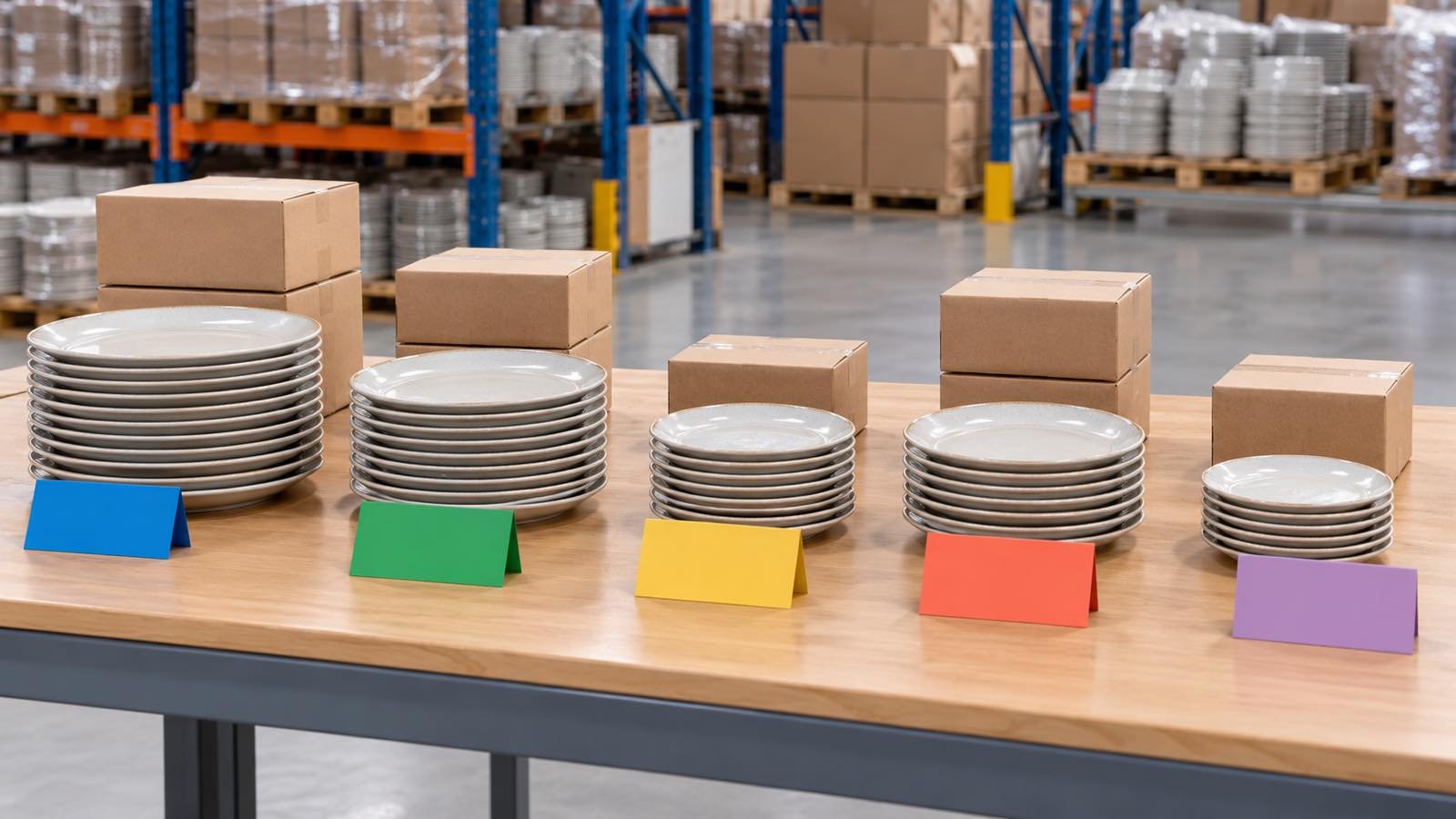
Calculate each line independently:
- Opening units per test location or customer.
- Number of participating locations or customers.
- Central reserve and any approved sample allowance.
- Total required pieces.
- Whole cartons based on confirmed pieces per carton.
- Final confirmed saleable quantity and inbound allocation.
Mixed product trials need controlled breadth. A shipment containing plates, bowls, and wholesale ceramic mugs may support a useful category test, but every item has its own carton multiple and sales rate. Do not allocate equal cartons merely for symmetry. Allocate quantities to the test design and record why the depth differs.
Include all relevant costs when setting the test margin. Allocate international freight, duties or taxes applicable to the buyer’s market, local transport, labeling, photography, marketplace fees, and local repacking. An item can generate attractive unit sales but fail the commercial test if handling costs remove the planned margin.
Plan receiving before the goods arrive. Assign internal codes, prepare location allocations, and tell the warehouse which cartons are part of the trial. If test units are mixed with existing stock without traceability, later sales data may be unreliable. Preserve the supplier code as a reference even if the buyer uses a different local code.
Measure Results and Prepare the Next Decision
Launch all participating locations within a controlled window when possible. Record stock on hand, date available for sale, display position, price, and promotion. For wholesale account tests, record which customers received the offer and whether they saw samples, photos, or both. Lack of exposure should not be misread as lack of product demand.
Review interim results without changing the experiment impulsively. A price reduction, new photograph, or wider distribution can be a useful second phase, but note the date so results before and after the change remain distinguishable. Keep qualitative comments in categories such as size, shape, color, perceived value, and intended use.

At the review date, compare products on several measures:
- Demand: sell-through, repeat requests, and account conversion.
- Economics: realized margin, handling, and discount requirements.
- Operations: receiving, storage, picking, and packing effort.
- Product response: feedback, returns, and reasons for nonpurchase.
- Supply fit: remaining current availability and alternative designs.
Use an explicit next action. Reorder when the evidence and current supply support it. Revise when demand exists but size, presentation, price, or channel needs adjustment. Stop when the product does not meet the predefined commercial threshold and additional testing is unlikely to answer a different question.
A successful ready stock trial does not guarantee unlimited continuity. Reconfirm the item and quantity as soon as the decision criteria are met. If the exact design is no longer available, return to the original hypothesis. A substitute can be tested if it preserves the important attributes, but it should not be presented internally as the same product without review.
Document the final lesson, including unsuccessful results. Note the audience, product attributes, price, exposure, test period, quantities, and decision. This record improves the next assortment and prevents a future buyer from repeating a test without understanding what was already learned.
Trial orders also help refine supplier communication. After the test, the buyer can provide a more precise request: preferred diameter, acceptable glaze families, target carton depth, price position, and realistic reorder quantity. This turns one trial into a stronger basis for future stock selection.
Conclusion
Ready stock ceramic tableware trial orders work when they begin with a defined hypothesis, a focused assortment, and measurable decision rules. Convert distribution needs into confirmed carton quantities, track every line separately, and include logistics and handling in the margin. Review demand alongside operational fit and current availability before scaling. Contact Chengguo with your target channel, product criteria, trial quantities, and destination to discuss available stock options.
FAQ
There is no universal number. Include only enough designs to test clearly different hypotheses while meeting confirmed carton and order requirements. Too many shallow lines can make results difficult to interpret and add warehouse work. Start with defined customer groups, uses, or price positions, then assign each selected design a specific role.
Samples are useful for checking size, feel, color, finish, and basic presentation before committing to commercial quantities. A sample does not replace confirmation of the bulk item, current availability, packing, or order terms. Keep the sample record linked to the exact item code and compare representative received goods with the approved reference.
Set the review and reorder rules before launch. Consider sell-through, margin, returns, customer feedback, remaining coverage, and current supplier availability. Reconfirm stock early because a successful test does not guarantee that the same quantity will remain available. A reorder decision should reflect both demand evidence and the realistic replacement options.