

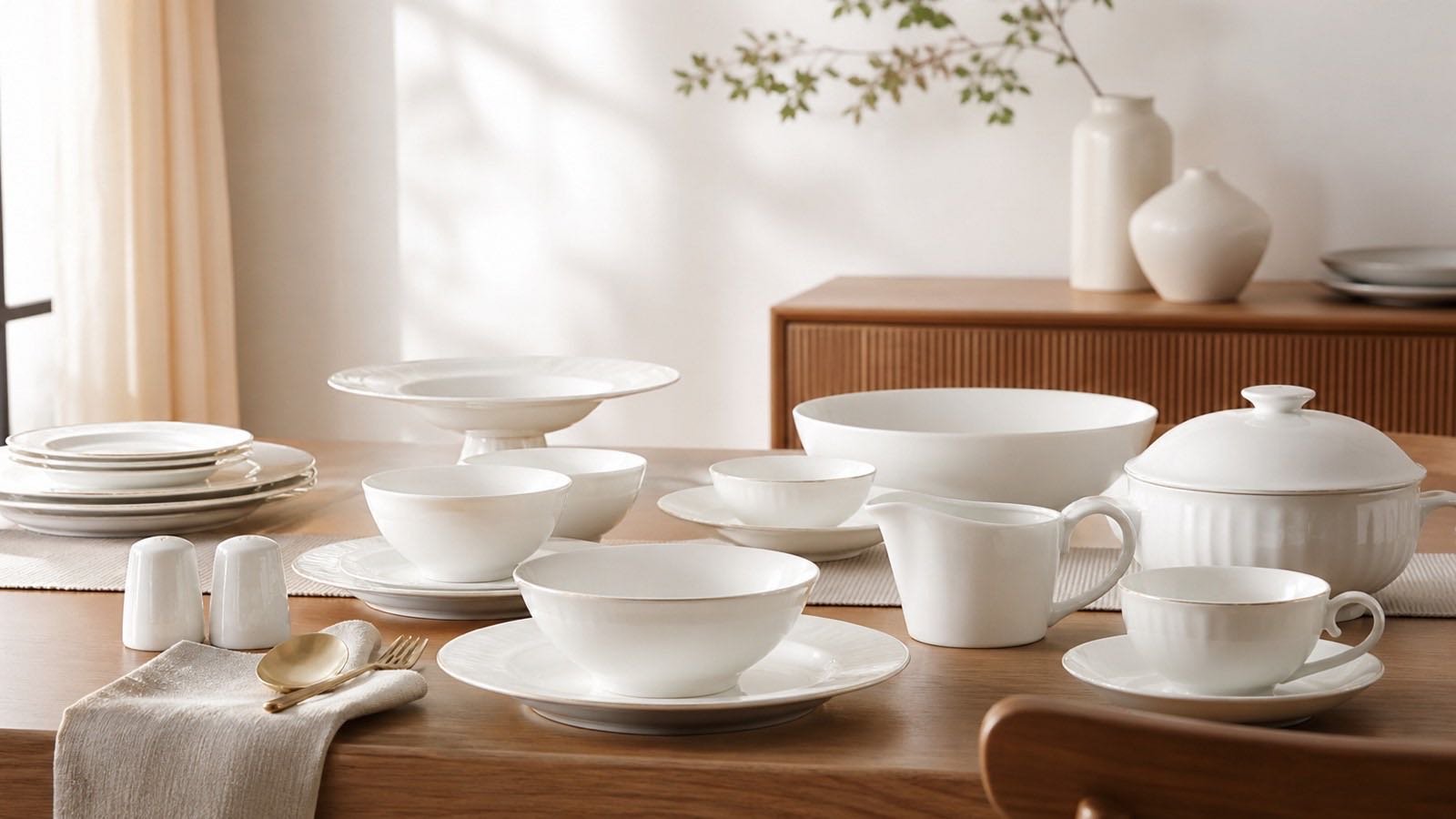
New Bone China attracts buyers who want elegant, light-looking tableware with a warm white character. The name, however, should not be treated as a complete specification or confused with traditional bone china. This guide shows ceramic tableware buyers how to evaluate New Bone China as a finished product, plan suitable ranges, review decoration and care, compare samples, and prepare a practical wholesale order.
Understand the New Bone China Category
New Bone China is a ceramic body category used for refined dinnerware, drinkware, and serving pieces. It is distinct from traditional bone china and should be described accurately in quotations, packaging, and sales materials. Formulations and commercial definitions can vary, so buyers should request product-specific information instead of assuming that the name proves a fixed composition or performance level.
The buyer’s first task is to separate category expectations from observable evidence. A finished piece may offer a warm light color, a smooth glazed surface, relatively fine proportions, and a lighter hand feel. These qualities depend on the actual body, firing, form, thickness, glaze, and quality control.
Build the specification with:
- supplier item reference and material description;
- dimensions, capacity, and piece weight;
- glaze color and finish;
- decoration method and placement;
- care guidance for the exact item;
- carton pack, dimensions, and gross weight;
- applicable product documentation for the destination market.
This prevents the material name from becoming a substitute for detailed purchasing information.
Evaluate Color Translucency Weight and Form
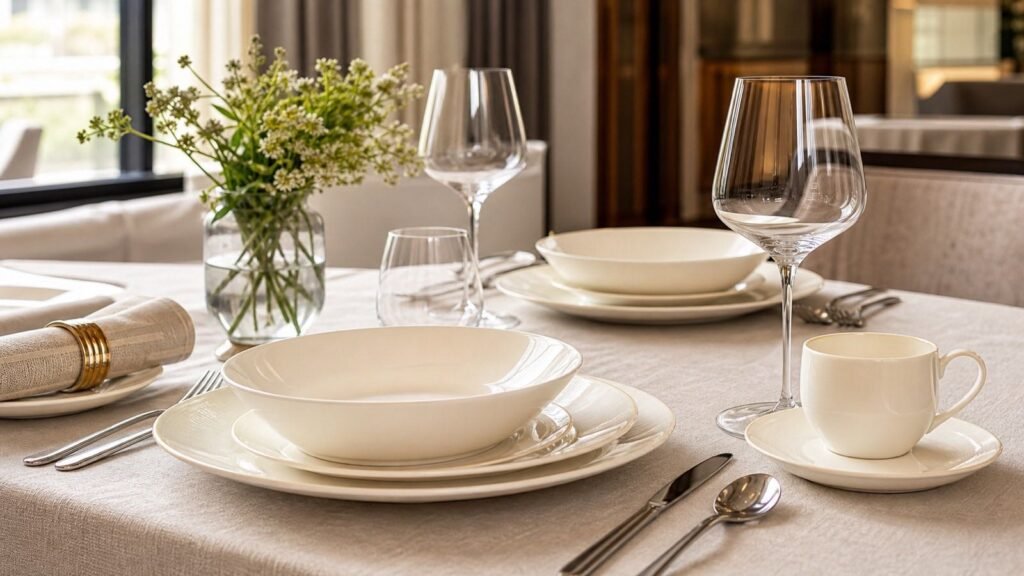
New Bone China is often selected for its visual refinement. Compare samples in natural daylight and in the lighting used by the target retailer, hotel, or restaurant. Warm white tones can coordinate beautifully with neutral interiors and colored textiles, but they may not match bright white porcelain already in a customer’s range.
Translucency is most visible on thinner sections held safely near a light source. It can contribute to a delicate appearance, yet buyers should avoid using it as the only quality test. A practical decision also considers weight, balance, rim profile, handle comfort, stability, and stacking.
For plates, inspect whether the center lies flat, whether the foot is even, and how the rim feels when carried. For bowls, compare usable capacity with external dimensions and check spoon access. For cups and mugs, hold a filled sample, review the handle opening and attachment, and test whether the rim supports the intended beverage experience. For serving pieces, consider table footprint and lifting points.
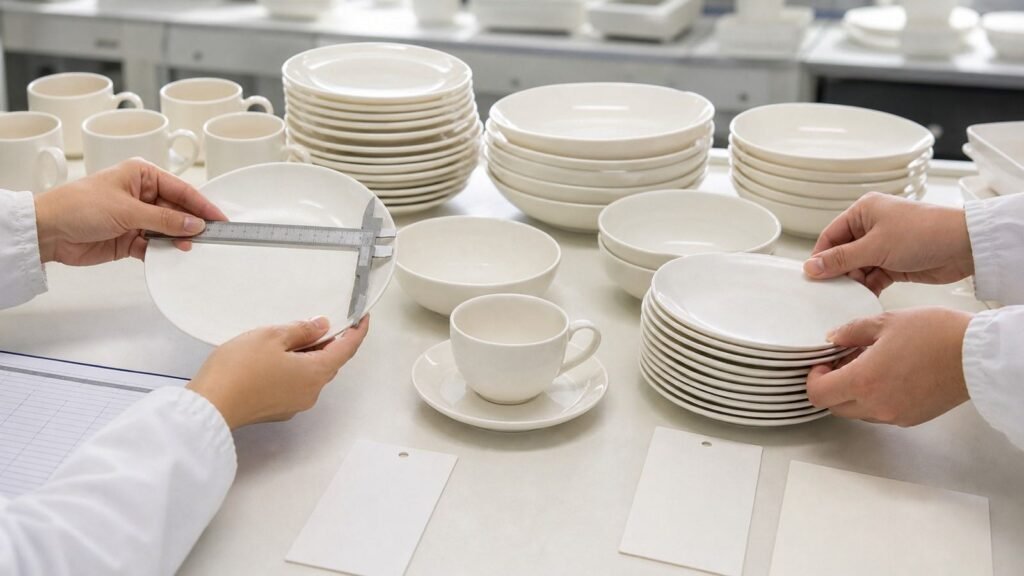
Measure several pieces and record nominal dimensions. Ceramic products can show controlled variation, so the goal is to define a commercially workable range. If items must fit lids, racks, gift-box inserts, or existing saucers, identify those interfaces as critical dimensions.
Compare New Bone China with Other Tableware Bodies
New Bone China is frequently considered alongside porcelain, stoneware, and traditional bone china. The right choice depends on customer positioning, application, range depth, and price architecture.
| Body direction | Typical visual impression | Potential range role | Buyer focus |
| New Bone China | Warm, light, refined | Elegant dinnerware and drinkware | Exact material description, weight, coordination |
| Porcelain | Clean, versatile, white | Broad core ranges and hospitality | Form, rim, glaze, stackability |
| Stoneware | Substantial, tactile, expressive | Casual and lifestyle collections | Weight, glaze variation, merchandising |
| Traditional bone china | Light, translucent, premium | Formal dining, tea, and gifts | Composition description, decoration, care |
This table describes common buying impressions, not guaranteed properties. Compare finished samples designed for the same use and price segment. A well-proportioned porcelain cup may be lighter than a thick New Bone China mug; a stoneware plate may be the better commercial fit for a rustic restaurant concept.
Use customer language carefully. Product listings, invoices, and packaging should distinguish New Bone China from traditional bone china. Clear naming supports trust and prevents channel confusion.
Review ready stock ceramic tableware as complete item families. Check whether the material, white tone, and design remain coordinated across dinner plates, side plates, bowls, cups, saucers, and serving pieces.
Choose Shapes for Retail and Hospitality
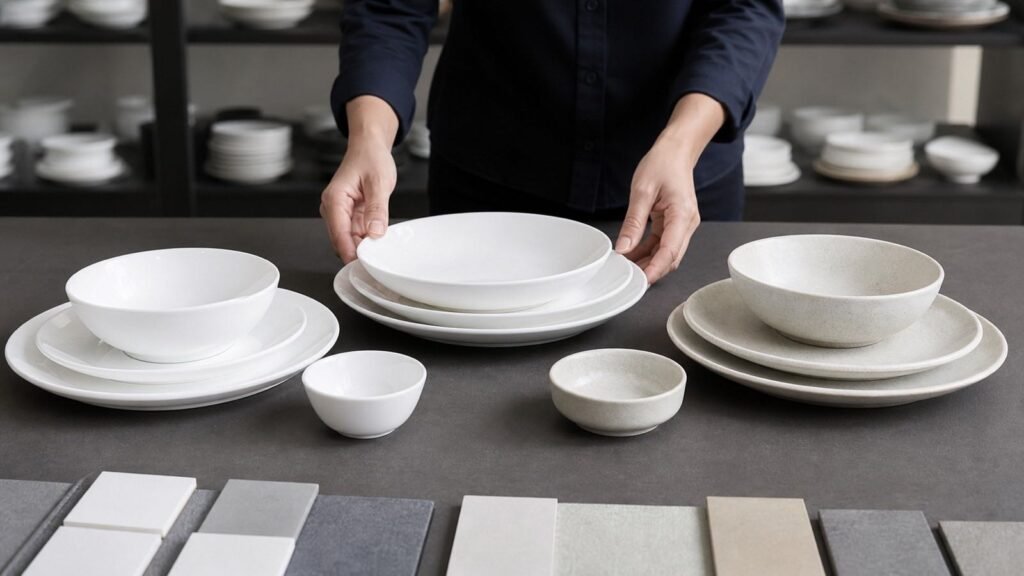
New Bone China can serve multiple channels when the form is matched to use. Retail dinner sets benefit from coordinated silhouettes and a clear set-building path. Start with dinner and side plates, a versatile bowl, and a cup or mug; add serving pieces only when they support the target basket size.
Hotels and restaurants should prioritize operations. Fine proportions may fit premium service, but pieces still need stable feet, manageable stacks, compatible racks, and practical replacement plans. Test a loaded service tray and the actual washing process. A dramatic wide rim may look elegant while consuming too much table or rack space.
Tea and coffee programs deserve focused attention. Cup capacity should reflect the beverage recipe, not a generic label. Match the cup and saucer physically, check the well and foot fit, and evaluate handle comfort with a filled cup. For mugs, browse compatible wholesale ceramic mugs and compare piece weight, rim feel, and carton data.
For e-commerce, parcel protection and accurate photography become important. Warm white color can shift under different lighting, so use controlled photography and consistent color references. List dimensions, capacity, and piece weight clearly, and avoid promises not supported by the product specification.
Review Glaze Decoration and Care
The glaze contributes sheen, touch, and cleaning behavior. A clear glossy glaze can emphasize the body’s light appearance, while colored glazes create a different design direction. Inspect surfaces at an angle under strong light to see coverage, texture, and normal firing character.
Decoration adds commercial value but also introduces evaluation points. Check color, registration, position, continuity around curved surfaces, and consistency across shapes. A motif may appear balanced on a dinner plate but crowded on a small cup. Build a full visual set before approving production or a stock assortment.
Special effects require specific care information. Metallic rims or details may not suit microwave use and may require gentler washing. Decoration in high-contact areas can face more utensil interaction. Obtain guidance for the exact design rather than copying instructions from another item.
Where food-contact or other regulatory requirements apply, verify the current destination-market rules and the exact scope of supporting reports through qualified providers. Body, glaze, decoration, and market can all affect what evidence is relevant.
Inspect Samples and Define Acceptance
Sample evaluation should be repeatable. Use several representative pieces and a written scorecard:
- confirm item reference and stated material;
- measure diameter, height, capacity, and weight;
- compare color in consistent lighting;
- inspect rim, foot, glaze, and decoration;
- check stability on a level surface;
- stack the planned working quantity;
- test actual food or beverage service;
- run the intended washing and storage workflow;
- review carton and inner-pack information;
- retain labeled approved references.
Quality criteria should distinguish critical functional issues from acceptable ceramic variation. Write observable requirements for stability, edge condition, decoration placement, glaze coverage, count, and carton integrity. If the design intentionally includes tonal or pattern variation, document representative limits using approved samples and images.
An inspection plan should state who checks the goods, when, how samples are selected, and which reference is used. Receiving teams should also sample different cartons and photograph labels before distributing inventory.
Calculate Packing and Commercial Fit
New Bone China should be evaluated as part of a complete business case. Normalize quotations by piece and confirm currency, trade term, named place, quantity, packing included, payment terms, validity, and expected preparation time. Current availability should be reconfirmed before commitment.
Request pieces per carton, carton dimensions, net and gross weight, protective arrangement, and retail-box details. A lighter piece can support efficient handling, but wide rims, unusual handles, or gift packs may still consume significant volume. Model both weight and cubic volume.
Build a range-level margin rather than examining every item in isolation. Core plates and bowls may deliver volume, while decorated cups or serving pieces create differentiation. Convert the proposed assortment into complete sets or shelf presentations to identify missing shapes and quantity imbalance.
Ready-stock purchasing offers access to varied designs and can shorten the sourcing cycle, but exact availability can change. Define approved alternatives by material, white tone, size, finish, and price band. If continuity is essential, discuss it early and document the requirement.
Prepare a Clear Wholesale Inquiry
A focused inquiry helps suppliers return useful information. Include destination market, customer channel, required shapes, preferred style, target quantity by item, packing needs, deadline, and any critical dimensions. Attach references for design direction without implying that appearance alone is sufficient.
Ask for an itemized response with photographs, model codes, specifications, available quantities, prices, carton data, and preparation schedule. Identify which samples are needed and how they will be labeled. Keep revisions in one controlled assortment sheet.
When comparing offers, use the same assumptions for freight, destination charges, and channel margin. Date any variable cost estimates. A clear inquiry makes it easier to select a commercially coherent New Bone China range rather than a collection of unrelated attractive pieces.
Conclusion
New Bone China can support refined wholesale dinnerware, drinkware, hospitality, and gift ranges when buyers evaluate the finished product rather than the name alone. Confirm the material description, compare several samples, test forms in real use, and document decoration, care, packing, and acceptance criteria. Build the assortment around a defined customer and verify current quantities at item level. To explore available designs, ask for a current wholesale quotation with your product brief.
FAQ
No. New Bone China and traditional bone china are distinct ceramic categories, and buyers should not use the names interchangeably. Exact formulations and commercial descriptions can vary, so request product-specific material information. Compare finished samples for color, translucency, weight, form, glaze, and use suitability, and label the product accurately in quotations and retail materials.
It can be suitable for refined hospitality settings when the specific item fits the operation. Buyers should check rim and foot design, stability, stackability, rack fit, weight, washing guidance, and replacement strategy. Test several samples using actual meals, beverages, trays, and wash cycles. Material category alone does not establish performance for every hospitality workflow.
Include the destination market, sales channel, required shapes, dimensions or capacities, preferred finish and decoration, quantity by item, packing needs, and target schedule. Ask for model codes, product specifications, current quantities, prices, carton dimensions, gross weights, care guidance, and sample options. An itemized inquiry makes comparisons and later inspection much more reliable.