


A product can appear on a stock list and still require a fresh quantity check before an order is approved. Confirming stock ceramic tableware quantities protects the buyer from building quotations, promotions, or complete sets around outdated numbers. This guide provides a practical workflow for matching item codes, converting pieces into cartons, documenting reservation terms, and controlling revisions from the first inquiry through payment.
Treat Every Availability Figure as Time Specific
Ready stock supports faster purchasing because products already exist, but availability is not static. Other inquiries, accepted orders, warehouse corrections, and packing checks can change the saleable balance. The date on a spreadsheet or message therefore matters as much as the number itself. Record when the information was received and ask for reconfirmation when the buying decision takes time.
Different quantity labels answer different questions. “Physical quantity” may describe pieces counted in storage. “Saleable quantity” should describe goods the supplier is prepared to offer under the stated conditions. “Reserved quantity” is associated with an agreed reservation process. “Available quantity” needs a timestamp and an exact item reference. Do not merge these terms into one column without knowing how the supplier uses them.
A screenshot, catalog page, or previous quotation helps identify products but should not be treated as a live inventory promise. Use it to prepare a shortlist, then send a structured inquiry. The supplier can check the current position against the exact code, design, finish, and size rather than interpreting a general description such as “blue plate.”
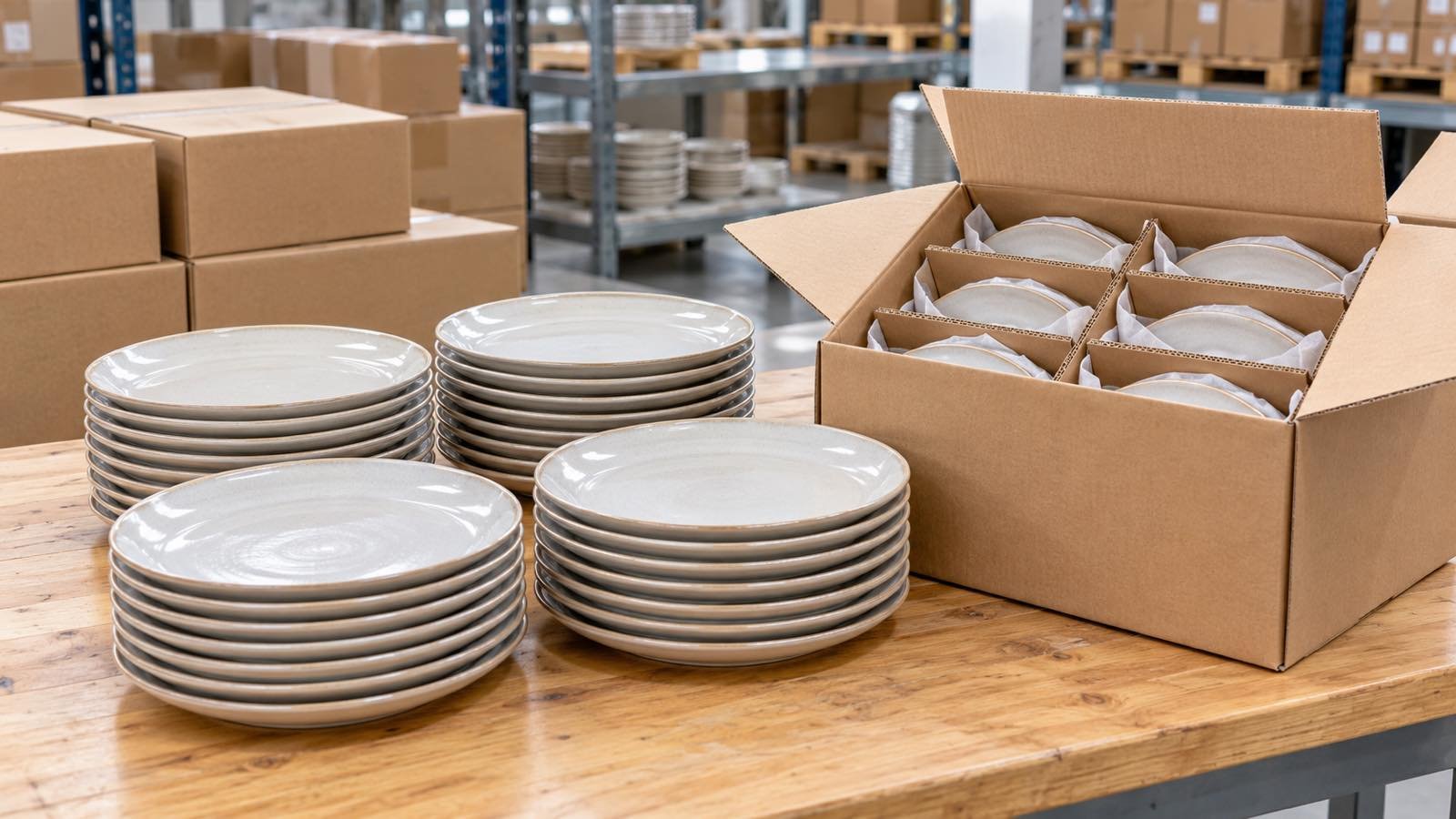
Start with the ready stock ceramic plates relevant to your channel, but record each selected diameter and design separately. Two plates in the same visual collection can have different balances and packing. A current figure for one size does not confirm another.

Build an Item Level Quantity Confirmation Sheet
Use one row per item and avoid merged descriptions. The minimum useful record includes the supplier item code, your internal code, product name, dimensions, color or pattern, requested pieces, confirmed pieces, pieces per carton, confirmed cartons, unit price basis, and confirmation date. Add a photo reference when codes could be confused.
Confirm the Identity Before the Number
Quantity accuracy begins with product identity. A code typed incorrectly can produce a perfectly calculated order for the wrong product. Compare the code in the stock list, quotation, pro forma invoice, packing details, and approved photo. If a design has multiple colors, assign each color its own row unless the supplier explicitly confirms a mixed code and composition.
Dimensions should use a consistent unit. Record whether a plate measurement is diameter, whether bowl capacity is nominal or measured, and whether a mug figure includes brim capacity. These details prevent two similar items from being treated as interchangeable during a fast availability discussion.
| Confirmation field | Why it matters | Buyer action |
| Item code and image | Prevents product mismatch | Match across every document |
| Requested pieces | Preserves original demand | Keep separate from confirmed pieces |
| Confirmed saleable pieces | Defines the current offer | Add date and source |
| Pieces per carton | Converts stock into shipping units | Verify full-carton requirement |
| Confirmed cartons | Supports logistics planning | Recalculate from confirmed pieces |
| Reservation condition | Clarifies whether quantity is being held | Record deadline or trigger |
| Revision number | Prevents mixed versions | Replace the full row, not one cell |
Ask for clarification when pieces and cartons do not reconcile. For example, 25 cartons at 24 pieces should represent 600 pieces under a simple single-item packing arrangement. If the document states another total, there may be partial cartons, inner-pack details, or a data error to resolve. Do not silently change the number that seems less convenient.
For available ceramic mugs, include capacity and shape along with the code. Similar glaze colors can make short descriptions unreliable, while handles and dimensions affect both customer use and carton packing.
Convert Requested Quantities into Workable Cartons
Buyers often request a round piece quantity, but export packing may require full cartons. The confirmed order must satisfy both the commercial quantity and the agreed packing rule. Use the actual pieces per carton for each item; do not apply one factor across an entire mixed tableware order.
Consider a hypothetical request for 500 side plates packed 36 pieces per carton. Fourteen full cartons contain 504 pieces. If the supplier confirms only 13 full cartons, the available full-carton quantity is 468 pieces under that assumption. The buyer must choose whether 468 pieces can support the sales plan or whether another design is needed. The original 500 should not remain in customer-facing records as if it were confirmed.
Use the following calculation sequence:
- Divide requested pieces by confirmed pieces per carton.
- Round according to the agreed full-carton rule.
- Multiply whole cartons by pieces per carton.
- Compare the result with the current confirmed saleable balance.
- Obtain a revised written confirmation for the exact workable total.
For sets, calculate every component. Suppose a place setting uses one dinner plate, one side plate, one bowl, and one mug. Confirmed quantities of 720, 720, 672, and 744 pieces support no more than 672 complete settings, before considering carton multiples and any agreed allowance for samples or replacements. Track remaining components rather than hiding them inside an average.
A quantity is not commercially complete until the price unit is clear. A figure quoted per piece cannot be compared directly with a figure quoted per set or carton. Add currency, trade terms, and packing basis to the same revision. This prevents the purchasing team from approving a quantity that was calculated against an earlier price structure.
Freight estimates should be refreshed when the mix changes. Replacing a flat plate with a deep bowl can alter carton volume even when the piece count stays the same. Ask for revised packing totals after the commercial lines are settled, and label early freight calculations as estimates rather than confirmed shipment data.
Manage Reservations Substitutes and Revision Control
Quantity confirmation and quantity reservation are different events. Ask whether the supplier is merely reporting a current balance or holding goods for the buyer, and what action creates a reservation. The answer may depend on written approval, payment, or other agreed terms. Do not tell customers that goods are secured until the relevant condition has been met and acknowledged.
Record any time limit associated with a confirmation. If no holding arrangement exists, state that internally. This encourages prompt decisions without inventing a deadline. If approval arrives after the quoted period, request another check rather than assuming the earlier quantity remains available.
When the balance is lower than requested, define acceptable responses before selecting a substitute:
- Reduce the order while preserving the original item.
- Choose a compatible design with sufficient current quantity.
- Divide the demand between two clearly identified designs.
- Change the product mix while maintaining the planned order value or use.
- Remove the line if the remaining quantity cannot support the sales purpose.
A substitute should be evaluated as a new line, not inserted under the old code. Check size, color, finish, price, packing, quantity, and intended use. Send the buyer or customer an image and specification when approval is required. This prevents a similar-looking product from becoming an undocumented change.

Use version numbers or dates on quantity sheets. When a revision arrives, copy the full confirmed row and identify what changed. Avoid editing a shared table without a trace, because teams may continue using downloaded or printed copies. Mark older versions as superseded, and make the newest approved document easy to identify.
Before payment, perform a final cross-check between the approved quantity sheet and the pro forma invoice. Confirm item codes, descriptions, pieces, cartons, unit prices, totals, and reservation conditions. If any line changed, ask for a corrected document rather than relying on an email to override the invoice.
After payment confirmation, keep changes controlled. If the supplier reports a discrepancy, evaluate it through the same revision process. Update sales allocations, inbound records, and logistics estimates together. Quantity control works when every department sees the same accepted version, not when purchasing holds the correction in a private message.
Conclusion
Reliable stock ceramic tableware quantities come from current item-level confirmation, not from an undated catalog or an earlier inquiry. Match product identity first, convert pieces into actual carton quantities, distinguish a balance check from a reservation, and keep every revision traceable. Reconfirm the final document before payment and update logistics when the product mix changes. Contact Chengguo with your item shortlist, target quantities, destination, and timing to discuss current availability.
FAQ
No. A stock list is a time-specific reference and quantities can change while inquiries are being prepared. Ask the supplier to reconfirm the exact item codes, saleable quantities, and carton multiples for your order. Treat only the supplier’s current written confirmation and stated reservation terms as the basis for approval and payment.
It should identify the exact item and design, requested quantity, confirmed saleable quantity, pieces per carton, carton count, price unit, and the time or condition attached to that confirmation. If pieces form a set, include the component breakdown. Record any substitutes separately rather than changing an item description without a clear revision.
First decide the minimum quantity the sales plan can accept. Then compare a reduced order, a compatible substitute, or a revised mix of products. Recalculate cartons, sets, freight assumptions, and customer commitments for every option. Obtain written confirmation of the chosen quantities before payment instead of combining figures from different versions of the stock list.