

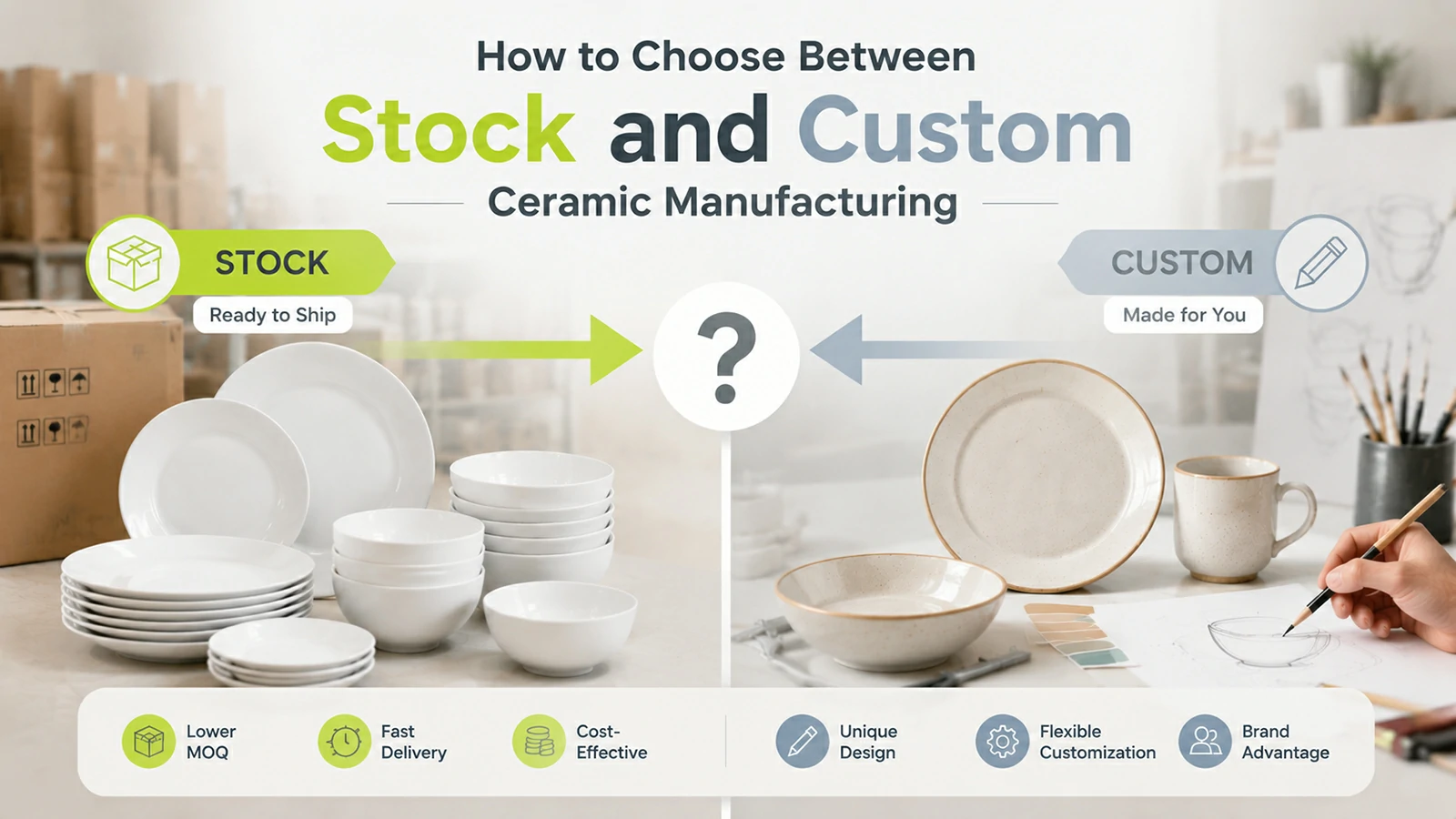
When sourcing ceramic tableware for your import or wholesale business, the first major decision is whether to order ready stock or go down the custom manufacturing route. Each approach has distinct advantages and trade-offs in terms of cost, lead time, flexibility, and risk. This guide breaks down the key differences between stock ceramic and custom manufacturing so you can make an informed decision that aligns with your business goals.
What Is Stock Ceramic Tableware?
Stock ceramic tableware refers to products that are pre-manufactured, held in inventory, and available for immediate purchase and shipment. A stock ceramic tableware supplier like Chengguo maintains a curated range of designs, materials, and sizes — ready to ship as soon as an order is confirmed.
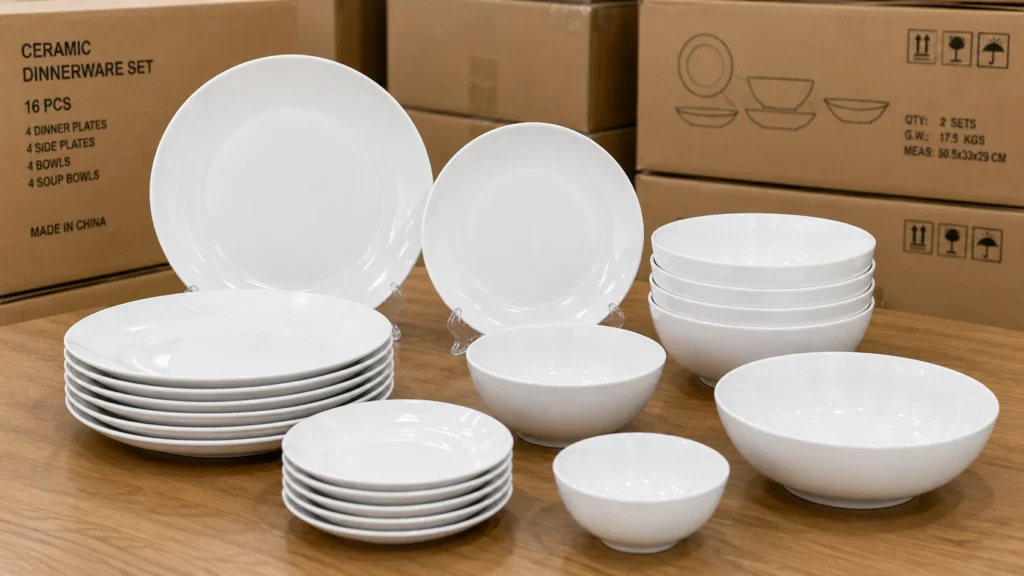
Stock products are typically produced in standard designs that appeal to a broad market. They cover common categories such as dinner plates, salad plates, bowls, mugs, cups, saucers, and serving dishes — in materials like porcelain, new bone china, stoneware, and earthenware.
Key characteristics of stock ceramic:
- Products are already made and stored in a warehouse
- Available for shipment within 7-15 days after payment
- MOQ is relatively low, often starting from 500-1,000 pieces per item
- Designs are market-tested and widely accepted
- Pricing is competitive due to bulk production efficiencies
What Is Custom Manufacturing?
Custom manufacturing involves producing ceramic tableware to your exact specifications. This includes custom shapes, sizes, colors, glazes, patterns, logos, and packaging. Production begins only after you place an order and approve samples.
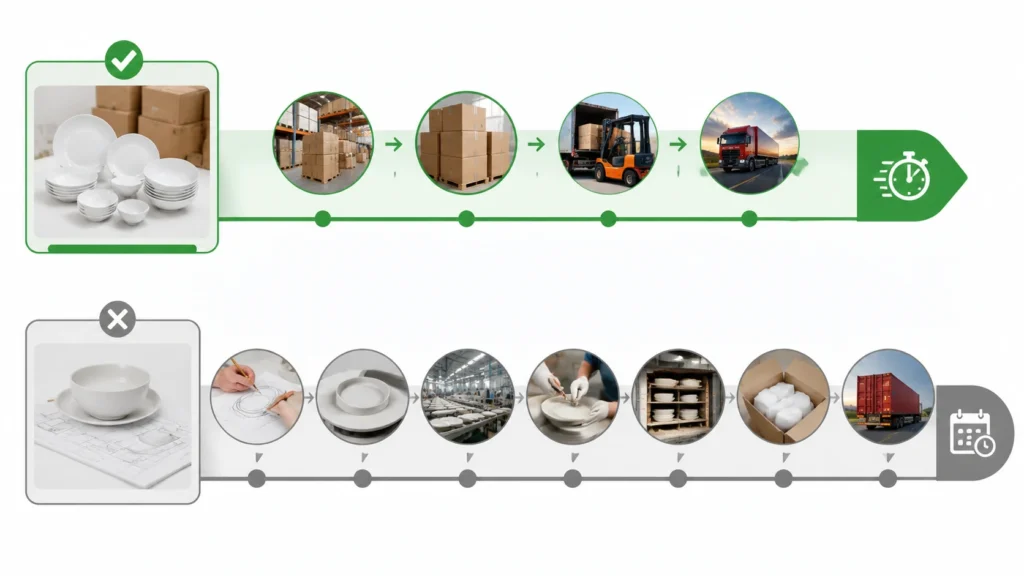
Custom orders are typically placed directly with a ceramic factory, and the process involves multiple stages: design confirmation, sample production, sample approval, mass production, quality inspection, and finally shipment.
Key characteristics of custom manufacturing:
- Production starts from scratch based on your specifications
- Lead time is typically 30-60 days (or longer for complex designs)
- MOQ is higher, often 3,000-10,000 pieces per design
- Full control over design, branding, and packaging
- Higher upfront investment in samples and tooling
Stock Ceramic vs Custom Manufacturing: A Detailed Comparison
Understanding the differences across key business dimensions helps you decide which sourcing model fits your current needs.
Cost Comparison
| Cost Factor | Stock Ceramic | Custom Manufacturing |
| Unit Price | Lower (mass-produced) | Higher (per-order production) |
| Sample Cost | Minimal or free | $50-$300+ per sample |
| Tooling/Mold Cost | None | $200-$2,000+ depending on complexity |
| Minimum Investment | $500-$2,000 | $5,000-$20,000+ |
| Packaging | Standard export packaging | Custom packaging at additional cost |
Stock ceramic tableware offers a clear cost advantage for buyers who want competitive wholesale pricing without heavy upfront investment. The products are manufactured in bulk, which drives down per-unit costs. There are no tooling fees, no mold charges, and sample costs are minimal.
Custom manufacturing requires a higher initial investment. Beyond the unit price, you need to budget for sample fees, potential mold or tooling charges, and custom packaging. However, if you are ordering very large volumes (50,000+ pieces), the per-unit cost of custom production can sometimes match or beat stock pricing.
Lead Time Comparison
| Stage | Stock Ceramic | Custom Manufacturing |
| Order Confirmation | 1-2 days | 3-7 days |
| Production | None (already made) | 30-60 days |
| Quality Inspection | 1-3 days | 3-5 days |
| Packing & Shipping Prep | 3-5 days | 5-7 days |
| Total (before shipping) | 7-15 days | 45-80 days |
This is where stock ceramic has the most dramatic advantage. Because the products are already manufactured and stored, the timeline from order to shipment is measured in days, not months.
For importers working on tight retail deadlines, seasonal promotions, or fast-moving wholesale channels, the ability to receive goods within weeks rather than months can be a decisive factor.
Flexibility and Product Range
| Factor | Stock Ceramic | Custom Manufacturing |
| Design Options | Limited to available stock | Unlimited (your specifications) |
| Color/Pattern Changes | Not possible | Fully customizable |
| MOQ Flexibility | Low MOQ, mix and match | High MOQ per design |
| Product Mix | Combine different items in one order | Each design has separate MOQ |
| Speed to Market | Immediate | 2-3 months minimum |
Stock ceramic suppliers typically offer a wide selection of existing designs across multiple product categories. You can mix dinner plates, bowls, mugs, and saucers in a single order — something that is difficult with custom manufacturing, where each design usually carries its own MOQ.
However, if your market requires a very specific design, a unique color palette, or branded products with your logo, custom manufacturing is the only path. Stock suppliers work within their existing catalog, which may not cover niche or highly specialized requirements.
Risk Comparison
| Risk Factor | Stock Ceramic | Custom Manufacturing |
| Design Risk | Low (market-tested designs) | Higher (unproven designs) |
| Financial Risk | Low (smaller upfront investment) | Higher (large deposit, tooling costs) |
| Quality Risk | Low (can inspect before ordering) | Medium (depends on sample approval) |
| Market Timing Risk | Low (fast delivery) | Higher (long lead time, market may shift) |
| Inventory Risk | Low (order what you need) | Higher (committed to large volumes) |
For new importers or those testing a new market, stock ceramic significantly reduces risk. You can order a small trial quantity, evaluate the products, and scale up gradually. There is no commitment to thousands of pieces of an unproven design.
Custom manufacturing carries more risk because you are committing significant capital before seeing the final product. If market conditions change during the 2-3 month production window, or if the products don’t sell as expected, you may be left with unsold inventory.
When to Choose Stock Ceramic
Stock ceramic tableware is the better choice in the following scenarios:
1. You need fast delivery.
If your customer has placed an urgent order, or you need to replenish inventory quickly, stock ceramic can get products to your warehouse in 2-4 weeks (including shipping).
2. You want to test a new market.
Entering a new market with a small trial order of stock products lets you gauge demand without committing to large custom production runs.
3. You prefer lower financial risk.
With stock ceramic, your upfront investment is limited to the product cost itself. No tooling fees, no sample rounds, no large deposits.
4. Your customers accept standard designs.
Many wholesale buyers — especially in the hospitality, catering, and mid-range retail sectors — are perfectly satisfied with standard ceramic designs in popular colors and styles.
5. You want to offer a wide product range.
Stock suppliers allow you to mix different product types, sizes, and designs in a single order, making it easy to build a diverse catalog without meeting high MOQs for each item.
Browse our stock ceramic tableware collection to see the range of products available for immediate shipment.
When to Choose Custom Manufacturing
Custom manufacturing is the right choice when:
1. You have specific branding requirements.
If you need products with your company logo, custom packaging, or a unique design identity, custom manufacturing is necessary.
2. You are serving a niche market.
Specialized markets — such as luxury hospitality, high-end retail, or culturally specific designs — often require products that are not available in standard stock catalogs.
3. You can commit to large volumes.
If your order volume is 10,000+ pieces per design, custom manufacturing becomes cost-competitive and gives you full control over the product.
4. You have a longer planning horizon.
If you can plan 3-6 months ahead and don’t need products immediately, the longer lead time of custom manufacturing is manageable.
5. Product differentiation is critical.
In competitive markets where every supplier offers similar stock designs, a custom product line can be a significant competitive advantage.
Can You Combine Both Approaches?
Many successful importers use a hybrid strategy: they source stock ceramic tableware for their core, fast-moving product range, and commission custom manufacturing for select flagship or branded items.
This approach offers the best of both worlds:
Stock products: provide steady cash flow with fast turnaround and low risk
Custom products: build brand identity and command higher margins
For example, a wholesaler might carry a broad range of stock ceramic dinner plates and bowls for everyday orders, while also offering a custom-branded collection for premium restaurant clients.
How to Evaluate a Stock Ceramic Supplier?
If you decide that stock ceramic tableware is the right fit, choosing a reliable supplier is critical. Here are the key factors to evaluate:
Product range: Does the supplier offer the categories and styles your market demands?
Inventory consistency: Can they fulfill repeat orders with the same products, or does availability fluctuate?
Quality standards: Do products meet the safety and quality requirements of your target market (FDA, LFGB, etc.)?
MOQ flexibility: Can you start with a small trial order and mix different products?
Communication: Is the supplier responsive and professional in handling inquiries and after-sales issues?
Export experience: Does the supplier have experience shipping to your region and handling export documentation?
A supplier with 20+ years of export experience, like Chengguo, brings not just product availability but also the operational expertise to ensure smooth transactions from inquiry to delivery. Contact us to discuss your specific requirements.
Conclusion
The choice between stock ceramic and custom manufacturing depends on your business priorities. If you value speed, flexibility, low risk, and competitive pricing, stock ceramic tableware is the practical choice — especially for importers and wholesalers who need to respond quickly to market demand. If brand identity and product differentiation are paramount, custom manufacturing offers full creative control at a higher cost and longer timeline.
Many successful businesses combine both approaches, using stock products as their foundation and custom items for differentiation. Whatever path you choose, working with an experienced ceramic tableware supplier ensures quality, reliability, and a smoother sourcing experience.
Explore our stock ceramic tableware collection or contact us for a customized quotation tailored to your business needs.
FAQ
No. Stock ceramic tableware is produced by the same factories using the same materials and processes as custom orders. The difference is that stock products are made in standard designs and held in inventory, while custom products are made to specific buyer requirements. Quality depends on the supplier’s standards, not on whether the product is stock or custom.
Yes. Most stock ceramic suppliers welcome trial orders. MOQ for individual items typically starts from 500-1,000 pieces, and you can mix different products in a single order. This allows you to evaluate product quality, market fit, and customer response before committing to larger volumes. Contact us to arrange a trial order.
This is a common and sensible approach. Many buyers begin with stock products to establish their market presence and cash flow, then gradually introduce custom-designed products as their business grows. A good supplier will support both sourcing models and help you transition smoothly when you are ready.