


Import totals can show where ceramic products move, but they do not reveal which plate, bowl, mug, or dinner set will sell for a particular buyer. Evaluating ceramic tableware import demand requires a layered approach that combines trade classifications, local channel research, price architecture, product testing, and inventory economics. This guide provides wholesale buyers with a repeatable method for moving from broad data to a controlled assortment decision.
Before contacting suppliers, establish a working budget, target arrival window, decision team, and the evidence needed for approval. Keep product taste separate from commercial requirements, and record uncertainties rather than filling them with assumptions. The result should be a brief that another colleague can review and a supplier can answer item by item. That clarity reduces repeated messages and exposes gaps while samples, quantities, packing, or timing can still be adjusted.
Use one controlled worksheet from research through receiving. Give each item a model code, intended channel, specification, sample status, quoted terms, carton data, landed-cost estimate, and final decision. Attach dated evidence instead of relying on memory or chat history. When a field changes, preserve the earlier value and record the reason. This audit trail helps buyers compare offers consistently, brief inspectors accurately, and explain assortment choices to colleagues. It also makes the next order faster because unresolved questions and successful criteria remain visible. Review the worksheet with every responsible department before approval.
Start with Reliable Ceramic Import Data
Use official or recognized trade databases to establish market context. Ceramic tableware commonly appears under HS 6911 for porcelain or china and HS 6912 for other ceramic household and tableware articles, but national tariff lines can be more detailed. Check both relevant headings, the reporting year, reporter, partner, trade flow, value unit, quantity unit, and revision status. World Bank WITS presents UN Comtrade data and is useful for country comparisons, while the destination customs authority should guide classification and current import requirements. One year is a snapshot; review several complete years and note disruptions or reporting gaps. Value divided by kilograms is not a retail price or a clean product price because the category mixes shapes, qualities, channels, and trade terms. Use it only as a directional indicator. Record the download date and do not combine incompatible nomenclature versions without reconciliation. Put the decision owner, evidence source, review date, and acceptance threshold beside each requirement. This small discipline separates a preference from a purchasing condition and makes later quotation comparisons fair. It also gives sales, quality, logistics, and finance teams one shared record. Where the market evidence is incomplete, label the point as an assumption and define how it will be tested before a larger commitment.
| Data field | Why it matters |
| HS heading | Separates porcelain from other ceramic articles |
| Trade value | Indicates declared import value for the category |
| Quantity and unit | Supports volume and unit-value checks |
| Partner country | Shows sourcing concentration |
| Reporting year | Prevents mixing incomplete and complete periods |

Translate National Demand into Sales Channels
A national import figure must be divided into addressable channels. Map mass retail, independent homeware stores, supermarkets, department stores, ecommerce, hospitality distributors, restaurant supply, promotional programs, and institutional catering. Visit stores and online marketplaces using a consistent observation sheet. Record selling price, promotions, material description, country of origin, color, shape, set composition, individual-piece availability, reviews, and stock status. Interview sales teams or customers where appropriate, but separate anecdote from measured evidence. Each channel values a different combination of price, packaging, design, continuity, and delivery. Ecommerce needs parcel-ready packaging and accurate dimensions; hospitality emphasizes operating performance and replacement; retail sets depend on shelf communication and price points. Build a channel hypothesis before selecting products so attractive samples are not mistaken for proven demand. Check the range as a system as well as item by item. A dinner plate, bowl, mug, and serving piece may look coordinated in a catalogue yet differ in scale, stack behavior, or price position. Assemble a sample setting, measure the working footprint, and photograph it under the intended light. Note which pieces are essential, optional, or interchangeable so budget changes do not destroy the assortment logic.
Segment Products by Price Design and Use
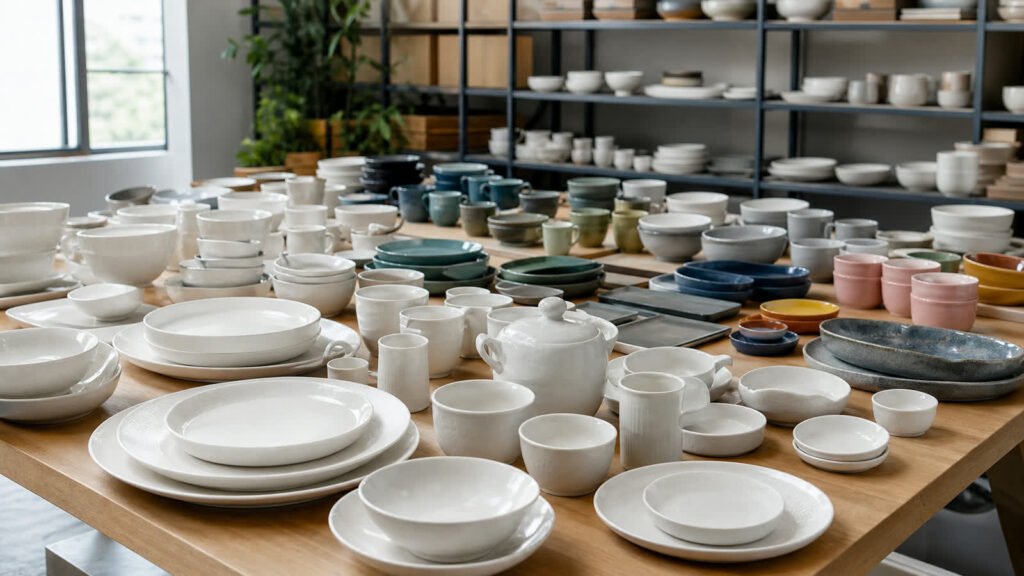
Create a market matrix rather than a single average. Useful axes include good-better-premium price position, porcelain or other ceramic body, classic or trend-led design, individual pieces or sets, domestic or hospitality use, and core or seasonal demand. Photograph comparable products only where store rules allow and record observations on the same date. Normalize set prices to comparable piece counts, but preserve the role of serving pieces and mugs because they affect perceived value. Review dinner plate diameter, bowl capacity, mug size, weight, finish, decoration, and carton presentation. Then identify gaps where customer need, channel margin, and supply availability overlap. A gap is not automatically an opportunity; it may reflect weak demand. Validate it through retailer conversations, keyword behavior, small advertising tests, preorders, or a limited launch. Browse ready stock ceramic tableware to compare available shapes with the assortment matrix. Write tolerances only where they are meaningful and measurable. Excessively narrow cosmetic limits can create disagreement without improving customer value, while vague functional criteria leave genuine risk uncontrolled. Ask the supplier to comment on the draft specification before order confirmation. Resolve conflicts in terminology, measurement method, sampling, and visual references while samples are still available and changes remain inexpensive.
| Assortment lens |
| – core white or neutral open-stock pieces |
| – coordinated color families for set building |
| – compact giftable sets for retail |
| – stackable durable forms for hospitality |
| – limited seasonal accents with controlled quantities |

Model Landed Cost and Wholesale Margin
Demand is commercially useful only when the product reaches the required margin and cash cycle. Build landed cost from the quoted trade term, product value, export charges where applicable, international freight, insurance, destination charges, duty, taxes that are not recoverable, customs brokerage, inland transport, inspection, finance cost, and an allowance based on documented damage experience. Confirm current tariff treatment with a customs professional; do not copy a rate from another market or an old quotation. Convert currencies using a stated planning rate and stress-test adverse movement. Allocate freight by a rational driver such as carton volume or weight. Then model wholesale and retail margins using the channel’s actual conventions, promotions, returns, commissions, and payment terms. A product with a low purchase price can underperform if it occupies excessive volume or requires costly parcel protection. Compare scenarios at multiple freight and sell-through assumptions before committing. Recalculate from final packing data whenever the assortment changes. Adding one bowl or changing a plate profile can alter carton count, volume, weight distribution, and the number of complete sets delivered. Keep the commercial comparison version-controlled and record who supplied each input. A transparent calculation is easier to update when freight, currency, quantities, or destination charges change.
Validate Demand with a Controlled Buying Test
Turn research into a limited experiment. Select a balanced group of core and exploratory items, define the buyer persona and channel for each, and set success measures before arrival. Measures may include qualified retailer interest, sample conversion, sell-through by a stated date, gross margin after promotions, return reasons, damage rate, and repeat demand. Avoid ordering equal quantities across every design. Allocate more depth to versatile core pieces and less to uncertain colors or forms. Ready-stock supply can support faster tests, but current quantities must be reconfirmed before commitment. Use samples to verify dimensions, color, handling, stacking, care information, and packing. After launch, review results by SKU rather than total sales alone. Stop, adjust, or reorder based on evidence. Keep seasonality in view: a short trial during a peak gift period should not be projected mechanically across the year. Set a formal review after the goods enter the channel. Compare actual results with the assumptions used for selection, costing, and quantity planning. Record slow and fast sellers, common customer questions, missing companion pieces, packaging complaints, and operational issues. Use those findings to revise the specification and assortment map. Reordering should be a fresh availability and cost decision, not an automatic copy of the first purchase.
| Pilot record |
| 1. channel and target customer |
| 2. item specification and quantity |
| 3. landed cost and planned selling price |
| 4. launch date and review date |
| 5. sales returns damage and feedback |
| 6. reorder discontinue or revise decision |
Conclusion
Ceramic tableware import demand is best evaluated by connecting consistent trade data with channel-level observation, product segmentation, landed cost, and a controlled launch. National totals provide context, while SKU decisions depend on local customers and inventory economics. Document assumptions and update them as new sales evidence arrives. For current specifications and packing data, request a wholesale quotation with your target market, channel, and assortment brief.
FAQ
HS 6911 generally covers tableware and household articles of porcelain or china, while HS 6912 covers other ceramic tableware and household articles. National schedules may divide these headings further. Confirm the exact classification with the destination customs authority or a qualified broker because material, product description, and local tariff lines affect the final code.
Import value provides market context but does not directly predict a buyer’s sales. It aggregates many products, price levels, channels, origins, and trade terms. Combine several years of value and quantity data with store audits, online research, customer interviews, landed-cost analysis, and a controlled SKU test before making an inventory decision.
There is no universal quantity. Base it on pack multiples, available cash, channel reach, review period, acceptable inventory exposure, and the number of meaningful customer tests. Use deeper quantities for versatile core items and shallower quantities for uncertain designs. Agree success measures and a decision date before placing the order.