

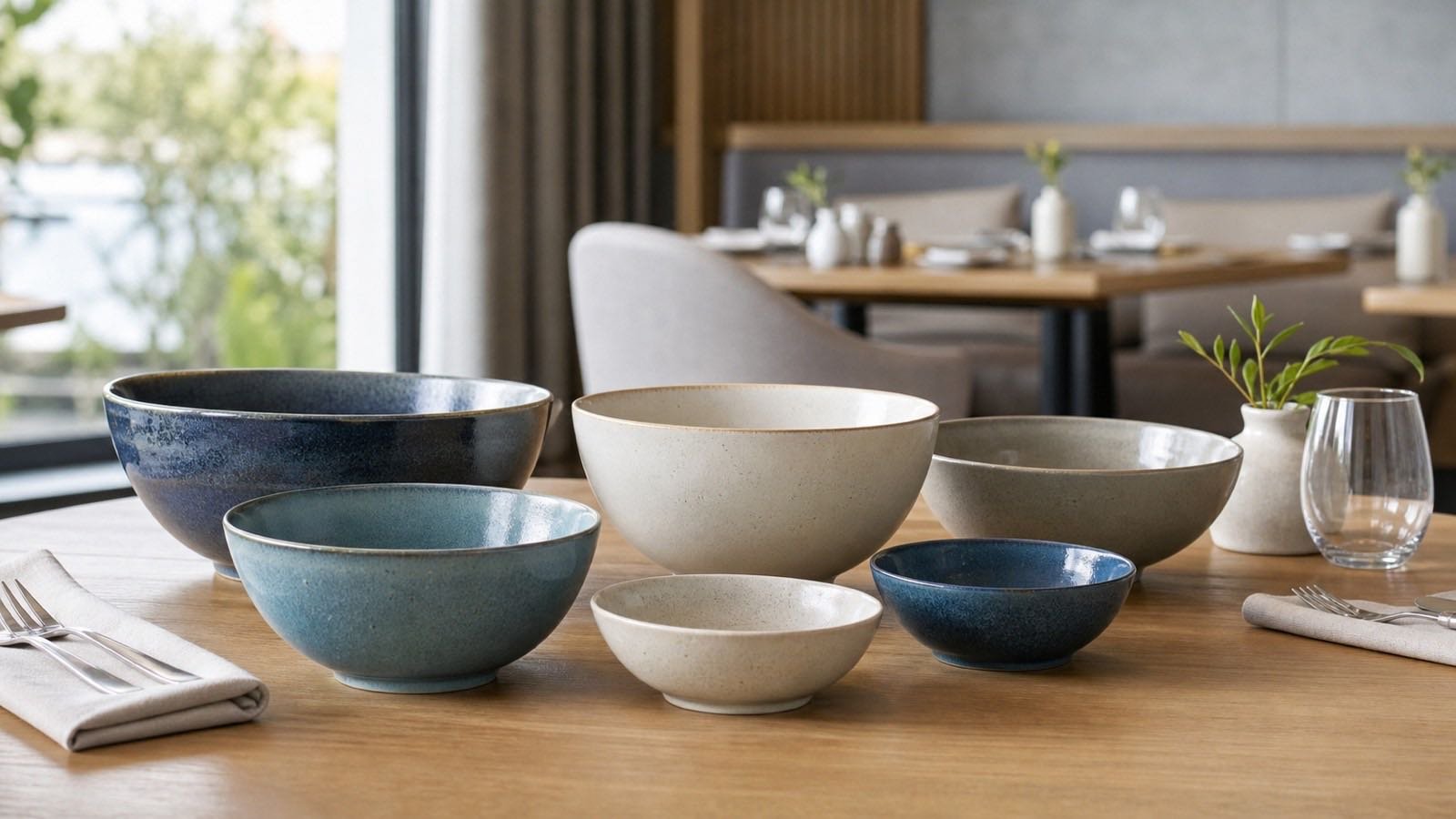
A bowl may look simple, but its shape influences portion control, presentation, storage, and service speed. When sourcing ceramic bowls for hotels and restaurants, buyers need to balance appearance with the realities of repeated daily use. This guide explains how to define applications, compare materials and shapes, check practical details, and build an order that works across dining rooms, buffets, and room service.
Start with the Menu and Service Format
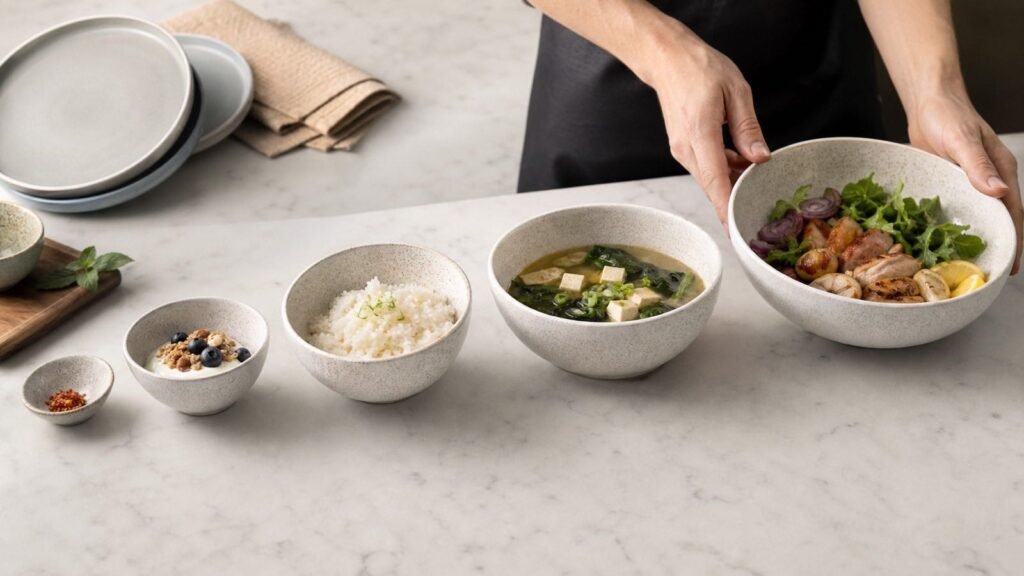
The most reliable buying process begins with food, not decoration. List every menu item that will be served in a bowl and record its typical portion, garnish, temperature, and service method. A breakfast buffet needs compact cereal and fruit bowls that stack efficiently. A noodle restaurant may need deeper vessels that hold broth without making the portion look small. A hotel banquet department often values bowls that coordinate with several plate ranges and can move between courses.
Service format changes the requirements. Servers carrying several dishes need manageable weight and a secure foot. Buffet bowls may sit under heat lamps, be replenished frequently, and require a stable base. Room-service pieces must fit trays and covers. For outdoor dining, a lower center of gravity can be more useful than a dramatic high-footed silhouette.
Create a use matrix before requesting quotations:
| Application | Useful capacity | Shape priority | Operational concern |
| Condiments and sides | 100–250 ml | Compact and stable | Fast sorting and storage |
| Cereal and dessert | 300–500 ml | Open profile | Easy spoon access |
| Rice and small mains | 350–600 ml | Rounded interior | Portion consistency |
| Soup and noodles | 600–1,200 ml | Deep with a broad rim | Heat handling and spill control |
| Shared dishes | 1,000 ml and above | Wide presentation area | Table space and serving utensils |
Capacity figures are planning ranges, not universal standards. Ask suppliers for brimful capacity and recommended serving capacity because the same external diameter can produce different usable volumes. Browse a varied ceramic bowls collection only after these operational needs are clear.
Compare Bowl Shapes for Restaurant Operations
Shape affects far more than visual style. It determines how food sits, how staff handle the piece, and how much shelf space a stack consumes. A good range usually uses a small number of compatible profiles instead of many unrelated shapes.
Coupe and open bowls
Coupe bowls have a smooth, rimless transition and a generous visual surface. They suit salads, grain bowls, pasta, and composed dishes because chefs can arrange ingredients across a broad area. The open shape makes food accessible, but liquids cool faster and can spill if the vessel is filled too close to the edge. Check whether the curved wall provides enough grip for service staff.
Deep and straight sided bowls
Deep profiles are practical for soup, noodles, curries, and shared dishes. A straighter wall increases usable capacity within a compact footprint, while a rounded inner transition helps spoons reach the bottom. Very vertical walls can make cleaning and nesting more difficult, so inspect the interior curve and stacking gap.
Rimmed bowls
A defined rim gives servers a handling area and frames the food. It can also support a lid or cover when dimensions are coordinated. The tradeoff is a larger external diameter for the same food capacity. For crowded tables or room-service trays, verify the full footprint rather than comparing only the well diameter.
Footed and specialty profiles
Footed bowls create elevation and can support premium presentation. They deserve additional stability testing because a narrow or uneven foot increases tipping risk. Angular and irregular shapes can strengthen a design concept, but buyers should check stack height, carton efficiency, and replacement compatibility before using them as high-volume service pieces.
Order representative samples and run a service simulation. Place actual portions in each bowl, carry a loaded tray, stack ten pieces, and wash them using the planned process. These tests reveal operational issues that a catalog photograph cannot show.
Select a Ceramic Body and Finish
Porcelain, stoneware, and New Bone China can all serve hospitality programs, but their characteristics should be matched to the concept and budget. Body names alone do not prove performance; firing, formulation, glaze fit, and quality control also matter. Compare finished samples under the conditions in which they will be used.
| Material option | Typical visual character | Useful hospitality fit | Points to verify |
| Porcelain | White, refined, relatively thin | Hotels, restaurants, banquets | Rim strength, translucency, glaze consistency |
| Stoneware | Substantial, tactile, varied colors | Casual dining and contemporary concepts | Weight, stacking, finish variation |
| New Bone China | Warm white, light, elegant | Premium dining and tea service | Chipping resistance, decoration care |
Glaze choice also changes the guest experience. Glossy finishes reflect light, show food colors clearly, and are familiar to many operations. Matte finishes create a modern appearance but may show metal marking or oily fingerprints more readily, depending on the surface. Reactive glazes intentionally produce controlled variation; buyers should agree on an acceptable appearance range so that natural differences do not become receiving disputes.
For decorated bowls, assess whether the decoration sits in a high-contact zone. Patterns near the inner well may face more utensil contact than decoration on the exterior wall. Request care guidance for the specific item and confirm its suitability for the intended dishwasher, microwave, warming, or serving practice. Do not infer performance from material category alone.
Ready-stock sourcing can help a hospitality buyer compare several finishes without committing every venue to one design. Review ready stock ceramic tableware by compatible colors and forms, then confirm current quantities before fixing the assortment.

Check Durability Handling and Storage
Hospitality durability is a system outcome. A bowl that performs well in gentle home use can fail early if racks are poorly sized, stacks are too high, or staff strike rims during clearing. Buyers should therefore evaluate the item together with the operation.
Use a documented sample check:
- Inspect the rim and foot. Look for a smooth rim, stable foot, and consistent contact surface. Run a finger carefully around accessible edges.
- Check level and wobble. Place samples on a flat surface, rotate them, and compare several pieces rather than one selected sample.
- Compare dimensions and weight. Measure diameter, height, capacity, and piece weight. Small differences can affect lids, racks, and portions.
- Test stacking. Stack the planned working quantity. Check whether pieces lock together, lean, or place excessive pressure on contact points.
- Simulate utensils. Use the actual spoon, fork, or serving utensil and observe sound, access, and visible marking.
- Run wash trials. Test with the operation’s dishwasher rack and detergent process, then inspect drainage and finish.
- Check temperature workflow. Confirm supplier guidance before microwave or oven use, and avoid abrupt temperature changes unless the item is specified for them.
Storage deserves a line in the purchasing specification. Record the stack height that fits each shelf, the number of pieces per stack, and the rack or divider required. Deep bowls often consume more vertical space than expected, while wide coupe bowls can exceed standard rack dimensions. Carton information matters too: pieces per carton, gross weight, carton dimensions, inner protection, and pallet arrangement all influence handling and landed cost.
Build a Flexible Wholesale Bowl Order
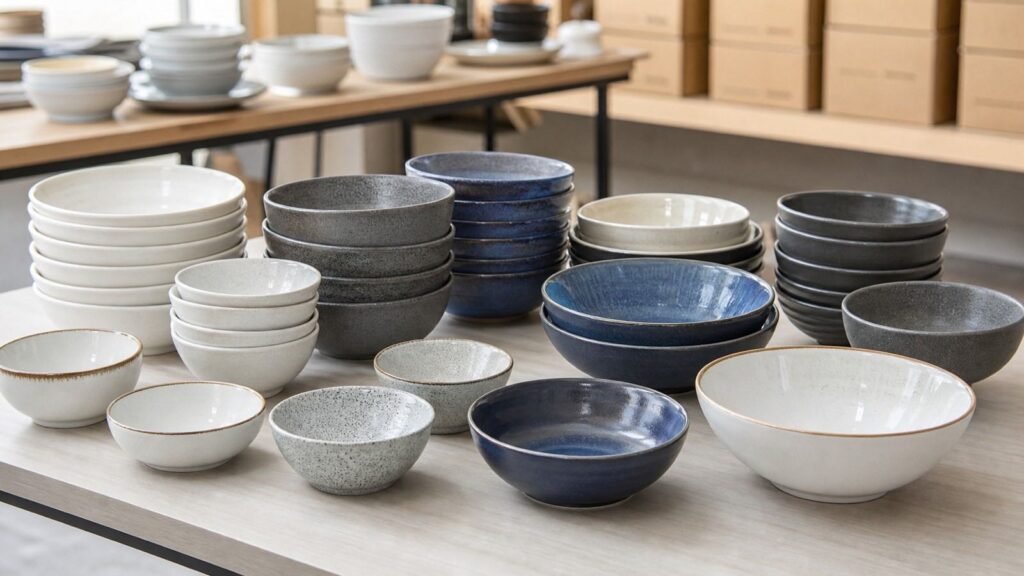
A practical hotel or restaurant order usually combines core continuity with controlled variety. Start with high-use neutral bowls for breakfast, rice, soup, and side dishes. Add one or two distinctive shapes or glazes for signature presentations. This protects daily operations while still giving chefs visual flexibility.
Estimate quantity by seat count, meal periods, wash-cycle duration, expected breakage replacement, and delivery interval. A venue cannot use every piece simultaneously; some are on tables, some are being washed, and others are waiting in service stations. Build a par-level model for each application rather than applying one multiplier to the entire range.
For multi-property groups, identify which bowls must be identical and which may vary by outlet. Record acceptable substitutions in advance—for example, the same diameter and capacity in one of two approved glazes. This makes replenishment more resilient when a particular ready-stock design changes.
When comparing wholesale offers, normalize:
- unit basis, currency, and trade terms;
- piece count and assortment by item;
- carton quantity, dimensions, and gross weight;
- sample and inspection arrangements;
- packing method and labeling;
- quantity available at quotation and order confirmation;
- preparation time and shipment documentation.
Do not approve a mixed order from a mood board alone. Ask for an itemized proforma invoice with model references and verify that photographs, sample labels, and carton marks use the same references. A simple master assortment sheet reduces errors between purchasing, receiving, and restaurant teams.
Plan Receiving and Reordering
Before shipment, agree on the inspection basis and retain approved sample references. When goods arrive, count cartons, inspect packaging condition, and sample pieces across different cartons. Check model, color family, dimensions, decoration, foot finish, and overall appearance against the approved information. Photograph carton labels and any issues before distributing stock to venues.
Maintain a small internal record for every approved bowl: supplier reference, photographs, dimensions, capacity, weight, carton pack, date received, and departments using it. This turns reordering into a controlled process instead of a visual search.
Ready-stock availability can change, so request current information when planning replenishment. If exact long-term continuity is essential, discuss the requirement before ordering. If flexible design rotation is acceptable, define functional limits—capacity, diameter, color family, and stackability—so purchasing teams can evaluate alternatives quickly.
Conclusion
Choosing ceramic bowls for hotels and restaurants requires coordination between menu design, service, washing, storage, and purchasing. Define applications first, test representative samples, and compare complete packing and availability information rather than unit price alone. A balanced range combines dependable core shapes with a limited number of presentation pieces. Explore Chengguo’s bowl selection or request a wholesale quotation with your size, quantity, and service requirements.
FAQ
Restaurants should select sizes from actual menu portions rather than diameter alone. Record both brimful and practical serving capacity, then test food presentation and handling. Many programs need a compact side bowl, a medium bowl for rice or desserts, and a larger bowl for soup, noodles, salads, or shared dishes. The final mix depends on cuisine, table space, service style, and storage.
Neither material is automatically better for every hotel. Porcelain often suits refined, coordinated banquet and dining settings, while stoneware can support a tactile, contemporary concept. Compare finished samples for weight, rim profile, stacking, glaze behavior, and compatibility with the hotel’s wash process. Operational testing and supplier specifications are more useful than relying on the material name alone.
Test several representative samples, not just one. Measure diameter, height, capacity, weight, and foot stability; stack the planned quantity; plate real menu portions; carry them on a tray; and run them through the intended washing workflow. Confirm packing details, care guidance, and current stock quantities in writing. Keep approved sample references for inspection and receiving.